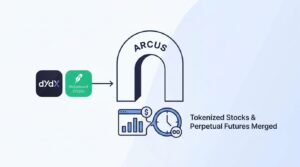
dYdX Labs unveiled Arcus on Wednesday, a decentralized exchange designed to bridge tokenized stock trading and perpetual futures on a single platform. Founder Antonio Juliano announced the launch on X, confirming that the project was built in collaboration with Robinhood Crypto. Arcus operates on Robinhood Chain, the EVM-compatible layer 2 network that Robinhood recently opened to developers, marking a significant convergence of traditional brokerage infrastructure and DeFi-native trading tools.
Why the Arcus Launch Reshapes DeFi-TradFi Convergence
The partnership between dYdX Labs and Robinhood Crypto signals more than a product release. It represents a deliberate architectural bet: that tokenized equities and crypto derivatives belong on the same rails. Before diving into the broader implications, here are the strategic takeaways worth tracking.
- First-mover positioning: Arcus appears to be among the earliest DEXs to combine tokenized stocks with perpetual futures under one interface, collapsing a gap that previously required users to move between centralized and decentralized platforms.
- Infrastructure leverage: By building on Robinhood Chain’s layer 2, Arcus inherits the settlement speed and EVM compatibility of an ecosystem already backed by a publicly traded brokerage with over 20 million funded accounts.
- The collaboration could pressure other CEX-adjacent players to accelerate their own tokenized asset strategies or risk ceding ground in a market segment that barely existed 18 months ago.
- Regulatory signal: Robinhood’s willingness to lend its chain infrastructure to a DeFi protocol suggests internal confidence that tokenized stock trading can operate within evolving U.S. regulatory frameworks (a distinction regulators have been slow to enforce).
What Arcus Actually Does
At its core, Arcus functions as a decentralized exchange where users can trade tokenized versions of traditional equities alongside perpetual futures contracts. Perpetual futures, for those outside the crypto-native crowd, are derivatives without an expiry date, allowing traders to hold leveraged positions indefinitely. Combining these with tokenized stocks on a single platform eliminates the friction of switching between siloed ecosystems.
The platform runs on Robinhood’s EVM-compatible layer 2 chain, which was designed to support high-throughput applications while maintaining compatibility with Ethereum’s broader tooling ecosystem. That choice matters. It means developers and liquidity providers already familiar with Ethereum-based infrastructure can integrate with Arcus without rebuilding from scratch.
Antonio Juliano’s Bet Beyond Perpetuals
dYdX has long been synonymous with perpetual futures in decentralized finance. The protocol’s v4 migration to its own Cosmos-based chain in 2023 was itself a bold infrastructure play. But Arcus represents something different: a pivot toward hybrid asset classes rather than deeper specialization in crypto-only derivatives.
Juliano’s decision to partner with Robinhood Crypto rather than build independently tells its own story. dYdX brings protocol design expertise and a loyal DeFi user base. Robinhood brings regulatory relationships, brand recognition among retail investors, and now, a purpose-built blockchain. Neither party could have shipped this product alone with the same credibility.
Still, questions linger about how tokenized stocks on Arcus will be backed, custodied, and regulated across jurisdictions.
Market Context and Competitive Pressure
Tokenized real-world assets have attracted increasing institutional attention throughout 2024 and into 2025. BlackRock’s BUIDL fund, which tokenizes U.S. Treasury exposure, surpassed $2 billion in assets. Ondo Finance and Securitize have carved out significant positions in tokenized fixed income. Yet tokenized equities have lagged behind, partly because of regulatory complexity and partly because the infrastructure wasn’t ready.
Arcus steps into that gap at a moment when the SEC’s posture toward digital asset platforms appears to be softening under new leadership. Whether that window stays open is another matter entirely.
| Feature | Arcus (dYdX + Robinhood) | Traditional DEX Perpetuals |
|---|---|---|
| Asset Types | Tokenized stocks + perpetual futures | Crypto perpetual futures only |
| Underlying Chain | Robinhood Chain (EVM L2) | Varies (Ethereum, Arbitrum, Cosmos) |
| Target User Base | DeFi traders and retail equity investors | Primarily crypto-native traders |
| Regulatory Positioning | Backed by a publicly traded brokerage’s infrastructure | Generally operates outside traditional regulatory frameworks |
How This Shift Reframes User Behavior in DeFi
From a behavioral standpoint, Arcus introduces something subtle but powerful: it reduces the cognitive load required to move between asset classes. In neuro-linguistic programming terms, this is an anchoring shift. Users who previously associated decentralized exchanges exclusively with crypto volatility now encounter a platform where familiar equity names sit alongside leveraged derivatives. That reframing changes the mental model.
When a retail trader sees Apple or Tesla tokenized on the same interface where they trade ETH perpetuals, the perceived boundary between “traditional” and “decentralized” finance dissolves. This isn’t just a UX improvement. It’s a recontextualization of what a DEX can be, and it lowers the psychological barrier to entry for users who might otherwise never interact with DeFi protocols. The platform essentially performs a pattern interrupt, breaking the assumption that decentralized trading means crypto-only trading.
And there’s a compounding effect. Each time a user successfully executes a tokenized stock trade on-chain, they build a new reference experience, one that normalizes blockchain-based equity exposure. Over time, this creates what behavioral economists call a “status quo bias” in favor of on-chain markets. The longer users stay, the harder it becomes to justify going back to fragmented legacy systems. Robinhood, which built its original business on removing friction from stock trading, clearly understands this dynamic. Applying that same philosophy to decentralized perpetual futures and tokenized equities is a logical extension of that thesis.
Frequently Asked Questions
What is Arcus?
Arcus is a decentralized exchange launched by dYdX Labs in partnership with Robinhood Crypto. It enables users to trade both tokenized stocks and perpetual futures on a single platform, built on Robinhood Chain’s EVM-compatible layer 2.
How does Arcus differ from existing DEXs?
Most decentralized exchanges focus exclusively on crypto assets. Arcus combines tokenized equities with perpetual futures, targeting a hybrid user base that spans traditional retail investors and DeFi-native traders. That combination, at least on paper, is rare in the current landscape.
Is Arcus regulated?
Arcus operates on infrastructure provided by Robinhood, a publicly traded and regulated brokerage. However, the specific regulatory status of tokenized stock trading on decentralized platforms remains an evolving area, and no formal regulatory approval has been publicly confirmed for this particular product.
Who built Robinhood Chain?
Robinhood developed its own EVM-compatible layer 2 blockchain, designed to support decentralized applications while leveraging Ethereum’s security and developer ecosystem.