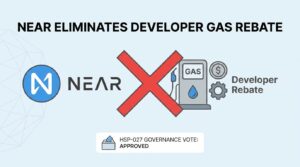
NEAR Protocol’s on-chain governance body, the House of Stake, has approved proposal HSP-027, a decision that scraps the protocol’s long-standing developer gas rebate mechanism. Under the new framework, all network gas fees will be routed to burning rather than partially returned to smart-contract owners. NEAR co-founder Illia Polosukhin confirmed the outcome on Monday, marking a structural shift in how the Layer 1 blockchain handles fee economics.
What HSP-027 Means for NEAR’s Fee Architecture
Before diving into the strategic implications, it helps to understand what changed and why it matters for builders, validators, and token holders across the ecosystem.
- Full fee burn activated: Gas fees that were previously split between burning and developer rebates will now be burned entirely, increasing deflationary pressure on the NEAR token supply.
- Developer incentive model shifts: Smart-contract developers lose a passive revenue stream, which could push teams toward alternative monetization strategies such as direct user fees or grant-based funding.
- The governance process itself signals growing maturity in NEAR’s decentralized decision-making, with the House of Stake exercising meaningful protocol-level authority.
- Token economics realignment: By channeling 100% of gas fees into burns, the protocol arguably moves closer to the deflationary models popularized by Ethereum’s EIP-1559, though the mechanics differ in important ways.
How the Developer Gas Rebate Worked
NEAR’s original fee structure carved out a portion of every transaction’s gas cost and returned it to the developer who deployed the smart contract being called. The logic was straightforward: reward builders for creating useful applications that generate network activity. In practice, this created a small but steady income stream for prolific contract deployers, particularly those running high-volume decentralized applications.
But the rebate also introduced complexity. Some critics argued it created perverse incentives, encouraging contract spam or artificial transaction volume designed to harvest rebates rather than serve genuine user demand. Whether that concern was widespread enough to justify elimination is a question the governance vote has now settled, at least on paper.
Deflationary Pressure and What It Signals
Burning all gas fees tightens NEAR’s token supply dynamics. Every transaction now reduces circulating supply with no offsetting redistribution to developers. For token holders, this is a net positive in isolation. More burn, less supply, stronger scarcity narrative.
Yet the picture is more nuanced than a simple supply squeeze. If the removal of rebates discourages some developers from building on NEAR, transaction volume could soften over time. Less activity means less gas burned, which would dilute the very deflationary effect the proposal aims to strengthen. The NEAR Protocol ecosystem will need to demonstrate that its developer pipeline remains robust without the rebate cushion.
That tension sits at the heart of HSP-027.
Governance Maturity in Decentralized Protocols
The House of Stake’s role in passing this proposal deserves attention beyond the technical change itself. On-chain governance bodies in crypto often struggle with low participation, whale dominance, or proposals that never reach quorum. NEAR’s governance apparatus managed to push through a consequential economic change, one that directly affects a stakeholder group (developers) with significant voice in most ecosystems.
This kind of decision-making carries weight. It suggests the House of Stake can function as more than a rubber stamp, capable of making trade-offs that prioritize long-term protocol health over short-term builder satisfaction. Whether developers agree with that characterization is another matter entirely. Still, the precedent matters: governance bodies that can enact meaningful change tend to attract more serious participation over time, creating a virtuous cycle of legitimacy.
Reframing Developer Incentives Through an NLP Lens
From a neuro-linguistic programming perspective, the framing of this change shapes how the developer community will internalize it. Language matters enormously in governance communications. Describing the rebate removal as “aligning incentives” or “strengthening tokenomics” activates different cognitive frames than calling it a “revenue cut for builders.” The NEAR Foundation and its ecosystem leaders face a communication challenge that goes beyond economics.
Anchoring is relevant here. When developers first joined NEAR, many anchored their expectations around the rebate as a baseline benefit. Removing that anchor creates a recalibration moment. How ecosystem leaders fill that gap, whether through enhanced grant programs, accelerator funding, or new revenue-sharing mechanisms, will determine the emotional and strategic response from the builder community. Reframing loss as opportunity requires specificity: vague promises of “future support” rarely survive contact with a developer who just lost predictable income.
Rapport-building with the developer base also becomes critical. Governance bodies that impose changes without adequate dialogue risk triggering reactance, a psychological resistance to perceived threats to autonomy. The House of Stake’s ability to maintain trust depends on transparent follow-through. Did they consult widely before the vote? Were alternative proposals considered and publicly debated? These process signals carry as much persuasive weight as the economic rationale itself. And in decentralized communities, where exit costs are low and competing chains actively recruit talent, the perception of fairness can be as consequential as the policy itself.
Competitive Positioning Among Layer 1 Chains
NEAR operates in a crowded field. Solana, Sui, Aptos, and a growing roster of modular chains all compete for developer attention and user activity. Each has its own fee model, its own incentive structure, its own pitch to builders.
By eliminating the gas rebate, NEAR differentiates on tokenomics but potentially weakens its developer acquisition story. The question is whether the deflationary narrative attracts enough capital and community enthusiasm to offset any builder attrition. Ethereum’s experience post-EIP-1559 suggests that fee-burn mechanisms can become powerful marketing tools (a distinction that took months, not days, to crystallize in market sentiment).
| Aspect | Before HSP-027 | After HSP-027 |
|---|---|---|
| Gas Fee Distribution | Split between burn and developer rebate | 100% burned |
| Developer Revenue from Gas | Passive income from contract usage | Eliminated entirely |
| Deflationary Mechanism | Partial burn | Full burn, stronger supply reduction per transaction |
| Governance Precedent | Limited economic restructuring via on-chain vote | Demonstrated capacity for consequential protocol-level changes through the House of Stake |
Frequently Asked Questions
What was the NEAR developer gas rebate?
A mechanism that returned a portion of gas fees to the developers who deployed the smart contracts being used in transactions. It functioned as a passive revenue stream tied to on-chain activity.
Why was it removed?
The House of Stake voted to redirect all gas fees to burning, strengthening NEAR’s deflationary tokenomics. Concerns about misaligned incentives and artificial transaction volume also factored into the debate, though the precise weighting of those arguments within the governance process has not been fully detailed.
Does this affect NEAR token holders?
Yes. With 100% of gas fees now burned, the circulating supply of NEAR faces greater deflationary pressure, which could support token value over time, assuming network activity remains steady or grows.
How might developers respond?
Some may seek alternative revenue models or migrate to chains offering direct builder incentives. Others will likely adapt, particularly those already monetizing through application-layer fees rather than relying on protocol rebates.