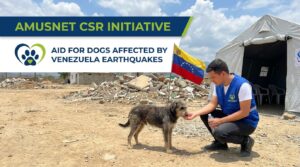
Amusnet, the Bulgaria-headquartered iGaming supplier, has directed humanitarian support toward animals displaced by recent seismic activity in Venezuela. The company’s charitable arm channelled resources to help dogs impacted by earthquakes in the South American country, marking another step in its broader corporate social responsibility programme. While the gaming industry’s CSR efforts typically focus on responsible gambling or community development, Amusnet’s initiative targets a less conventional but increasingly visible cause: animal welfare in disaster zones.
What Amusnet’s Venezuela Initiative Signals for iGaming CSR
Corporate responsibility in the gaming sector has, for years, orbited a narrow set of themes. Responsible gambling frameworks, anti-money laundering compliance, and local community grants dominate the conversation. Amusnet’s decision to fund animal rescue operations following natural disasters in Venezuela breaks from that pattern in a way worth examining.
- The initiative reflects a widening of CSR scope among mid-tier iGaming suppliers, moving beyond regulatory obligation into cause-driven engagement
- Animal welfare as a CSR pillar remains uncommon in the sector, potentially differentiating Amusnet in markets where brand perception influences B2B partnerships
- Disaster relief efforts, even small-scale ones, tend to generate outsized goodwill relative to cost, particularly when they address underserved causes
- The move aligns with a broader trend of European gaming companies extending their social impact programmes into Latin America and other emerging regions
Why Animal Welfare in Disaster Zones Draws Corporate Attention
Natural disasters displace millions of animals alongside human populations. Yet relief funding overwhelmingly prioritises human needs (a distinction that few would argue with, but one that leaves a significant gap). Dogs and other domestic animals caught in earthquake aftermaths face starvation, injury, and abandonment. Organisations working in this space often operate on shoestring budgets, making corporate sponsorship disproportionately impactful.
Venezuela’s seismic vulnerability compounds an already fragile humanitarian landscape. The country’s ongoing economic crisis has strained veterinary infrastructure and animal rescue capacity. When earthquakes strike, the systems that might otherwise absorb displaced animals simply aren’t there.
Amusnet’s contribution, while not quantified in public disclosures, targets this precise gap. Whether the company plans to scale this type of intervention or treat it as a one-off remains an open question.
Amusnet’s Broader CSR Footprint
Amusnet’s gaming technology and content portfolio spans slots, table games, and jackpot solutions distributed across regulated markets in Europe, Latin America, and Africa. The company has previously engaged in charitable activities, though its animal welfare work in Venezuela represents a departure from its typical focus areas.
For a supplier competing against larger rivals like Pragmatic Play, Evolution, and Playtech, CSR differentiation carries strategic weight. B2B buyers in regulated markets increasingly evaluate suppliers not just on product quality and compliance, but on the values they project. A distinctive social impact programme can tip procurement decisions, particularly in jurisdictions where licensing bodies scrutinise corporate character.
Still, the iGaming industry’s relationship with CSR is complicated. Critics argue that charitable initiatives sometimes function as reputation management rather than genuine social investment. The test, arguably, lies in consistency and transparency over time.
How Purpose-Driven Initiatives Reshape Brand Perception
From a neuro-linguistic programming perspective, the framing of corporate actions profoundly shapes how stakeholders internalise a brand’s identity. When a company associates itself with emotionally resonant causes like animal rescue, it activates empathy-driven cognitive patterns that bypass the analytical filters typically applied to corporate messaging. This isn’t manipulation; it’s alignment between action and emotional truth.
The language a company uses around its CSR efforts matters as much as the effort itself. Phrases that emphasise tangible outcomes rather than abstract commitments create stronger mental anchors. Saying “we provided veterinary care to 200 displaced dogs” lands differently than “we are committed to making a difference.” Specificity builds trust. Vagueness erodes it.
Amusnet’s challenge going forward is to build a narrative architecture around its social initiatives that feels earned rather than performed. Stakeholders, whether they are B2B partners, regulators, or end consumers, have grown adept at distinguishing between companies that embed purpose into operations and those that bolt it on for optics. The sensory detail, the reported outcomes, the willingness to share what didn’t work alongside what did: these are the markers of authenticity that shape long-term brand equity in ways no advertising budget can replicate.
And the timing matters. Associating a brand with disaster relief during an active crisis carries more weight than retrospective philanthropy, because it signals responsiveness rather than calculation.
Frequently Asked Questions
What did Amusnet do to help dogs in Venezuela?
Amusnet directed charitable resources through its CSR programme to support dogs displaced or affected by earthquakes in Venezuela, addressing gaps in local animal rescue and veterinary capacity.
Why is this unusual for an iGaming company?
Most iGaming CSR programmes centre on responsible gambling, compliance, or local community development. Animal welfare in disaster zones sits well outside the sector’s typical scope, which makes Amusnet’s initiative a notable outlier.
Does this affect Amusnet’s business operations?
Not directly. But in regulated markets where licensing bodies and B2B partners evaluate corporate character, a credible and distinctive CSR programme can influence commercial relationships over time. The reputational dividends tend to compound quietly rather than arrive all at once.



