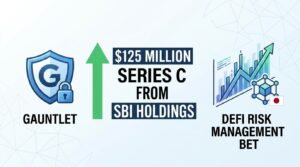
Gauntlet, the DeFi risk management and vault curation firm overseeing $1.42 billion in assets under advisement, has closed a $125 million Series C funding round backed solely by SBI Holdings, the Japanese financial conglomerate. The deal, announced Thursday on X, marks one of the largest single-investor raises in the DeFi infrastructure space this year. It also signals a deepening convergence between traditional Asian financial capital and the operational backbone of decentralized finance.
What a $125M Single-Investor Round Tells Us About DeFi Infrastructure
Before unpacking the strategic implications, it helps to isolate what makes this round unusual. A sole investor committing $125 million at Series C is not a typical venture structure. That SBI Holdings chose to write the entire check, rather than participate alongside a syndicate, suggests a level of conviction (and exclusivity) that goes beyond portfolio diversification.
- Scale of commitment: SBI Holdings’ sole investment of $125 million positions Gauntlet among the best-capitalized DeFi infrastructure firms globally, with resources to expand risk modeling and vault curation capabilities significantly.
- Strategic alignment with TradFi: SBI Holdings has a long track record of crypto-adjacent investments in Japan and Southeast Asia. This round deepens its exposure to the protocol-level risk layer of DeFi.
- The $1.42 billion in assets under advisement gives Gauntlet a footprint that few pure-play DeFi risk firms can match, and this capital injection could widen that gap further.
- Institutional validation: A financial conglomerate of SBI’s stature backing a DeFi-native firm at this valuation tier sends a clear message to regulators and competitors alike about where institutional money sees durable value in crypto.
SBI Holdings and the Quiet Expansion Into DeFi Plumbing
SBI Holdings’ portfolio of digital asset investments has grown steadily over the past several years, spanning exchanges, custody solutions, and blockchain infrastructure across Asia-Pacific markets. But this round represents something different. Rather than investing in consumer-facing crypto platforms, SBI is placing capital directly into the risk management layer that underpins protocol-level decision-making.
That distinction matters. Vault curation and risk parameterization are not glamorous verticals. They don’t generate headlines the way token launches or exchange listings do. Yet they sit at the core of how DeFi protocols manage liquidity, set collateral thresholds, and avoid cascading liquidation events. In practice, firms like Gauntlet function as the actuarial backbone of decentralized lending and borrowing markets.
Why SBI chose to go it alone on this round remains an open question.
Gauntlet’s Position in the DeFi Risk Landscape
Founded by CEO Tarun Chitra, Gauntlet has carved out a niche that sits at the intersection of quantitative finance and on-chain protocol governance. The firm uses agent-based simulation models to stress-test DeFi protocols, advising on risk parameters that govern billions in total value locked. Its client base includes some of the most prominent lending and liquidity protocols in the ecosystem.
With $1.42 billion in assets under advisement, Gauntlet already operates at a scale that makes it a systemically relevant player. And while competitors exist in the DeFi risk space, few combine the quantitative depth with the breadth of protocol relationships that Gauntlet’s risk management platform has built over successive market cycles.
Still, scale brings its own complications. As DeFi protocols grow more complex and multi-chain deployments become standard, the computational and analytical demands on risk curators multiply. The $125 million infusion likely targets exactly this kind of infrastructure buildout.
How This Shapes Institutional Appetite for DeFi Services
| Factor | Before This Round | After This Round |
|---|---|---|
| Gauntlet’s capitalization | Series B stage; undisclosed prior raise | $125M Series C; significantly expanded war chest |
| SBI’s DeFi exposure | Primarily exchange and custody layer | Now extends to protocol-level risk infrastructure |
| Institutional perception of DeFi risk firms | Niche, early-stage category | Validated at conglomerate-level ticket sizes |
| Competitive landscape | Fragmented, with several smaller players | Gauntlet pulls further ahead in resources and credibility |
The broader signal here is arguably more important than the transaction itself. When a financial group managing hundreds of billions in assets decides that DeFi risk management deserves a nine-figure allocation, it recalibrates how the entire category gets priced and perceived by other institutional allocators.
What Drives Conviction in Protocol-Level Risk Management
Understanding why capital flows toward DeFi risk infrastructure requires reframing how value creation works in decentralized systems. Traditional finance separates risk management from product delivery. Banks have internal risk desks; asset managers hire external actuaries. DeFi collapses these layers. The protocol is the product, and the risk parameters are the guardrails that determine whether it survives a stress event or implodes.
This structural reality creates a feedback loop. As total value locked across DeFi protocols grows, the demand for sophisticated, real-time risk modeling grows proportionally. Protocols that fail to manage risk effectively don’t just lose users; they lose capital permanently through exploits or cascading liquidations. The 2022 cycle demonstrated this with painful clarity. Gauntlet’s value proposition, at its core, is preventing those outcomes through simulation-driven governance recommendations.
And the timing matters. With DeFi activity rebounding in 2025 and new institutional entrants exploring on-chain strategies, the need for credible risk infrastructure has never been more acute. SBI’s bet reflects a view that this demand curve is structural, not cyclical.
Frequently Asked Questions
What does Gauntlet do in DeFi?
Gauntlet provides risk management and vault curation services for DeFi protocols. It uses agent-based simulations to model protocol behavior under stress conditions, advising on parameters like collateral ratios, liquidation thresholds, and interest rate curves. The firm currently oversees $1.42 billion in assets under advisement.
Why did SBI Holdings invest alone?
SBI Holdings served as the sole investor in Gauntlet’s $125 million Series C. The specific rationale for a single-investor structure has not been publicly detailed, though it suggests a high degree of strategic alignment between the two firms rather than a purely financial allocation.
How does this affect other DeFi risk management firms?
The round raises the competitive bar substantially. Smaller risk firms may find it harder to compete for top-tier protocol mandates against a significantly better-capitalized Gauntlet, though the overall market for DeFi risk services continues to expand.