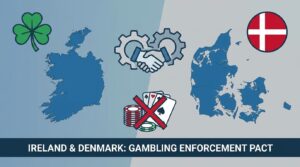
The Gambling Regulatory Authority of Ireland (GRAI) and Denmark’s Spillemyndigheden have signed a Memorandum of Understanding that binds the two regulators into a shared enforcement framework targeting unauthorised online gambling. Signed by GRAI CEO Anne Marie Caulfield and Danish Director General Anders Dorph, the agreement covers data sharing, joint monitoring protocols, and coordinated compliance actions against remote operators. The timing is deliberate: both agencies are scaling up technical oversight of digital wagering just as Denmark publishes its annual report on unlicensed gambling activity for 2025.
What the Ireland-Denmark MoU Signals for Cross-Border Gambling Oversight
Bilateral regulatory agreements in gambling are not new, but the specifics of this one deserve attention. Rather than a ceremonial handshake between agencies, the MoU establishes operational mechanisms for real-time intelligence exchange and parallel enforcement action. That distinction matters because unlicensed operators rarely confine themselves to a single jurisdiction; they exploit gaps between national regimes. Here’s what stands out from a strategic perspective:
- The agreement creates a structured channel for sharing monitoring data on remote operators, reducing the lag between detection and enforcement across borders
- Coordinated compliance actions mean that an operator flagged in Denmark could face simultaneous scrutiny from Irish regulators, and vice versa
- Timing is tied to Spillemyndigheden’s 2025 report on unlicensed gambling, suggesting the Danish side brought fresh enforcement intelligence to the table
- For licensed operators in either market, the MoU raises the bar on regulatory expectations around transparency, AML controls, and advertising standards
- The partnership could serve as a template for similar bilateral deals across the EU, particularly as the European Commission continues to monitor gambling regulation without imposing harmonised rules
Denmark’s Unlicensed Gambling Report: The Catalyst
Spillemyndigheden’s “Rapport om ulovligt spil 2025” provides the empirical backdrop to this agreement. The report documents the scale and tactics of unlicensed operators targeting Danish consumers through offshore platforms, unlicensed payment processing, and aggressive digital marketing. While the full data set has not been publicly broken down in English-language summaries, the report’s release immediately preceding the MoU signing suggests its findings shaped the terms of cooperation.
Denmark has long maintained one of Europe’s more structured licensing regimes. Still, the persistence of unlicensed operators highlights a familiar problem: national enforcement tools alone cannot contain cross-border digital activity. The Danish Gambling Authority’s regulatory framework already includes ISP blocking and payment disruption measures, but these tools work better when paired with intelligence from partner jurisdictions.
Ireland’s Regulatory Trajectory Under GRAI
For Ireland, this MoU arrives at a formative moment. GRAI is a relatively young authority, having assumed its regulatory mandate under the Gambling Regulation Act 2023. The agency is still building out its licensing infrastructure, enforcement capacity, and supervisory technology. Partnering with a more established regulator like Spillemyndigheden gives GRAI access to operational playbooks that took Denmark years to develop.
Anne Marie Caulfield’s decision to prioritise this agreement early in GRAI’s institutional life is arguably a signal that Ireland intends to position itself as a proactive regulator rather than a reactive one (a distinction regulators have been slow to enforce in other EU member states). Whether that ambition survives contact with the political and commercial pressures of a growing Irish gambling market remains an open question.
The Gambling Regulatory Authority of Ireland has indicated that additional international partnerships are under consideration, though no further MoUs have been announced.
How Operators Should Read This Development
Licensed operators in both markets face a more interconnected regulatory environment. And while compliance teams may already meet domestic requirements, the MoU introduces a layer of cross-jurisdictional visibility that changes the calculus on risk management.
| Dimension | Before MoU | After MoU |
|---|---|---|
| Data sharing | Ad hoc, request-based | Structured, protocol-driven exchange |
| Enforcement coordination | Independent national actions | Parallel or joint enforcement possible |
| Operator risk exposure | Contained within single jurisdiction | Cross-border scrutiny from two regulators simultaneously |
| Unlicensed operator deterrence | Limited to domestic tools (ISP blocks, payment disruption) | Combined intelligence increases detection speed and scope significantly |
Operators with licences in both jurisdictions should audit their compliance posture now, not after the first joint enforcement action lands.
The Broader European Context: Fragmentation Meets Cooperation
The EU does not regulate gambling at a supranational level. Each member state sets its own rules, licensing requirements, and enforcement priorities. This fragmentation has long been criticised for creating arbitrage opportunities that unlicensed operators exploit. But it has also produced a patchwork of bilateral agreements like this one, where regulators build cooperation from the ground up rather than waiting for Brussels to act.
What makes the GRAI-Spillemyndigheden agreement notable is its operational depth. Many existing MoUs between gambling regulators are broad and aspirational. This one, at least on paper, includes specific provisions for monitoring protocols and coordinated action. Whether it delivers measurable results will depend on execution, resource allocation, and political will on both sides.
Even so, the direction is clear. Regulators are no longer content to police their own borders alone. The digital nature of modern gambling makes that approach untenable, and the proliferation of unlicensed platforms only accelerates the need for shared enforcement infrastructure.
Frequently Asked Questions
What does the MoU between GRAI and Spillemyndigheden cover?
The agreement establishes formal channels for data sharing, joint monitoring of remote gambling operators, and coordinated compliance enforcement between Ireland and Denmark.
Why was this agreement signed now?
Its timing aligns with the publication of Denmark’s 2025 report on unlicensed gambling, which documented the ongoing challenges of cross-border unauthorised operators. GRAI is also in an early phase of building its regulatory capacity under Ireland’s 2023 gambling legislation, making international partnerships a strategic priority.
Does this affect licensed operators?
Yes. Operators licensed in either or both jurisdictions now face the possibility of cross-border regulatory scrutiny. Compliance gaps identified by one authority could trigger attention from the other, raising the stakes for maintaining robust internal controls across markets.
Could this model expand to other EU countries?
Potentially. Several EU gambling regulators have signed bilateral agreements in recent years, though most lack the operational specificity described in this MoU. If the Ireland-Denmark framework produces tangible enforcement outcomes, it could encourage similar arrangements elsewhere across Europe.