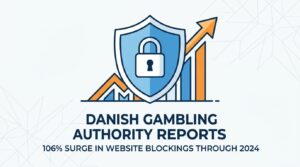
Denmark’s gambling regulator, Spillemyndigheden, has recorded a dramatic 106.2 per cent increase in website blockings over the course of 2024, signalling a sharper enforcement posture against unlicensed online gambling operators targeting Danish consumers. The figures, drawn from the authority’s latest annual enforcement report, underscore a widening gap between the pace of unauthorised market activity and the regulatory tools deployed to contain it. For an industry already navigating tightened compliance frameworks across Europe, the Danish data offers a concrete measure of how aggressively one Nordic regulator is now willing to act.
What the Numbers Reveal About Denmark’s Enforcement Shift
Before diving into the strategic implications, it helps to ground the discussion in what Spillemyndigheden actually did differently in 2024. The more-than-doubling of blocked domains suggests not just increased vigilance but a likely expansion of the technical and legal mechanisms the authority uses to identify and act against unlicensed sites. Whether this reflects improved detection capabilities, greater cooperation with internet service providers, or simply a larger volume of offending operators entering the Danish market remains an open question (one the regulator has not fully addressed in public statements).
Here are the core takeaways for industry stakeholders:
- Enforcement velocity is accelerating. A 106.2% year-on-year rise in blockings is not incremental. It represents a step-change in regulatory output that licensed operators and compliance teams should factor into their risk models.
- Unlicensed operators face shrinking room. The sheer volume of blocked sites indicates that Denmark’s regulated perimeter is being actively patrolled, reducing the competitive threat from grey-market entrants.
- The data may also reflect a growing number of unlicensed operators attempting to reach Danish players, which complicates the narrative that blocking alone solves the channelisation problem.
- ISP cooperation appears to be functioning. Website blocking at this scale requires reliable execution by Danish internet service providers, suggesting the enforcement pipeline from regulator to ISP is operationally mature.
How Denmark’s Approach Compares Across Europe
Denmark is not alone in escalating domain-blocking activity. Regulators in Italy, Spain, and the Netherlands have all expanded their blacklists in recent years. But the Danish trajectory stands out for its speed. Doubling the number of blocked sites in a single year puts Spillemyndigheden among the most active enforcers in the European Economic Area.
| Country | Regulator | Blocking Trend (2024) | Approach |
|---|---|---|---|
| Denmark | Spillemyndigheden | +106.2% YoY | ISP-level domain blocking, active monitoring |
| Netherlands | Kansspelautoriteit (KSA) | Steady increase | ISP blocking + financial payment blocking |
| Italy | ADM | Expanded blacklist | Large-scale IP and DNS blocking |
| Spain | DGOJ | Moderate growth | Domain blocking with judicial involvement |
Still, blocking websites is a blunt instrument. Operators with the resources to rotate domains or use mirror sites can partially circumvent these measures. The real question is whether blocking, combined with payment disruption and advertising restrictions, creates enough friction to meaningfully redirect consumers toward licensed platforms.
Why This Matters for Licensed Operators
For companies holding a Danish gambling licence, the enforcement surge carries a dual signal. On one hand, aggressive action against unlicensed competitors protects market share and validates the cost of compliance. On the other, it highlights the persistent scale of the unlicensed market. If regulators need to block twice as many sites as the previous year, the unauthorised supply side is clearly not shrinking on its own.
Licensed operators investing in the Danish market through Denmark’s regulated gambling framework may find some comfort in the regulator’s willingness to act. But comfort and certainty are different things. The sustainability of this enforcement pace, particularly if domain volumes continue to climb, will test both the regulator’s resources and its political mandate.
The Channelisation Puzzle
Arguably the most important metric is not how many sites get blocked, but how effectively Danish consumers are channelled into the licensed market. Blocking is a means, not an end. And while Spillemyndigheden’s report demonstrates operational capability, the authority has yet to publish granular data linking blocking activity to measurable shifts in player behaviour or channelisation rates.
That gap matters. Without it, the enforcement narrative rests on output metrics rather than outcome metrics.
Behavioural Dimensions: What Drives Players Toward Unlicensed Sites?
Understanding the psychology behind player choices adds a layer that pure enforcement data cannot capture. Neuro-linguistic programming principles and behavioural research suggest that consumer decisions around gambling platforms are shaped by a combination of perceived value, trust signals, and friction tolerance. When a licensed platform imposes deposit limits, mandatory cooling-off periods, or identity verification steps, some players experience these as barriers rather than protections. The unlicensed market exploits precisely this gap in perception.
Framing effects play a significant role here. Players who encounter an unlicensed site often perceive fewer restrictions as greater freedom, even when the absence of consumer protections exposes them to considerably higher risk. Regulators across Europe have begun to recognise that enforcement alone cannot fully address this cognitive asymmetry. Denmark’s own responsible gambling campaigns attempt to reframe compliance measures as player benefits rather than obstacles, but the effectiveness of such messaging varies widely across demographic groups.
Anchoring bias also influences how players evaluate odds and bonus offers on unlicensed platforms. When an unauthorised operator presents inflated welcome bonuses or unrealistic payout claims, the initial anchor distorts the player’s ability to compare those offers rationally against what licensed operators provide. Addressing this requires not just blocking access but actively reshaping the informational environment in which players make decisions. Educational initiatives, clearer labelling of licensed platforms, and targeted digital literacy campaigns all form part of a broader toolkit that complements the technical act of domain blocking.
What remains less clear is whether Danish regulators intend to invest as heavily in these behavioural interventions as they have in enforcement infrastructure. The 2024 blocking figures are impressive as an operational achievement. Whether they translate into a safer, better-channelled market depends on work that happens far upstream of any ISP filter.
Frequently Asked Questions
What does Spillemyndigheden do?
Spillemyndigheden is Denmark’s gambling regulatory authority, responsible for licensing, supervision, and enforcement across all forms of gambling offered to Danish residents. It also manages the blocking of unlicensed gambling websites.
Why did website blockings increase so sharply in 2024?
The 106.2 per cent rise likely reflects a combination of improved detection methods, expanded monitoring scope, and a growing number of unlicensed operators attempting to access the Danish market. The regulator has not attributed the increase to a single factor.
Does blocking websites actually stop players from gambling on unlicensed platforms?
It raises the barrier significantly, but determined users can sometimes bypass blocks through VPNs or mirror domains. Blocking works best as part of a layered strategy that includes payment blocking and consumer education.
How does Denmark’s enforcement compare to other EU countries?
Denmark’s year-on-year growth rate in blockings is among the highest in Europe. Countries like Italy maintain larger absolute blacklists, but few have matched the pace of Denmark’s 2024 escalation.