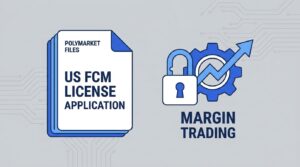
Polymarket, the blockchain-based prediction market platform, has filed an application for a US futures commission merchant (FCM) license, signaling its intent to offer margin trading capabilities to users. The application, submitted on July 3 to the National Futures Association, would allow traders to open positions on prediction market outcomes without posting full collateral upfront. If approved, the license would mark a significant regulatory milestone for a platform that has operated largely outside the traditional US financial licensing framework (a distinction that has drawn both admiration and scrutiny from market observers).
What Polymarket’s FCM Application Means for Prediction Markets
Before diving into the specifics, it’s worth understanding the broader strategic calculus at play. Polymarket isn’t simply chasing a regulatory stamp. The company is positioning itself to compete directly with traditional derivatives venues by lowering the capital barrier for participants. That shift carries implications well beyond one platform’s balance sheet.
- Margin trading access: An FCM license would let Polymarket users leverage their positions, dramatically expanding the platform’s appeal to sophisticated and institutional traders who expect capital efficiency.
- Regulatory legitimacy: Filing with the NFA places Polymarket squarely within the US regulatory perimeter, a move that could preempt enforcement risk and open doors to partnerships with compliant financial institutions.
- The timing aligns with a broader thaw in US regulatory posture toward crypto-native platforms, particularly those offering event-based contracts.
- Competitive pressure: Rivals like Kalshi, which already holds CFTC-regulated exchange status, will face a more capable competitor if Polymarket secures the license and rolls out leveraged products.
- Market depth: Margin trading typically increases liquidity and tightens spreads, which could make Polymarket’s prediction markets more accurate as price discovery tools.
Why the Timing Matters
Polymarket’s filing arrives during a period of unusual regulatory fluidity in the United States. The CFTC has been gradually expanding its framework for event contracts, and congressional interest in stablecoin and digital asset legislation has created a window where crypto-adjacent firms see an opening to formalize their operations. Still, the path from application to approval is neither short nor guaranteed.
The NFA registration process involves detailed financial disclosures, compliance infrastructure reviews, and ongoing reporting obligations. For a platform built on blockchain rails, meeting these requirements means bridging two very different operational paradigms. Whether Polymarket’s existing architecture can satisfy traditional FCM standards without significant overhaul remains an open question.
How Margin Trading Could Reshape User Behavior
Prediction markets thrive on participation volume. The more traders placing bets on real-world outcomes, the more informative the resulting probabilities become. Margin trading amplifies this dynamic by letting participants deploy capital more efficiently.
Consider a trader who currently needs to post $1,000 in collateral to take a position on, say, a US election outcome. With margin, that same trader might need only $200 upfront. The freed-up capital can be deployed across multiple contracts simultaneously. That’s not a marginal change. It fundamentally alters how active participants allocate risk across the platform.
But leverage cuts both ways. Margin calls, forced liquidations, and amplified losses are standard features of leveraged markets. Polymarket’s prediction market infrastructure would need robust risk management protocols to prevent cascading liquidations during volatile events.
Competitive Landscape and Institutional Interest
| Platform | Regulatory Status | Margin Trading | Primary Market |
|---|---|---|---|
| Polymarket | FCM application pending (NFA) | Proposed | Crypto-native prediction markets |
| Kalshi | CFTC-regulated exchange | Not currently offered | Event contracts (US-regulated) |
| PredictIt | CFTC no-action letter (expired) | No | Academic/political prediction markets |
Kalshi has built its business on regulatory compliance from day one, securing CFTC approval to list event contracts. Polymarket, by contrast, grew rapidly by operating outside US jurisdiction for most users while building a massive global user base. The FCM filing suggests a strategic pivot toward regulatory integration rather than avoidance.
And while institutional players have largely stayed on the sidelines of prediction markets, a licensed margin-enabled platform could change that calculus. Hedge funds and proprietary trading firms are accustomed to leveraged instruments; what they lack is a compliant venue offering event-based contracts with sufficient liquidity.
The Broader Signal for Crypto-Native Platforms
Polymarket’s move reflects a pattern emerging across the digital asset industry. Platforms that once operated in regulatory gray zones are now actively seeking licenses, registrations, and formal recognition. The calculus has shifted: the cost of remaining unlicensed increasingly outweighs the friction of compliance.
This isn’t purely defensive. Licensed status unlocks banking relationships, fiat on-ramps, and access to a class of users who won’t touch unregulated platforms. For Polymarket, an FCM license could be the difference between remaining a niche crypto tool and becoming a mainstream financial venue.
Yet the tension between decentralization and regulatory compliance hasn’t disappeared. Blockchain-native platforms must reconcile permissionless architecture with KYC requirements, transaction monitoring, and capital adequacy rules. How Polymarket navigates that tension will be closely watched by every crypto project weighing a similar path.
Frequently Asked Questions
What is a futures commission merchant license?
An FCM license, issued through registration with the National Futures Association and oversight by the CFTC, authorizes a firm to solicit or accept orders for futures and options contracts and to accept money or assets from customers to support such orders. It carries significant compliance and capital requirements.
Does Polymarket currently operate in the US?
Polymarket has historically restricted access for US-based users following a 2022 settlement with the CFTC. The FCM application suggests the platform is seeking a formal pathway back into the US market under a regulated framework.
How would margin trading work on a prediction market?
Traders would be able to open positions by posting only a fraction of the total contract value as collateral. This increases capital efficiency but also introduces liquidation risk if positions move against the trader beyond their margin threshold. The specifics of Polymarket’s proposed margin structure have not been publicly detailed.
When could Polymarket receive approval?
NFA registration timelines vary, and the process involves multiple stages of review. No official timeline has been disclosed, and approval is not assured.