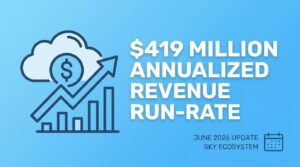
Sky Frontier Foundation, the reporting arm of the Sky Ecosystem, revealed a record $419.08 million annualized gross revenue run-rate in its June 2026 Financial & Operational Update. The protocol, formerly known as MakerDAO and now operating as a $6.12 billion total value locked (TVL) lending and stablecoin platform, has reached a financial milestone that few DeFi protocols have matched. The disclosure, published Friday, underscores a broader trend of maturing decentralized finance projects generating revenue figures that rival mid-cap traditional financial firms.
What Sky’s Revenue Milestone Signals for DeFi Lending
Before unpacking the numbers, it’s worth framing what this kind of run-rate actually means for the decentralized finance sector and the stakeholders watching it closely.
- A $419.08 million annualized gross revenue figure places Sky among the highest-earning DeFi protocols globally, reinforcing its dominance in decentralized lending and stablecoin issuance.
- The rebrand from MakerDAO to Sky has not diluted protocol performance; if anything, the ecosystem’s financial trajectory has accelerated under the new identity.
- With $6.12 billion in TVL, Sky maintains one of the deepest liquidity pools in DeFi, a metric institutional participants weigh heavily when evaluating protocol risk.
- Revenue at this scale invites sharper regulatory scrutiny, particularly as global jurisdictions refine their approaches to stablecoin oversight and DeFi governance.
- For competing lending protocols, Sky’s numbers set a benchmark that reshapes expectations around what sustainable DeFi revenue looks like.
From MakerDAO to Sky: A Rebrand That Kept Delivering
When MakerDAO announced its transformation into the Sky Ecosystem, skeptics questioned whether the rebrand would fracture community trust or dilute the protocol’s established market position. That concern, at least on paper, appears unfounded. The protocol’s TVL has held firm at $6.12 billion, and the revenue trajectory suggests operational continuity rather than disruption.
Sky’s core business remains unchanged: overcollateralized lending and the issuance of its stablecoin. But the organizational restructuring introduced through the Sky Frontier Foundation has added a layer of transparency to financial reporting that MakerDAO’s governance structure previously lacked (a distinction worth noting, given how few DeFi protocols publish regular financial updates at all).
The $419.08 million figure is annualized, meaning it extrapolates current revenue generation across a full year. Still, even as a projection, it represents a pace of earnings that positions Sky alongside protocols like Aave and Lido in the upper tier of DeFi revenue generators.
How $6.12 Billion in TVL Anchors the Revenue Engine
Revenue doesn’t materialize from thin air. Sky’s earnings are fundamentally tied to the lending activity and stability fees generated within its decentralized lending and stablecoin protocol. The $6.12 billion TVL figure functions as the engine beneath those numbers.
Higher TVL means more collateral locked, more loans issued, and more fees collected. It’s a straightforward relationship, but one that depends on sustained user confidence and competitive interest rates. What remains less clear is how much of Sky’s TVL growth stems from organic demand versus yield-seeking capital that could rotate out during market shifts.
| Metric | Value | Context |
|---|---|---|
| Annualized Gross Revenue | $419.08 million | Record high for the protocol |
| Total Value Locked (TVL) | $6.12 billion | Among the top DeFi protocols by TVL |
| Protocol Type | Lending & Stablecoin | Overcollateralized model, formerly MakerDAO |
| Reporting Entity | Sky Frontier Foundation | Handles ecosystem financial disclosures |
Regulatory and Market Implications Worth Watching
Protocols generating hundreds of millions in annualized revenue inevitably attract attention beyond the crypto-native community. Regulators in the EU, under MiCA, and U.S. agencies evaluating stablecoin frameworks are increasingly focused on protocols of this scale. Sky’s stablecoin operations place it squarely within the scope of emerging oversight regimes.
And while DeFi’s permissionless architecture complicates traditional regulatory approaches, revenue figures this large make the “too small to regulate” argument harder to sustain. The question isn’t whether regulators will engage with protocols like Sky. It’s whether the engagement will be collaborative or adversarial.
For institutional allocators, arguably the more immediate consideration is protocol risk. A $6.12 billion TVL pool backed by overcollateralized lending carries different risk characteristics than yield farming or algorithmic stablecoin models. That distinction matters when capital allocation committees evaluate DeFi exposure.
Reframing DeFi Revenue Through a Behavioral Lens
Numbers like $419 million reshape perception. In neuro-linguistic programming terms, Sky’s disclosure functions as a powerful reframe for how market participants anchor their understanding of DeFi’s economic viability. For years, the dominant narrative positioned decentralized protocols as experimental, pre-revenue, or speculative infrastructure. Sky’s update challenges that frame directly.
Anchoring bias plays a role here. Once a protocol publicly establishes a revenue figure north of $400 million, every subsequent DeFi revenue disclosure gets measured against that benchmark. Competing protocols find themselves either validated or diminished by proximity to the number. This is not abstract psychology; it shapes where capital flows, which governance proposals gain traction, and how media frames the sector’s maturity.
There’s also a trust calibration effect. Regular, structured financial reporting from the Sky Frontier Foundation builds a pattern of predictability that reduces perceived risk. Investors and participants develop what behavioral economists call “process trust,” where confidence stems not from any single data point but from the consistency of disclosure itself. Few DeFi protocols have invested in this kind of reporting cadence, which gives Sky a positioning advantage that extends well beyond the raw revenue figure.
The framing also shifts internal community dynamics. Token holders and governance participants who see concrete revenue data are more likely to engage constructively in protocol decisions. Vague promises about future value give way to grounded discussions about allocation, growth strategy, and risk management. That shift from speculative to operational thinking, subtle as it sounds, arguably changes the quality of governance itself.
Frequently Asked Questions
What does annualized gross revenue run-rate mean?
It takes the protocol’s current revenue generation pace and projects it across a twelve-month period. It’s a snapshot of momentum, not a guarantee of full-year earnings.
Is Sky the same as MakerDAO?
Yes. Sky is the rebranded identity of MakerDAO. The core protocol mechanics, including overcollateralized lending and stablecoin issuance, remain fundamentally the same under the new structure.
How does Sky generate revenue?
Primarily through stability fees charged on loans and interest generated from its lending operations. The $6.12 billion in locked collateral drives the volume that produces these fees.
Why does this revenue figure matter for the broader DeFi market?
It establishes a concrete benchmark. Protocols, investors, and regulators now have a reference point for what a mature, large-scale DeFi lending operation can generate, and that changes how the entire sector gets evaluated.