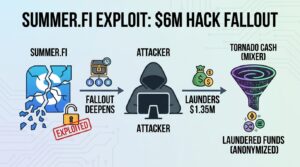
The individual behind the $6 million Summer.fi exploit has started moving stolen funds through Tornado Cash, funneling approximately $1.35 million in DAI through the sanctioned cryptocurrency mixer. Summer.fi, which serves as the front-end interface for the Lazy Summer Protocol, disclosed the laundering activity in its post-mortem analysis of the July 6 attack. The development underscores persistent vulnerabilities in DeFi front-end infrastructure and raises fresh questions about the effectiveness of on-chain tracing once mixers enter the picture.
What the Summer.fi Exploit Means for DeFi Security and Fund Recovery
Before diving into the specifics, the broader pattern here deserves attention. Front-end exploits targeting DeFi protocols have grown more sophisticated in 2025, and the speed at which stolen assets are being laundered continues to compress the window for recovery. This incident carries implications not just for Summer.fi users but for the wider ecosystem grappling with mixer-related enforcement gaps.
- Roughly $1.35 million of the $6 million in stolen funds has already been routed through Tornado Cash, significantly complicating asset recovery efforts
- The exploit targeted Summer.fi’s front-end layer rather than the underlying smart contracts, a vector that traditional audits often overlook
- Use of a U.S.-sanctioned mixer raises potential regulatory scrutiny for any intermediaries that interact with tainted addresses downstream
- The attack and subsequent laundering highlight how quickly threat actors can fragment and obscure stolen crypto, sometimes within days of the initial breach
- Summer.fi’s willingness to publish a detailed post-mortem sets a transparency benchmark, though it also reveals the limits of protocol-level response once funds leave the platform
How the Attack Unfolded
On July 6, an attacker exploited vulnerabilities in Summer.fi’s front-end interface for the Lazy Summer Protocol, siphoning approximately $6 million in user funds. The breach did not compromise the protocol’s smart contracts directly. Instead, the attacker manipulated the front-end layer, intercepting transactions before they reached the blockchain in their intended form.
That distinction matters.
Smart contract audits, which have become standard practice across DeFi, would not have caught this type of vulnerability. Front-end attacks exploit the user-facing application rather than the on-chain logic, making them harder to detect through conventional security reviews. And while the underlying protocol remained technically intact, the practical outcome for affected users was identical to a contract-level exploit: funds gone.
Laundering Through Tornado Cash: A Familiar Playbook
The attacker’s decision to route $1.35 million in DAI through Tornado Cash follows a well-established pattern among crypto exploiters. Tornado Cash, despite being sanctioned by the U.S. Office of Foreign Assets Control (OFAC) since August 2022, remains operational as a decentralized smart contract system that anyone can interact with on Ethereum.
What remains less clear is whether blockchain analytics firms tracking the stolen funds can maintain visibility beyond the mixer. Tornado Cash is designed to sever the on-chain link between deposit and withdrawal addresses, and while some forensic techniques have improved, the protocol still provides meaningful obfuscation for motivated actors. The $1.35 million moved so far represents roughly 22.5% of the total haul, suggesting additional laundering activity is likely underway or planned.
Breakdown of Known Fund Movement
| Category | Amount | Status |
|---|---|---|
| Total exploited | $6 million | Confirmed by Summer.fi post-mortem |
| Laundered via Tornado Cash | ~$1.35 million (DAI) | Detected on-chain |
| Remaining in attacker wallets | ~$4.65 million | Under monitoring; disposition unclear |
Regulatory and Enforcement Dimensions
Every interaction with Tornado Cash carries legal weight in the United States. OFAC’s 2022 designation made it unlawful for U.S. persons to transact with the mixer’s smart contract addresses (a distinction regulators have been slow to enforce consistently across all market participants). Still, the attacker’s use of a sanctioned tool could trigger additional law enforcement interest, particularly if any of the downstream addresses touch centralized exchanges subject to U.S. jurisdiction.
Arguably, the enforcement landscape around mixers has grown more complex rather than more effective. Courts have issued conflicting rulings on the legality of sanctioning immutable smart contracts, and the practical deterrent effect on attackers appears limited. The funds keep flowing.
Front-End Security: The Overlooked Attack Surface
This exploit adds to a growing body of evidence that DeFi’s security model has a blind spot. Protocols invest heavily in smart contract audits, formal verification, and bug bounty programs. But the front-end, the interface through which users actually interact with these contracts, often receives far less scrutiny.
Front-end compromises can take several forms: DNS hijacking, supply chain attacks on JavaScript dependencies, or direct manipulation of hosted application code. Each of these vectors bypasses on-chain security entirely. For users, distinguishing between a legitimate and compromised front-end is nearly impossible without independent transaction verification tools.
The Summer.fi incident should prompt protocol teams to reassess their security posture beyond the contract layer. Investments in front-end integrity monitoring, content security policies, and decentralized hosting alternatives may prove just as critical as the next audit cycle.
Frequently Asked Questions
What exactly was exploited in the Summer.fi attack?
The attacker targeted the front-end interface of Summer.fi, not the Lazy Summer Protocol’s smart contracts. This allowed them to intercept and redirect user transactions before they were executed on-chain as intended.
Can the laundered funds be recovered?
Recovery becomes significantly harder once funds pass through Tornado Cash. While blockchain forensics firms continue to develop techniques for tracing mixer outputs, the practical likelihood of full recovery diminishes with each laundering step. No recovery has been publicly announced.
Is Tornado Cash still operational despite sanctions?
Yes. Because Tornado Cash operates as a set of immutable smart contracts on Ethereum, it cannot be shut down by any single entity. The OFAC sanctions prohibit U.S. persons from interacting with it, but the contracts themselves remain accessible to anyone with an Ethereum wallet.
How much of the stolen funds remain traceable?
Approximately $4.65 million has not yet been routed through a mixer, based on available on-chain data. These funds are being monitored, though the attacker could fragment them across wallets or use additional obfuscation methods at any time.
What Protocols Should Take From This
Summer.fi’s transparent post-mortem deserves credit, but transparency after the fact cannot substitute for prevention. The DeFi industry’s security spending remains disproportionately focused on smart contract layers while front-end infrastructure, often maintained by small teams with limited resources, goes under-examined. Until that imbalance shifts, exploits like this one will keep finding the path of least resistance. And the mixers will keep doing what they were built to do.