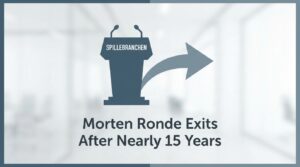
Morten Ronde, the long-serving head of Spillebranchen, is stepping down from his role leading the Danish gambling industry association after almost 15 years. The departure marks the end of an era for the trade body, which represents several licensed operators active in the Danish market. While details surrounding the transition remain sparse, the move raises immediate questions about the association’s strategic direction and its voice in an increasingly regulated European gambling landscape.
What Ronde’s Departure Signals for Danish Gambling Advocacy
Spillebranchen has functioned as the primary collective voice for Denmark’s licensed gambling operators, engaging with regulators, policymakers, and the broader public on issues ranging from responsible gambling frameworks to advertising restrictions. Ronde’s tenure coincided with a period of significant regulatory evolution in Denmark, including the liberalisation of the online gambling market in 2012 and successive tightening of compliance requirements in the years that followed.
Before unpacking the broader implications, here are the core takeaways from this leadership change:
- Leadership vacuum at a pivotal moment: Denmark’s gambling regulation continues to tighten, and the association now faces the challenge of finding a successor who can navigate both political and commercial pressures.
- Continuity risk for operator representation: Ronde’s relationships with regulators and EU-level stakeholders were built over nearly a decade and a half. Replacing institutional memory of that depth is not straightforward.
- The timing coincides with broader European debates around gambling advertising bans, affordability checks, and digital identity verification standards.
- Operator confidence: Member operators will be watching closely to see whether the association maintains its influence or loses ground during the transition period.
A Career That Tracked Denmark’s Regulatory Arc
Ronde joined the Danish gambling trade association at a time when the market was on the cusp of transformation. Denmark’s 2012 Gambling Act opened the door to licensed online operators, breaking the previous monopoly structure and creating a competitive, multi-operator environment. That shift demanded a trade body capable of coordinating industry positions, and Ronde became the face of that effort.
Over the years, his role extended well beyond domestic advocacy. He became a familiar presence at European gambling conferences and was known for articulating the Danish industry’s position on cross-border regulatory harmonisation. Still, not all of his tenure was smooth. The Danish market has seen periodic tensions between operators and the national regulator, Spillemyndigheden, particularly around enforcement actions and marketing restrictions.
What made his position distinctive was the balancing act it required: representing commercial interests while publicly endorsing responsible gambling measures that, at least on paper, constrained those same interests.
Why the Timing Matters More Than It Appears
This is not a quiet moment to hand over the reins. Across Europe, gambling regulation is accelerating in scope and intensity. Germany’s fragmented licensing regime continues to create compliance headaches. The UK’s long-awaited Gambling Act review has introduced affordability checks and stake limits that ripple across the continent as regulatory benchmarks. And in Scandinavia specifically, Norway and Sweden have both moved toward stricter channelisation models in recent months.
Denmark sits in a relatively stable regulatory position compared to some neighbours, but stability is not permanence. The Danish government has signalled ongoing interest in reviewing gambling advertising rules, and EU-level discussions around digital services regulation could introduce new obligations for online operators (a distinction regulators have been slow to enforce at the national level).
Whoever succeeds Ronde will inherit a role that demands fluency in both Danish political dynamics and the broader Brussels regulatory machinery.
The Organisational Challenge Ahead
Trade associations in regulated industries often underestimate how much institutional credibility is tied to a single individual. Ronde’s near-15-year tenure means that for many stakeholders, he was Spillebranchen. That kind of personal brand equity doesn’t transfer automatically to a successor.
And there’s a subtler risk. Member operators may use a leadership transition as an opportunity to reassess their membership, their dues, or their level of engagement. If the incoming leader lacks a clear mandate or a compelling strategic vision, the association could find itself weakened precisely when it needs to be strongest.
Yet transitions also create openings. A new leader could push the association toward more aggressive digital advocacy, deeper engagement with player protection research, or stronger alliances with peer organisations across Europe. The question is whether Spillebranchen’s board treats this as a routine succession or a strategic inflection point.
Frequently Asked Questions
What is Spillebranchen?
Spillebranchen is a Danish trade association representing licensed gambling operators in Denmark. It engages with regulators and policymakers on behalf of its members on issues including licensing, responsible gambling, and advertising standards.
How long did Morten Ronde lead the association?
Nearly 15 years, a tenure that spanned the liberalisation of Denmark’s online gambling market and multiple rounds of regulatory reform.
Has a successor been named?
No successor has been publicly announced at this stage. The association has not disclosed a timeline for the appointment.
Why does this matter for the wider European gambling industry?
Denmark’s regulatory model is often cited as one of the more effective liberalised frameworks in Europe. The strength of its trade association influences how the Danish operator perspective is represented in cross-border regulatory discussions, particularly at the EU level. A weakened advocacy body could shift the balance of influence toward regulators or competing national models.