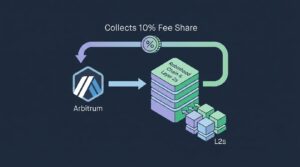
Offchain Labs co-founder Steven Goldfeder confirmed Wednesday that Arbitrum will take a 10% cut of fees generated by every Layer 2 network built on its technology stack, including the recently announced Robinhood Chain. The revenue split directs 8% to the tokenholder-governed Arbitrum treasury and channels the remaining 2% toward ongoing protocol development. The announcement, made on X, crystallizes a monetization model that could reshape how rollup infrastructure providers capture value across the expanding Layer 2 ecosystem.
What Arbitrum’s Fee-Sharing Model Means for the L2 Economy
This isn’t a minor operational detail. It’s a structural revenue mechanism that positions Arbitrum’s technology licensing closer to a franchise model than an open-source giveaway. Before unpacking the implications, here are the key strategic takeaways:
- Recurring revenue stream: Arbitrum now earns passive income from every chain deployed on its Orbit stack, creating a compounding revenue model tied directly to ecosystem growth
- The 8% treasury allocation gives ARB tokenholders indirect economic exposure to the success of chains they don’t directly govern
- Development sustainability: A dedicated 2% development fund reduces reliance on grants or one-time funding rounds for core protocol maintenance
- Robinhood Chain’s participation validates the model at the institutional level, signaling that major fintech players accept this cost structure
- Competitive pressure: Rival rollup frameworks from Optimism, zkSync, and Polygon now face a benchmark for how infrastructure monetization can work at scale
Why Robinhood’s Involvement Changes the Calculus
Robinhood is not a crypto-native startup experimenting with blockchain rails. It’s a publicly traded brokerage with over 24 million funded accounts and deep regulatory exposure. When a company of that profile agrees to build on Arbitrum’s Orbit technology stack, it sends a particular signal to the market: the fee-sharing terms are commercially viable even for entities operating under traditional financial scrutiny.
That matters more than it might appear at first glance.
Most Layer 2 deployments to date have come from crypto-native teams, DeFi protocols, or gaming studios with high risk tolerance and low regulatory overhead. Robinhood sits in a different category entirely. Its willingness to absorb a 10% fee share suggests the economics still pencil out, which in turn makes it harder for other prospective Orbit deployers to argue the terms are prohibitive. Whether this becomes a ceiling or a floor for future negotiations remains an open question (and one Offchain Labs has not publicly addressed).
The Treasury Dynamics Behind the 8/2 Split
Goldfeder’s breakdown of the fee allocation deserves closer scrutiny. Directing 80% of Arbitrum’s take to the DAO-controlled treasury rather than to Offchain Labs itself is a deliberate governance signal. It aligns the revenue model with decentralization narratives that matter to both tokenholders and regulators watching how protocol economics function.
But governance and execution are different animals. The Arbitrum DAO has already managed billions in treasury assets, and its track record on capital deployment has been mixed. Some grants programs have drawn criticism for unclear ROI metrics. Others have funded infrastructure that arguably strengthened the ecosystem. Adding a new, potentially significant revenue stream raises the stakes on treasury governance considerably. More money flowing in means more scrutiny on how it flows out.
The 2% development allocation, meanwhile, creates a self-sustaining funding loop for Offchain Labs and contributing developers. In practice, this could reduce the political friction that arises when core teams need to request funding from their own DAOs.
How This Compares to Competing Rollup Frameworks
| Framework | Fee-Sharing Model | Treasury Allocation | Notable Deployers |
|---|---|---|---|
| Arbitrum Orbit | 10% of L2 fees | 8% to DAO treasury, 2% to development | Robinhood, Xai, Degen Chain |
| OP Stack (Optimism) | Revenue sharing via Superchain model | Varies by agreement | Base (Coinbase), Worldcoin, Zora |
| Polygon CDK | No standardized public fee share | Not publicly disclosed | Immutable zkEVM, Astar |
| zkSync (ZK Stack) | Under development | Details pending | Cronos, Lens Protocol |
Optimism’s Superchain model operates on a broadly similar principle but with less uniform public terms. Polygon and zkSync have yet to formalize equivalent structures, at least on paper. Arbitrum’s explicit, published fee schedule arguably gives it a transparency advantage, even if the rate itself becomes a point of negotiation for larger partners.
What Institutional Adoption Signals About L2 Maturity
The broader pattern here extends well beyond a single fee arrangement. Layer 2 networks are transitioning from experimental scaling solutions into productized infrastructure with defined commercial terms. That shift carries implications for how institutional capital evaluates the space. When Robinhood builds its own blockchain infrastructure, it normalizes a category that venture investors and public market analysts have struggled to price.
Still, questions linger about sustainability. If transaction volumes on Orbit-based chains remain modest, the 10% fee share generates negligible revenue. The model only works at scale. And scale, in the Layer 2 world, depends on applications that drive genuine user activity rather than speculative volume spikes that fade within weeks.
Arguably, the real test comes not from Robinhood’s launch but from what happens twelve months after it. Sustained fee generation would validate the model. A quiet chain would expose its limits.
Frequently Asked Questions
Does the 10% fee apply to all Arbitrum Orbit chains?
Yes. According to Goldfeder’s statement, the fee structure applies universally to Layer 2 networks built on Arbitrum’s Orbit technology stack, not just Robinhood Chain.
Who controls the 8% that goes to the Arbitrum treasury?
The Arbitrum DAO, governed by ARB tokenholders, controls treasury funds. Spending decisions are subject to governance proposals and votes, though the efficiency of that process has drawn mixed reviews from community participants.
How does this compare to what Coinbase pays Optimism for Base?
The exact terms of Base’s arrangement with Optimism have not been fully disclosed publicly. Optimism’s Superchain model involves revenue sharing, but the specific percentages and structures differ from Arbitrum’s flat 10% approach.
Could this fee structure deter new projects from choosing Orbit?
Possibly, for cost-sensitive teams. But Robinhood’s acceptance of the terms suggests that for projects with meaningful transaction volume expectations, the infrastructure benefits outweigh the fee burden. The competitive landscape among rollup providers will ultimately determine whether 10% holds as a standard or gets undercut.