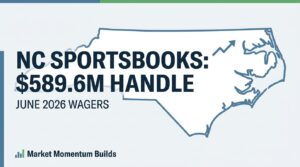
North Carolina’s regulated online sportsbooks collected $589.6 million in wagers during June 2026, a figure that underscores the state’s rapid emergence as a competitive force in the U.S. sports betting landscape. The Tar Heel State, which launched legal mobile wagering in March 2024, continues to post monthly handle numbers that rival more established markets. Seasonal factors and a packed sports calendar helped sustain betting volumes even as the traditional summer slowdown loomed.
What North Carolina’s June Handle Signals for Operators and Regulators
The $589.6 million figure is more than a data point. It reflects a maturing market where consumer adoption has moved past the initial launch surge and settled into a rhythm that operators can plan around. Below are the strategic takeaways worth tracking:
- Sustained engagement beyond novelty: North Carolina’s handle has remained elevated more than two years after launch, suggesting structural demand rather than promotional-driven spikes.
- Operator competition is keeping promotional spending high, which compresses margins but expands the customer base.
- Tax revenue implications: The state’s 18% tax rate on adjusted gross revenue means June’s handle translates into meaningful fiscal contributions, though the exact revenue figure depends on operator hold percentages.
- Summer resilience: Unlike some states that see sharp declines between the NBA Finals and NFL preseason, North Carolina’s June numbers suggest bettors are diversifying across sports like baseball, golf, and international soccer.
How the Tar Heel State Stacks Up
Context matters. A $589.6 million monthly handle places North Carolina comfortably in the upper tier of U.S. sports betting states, though still behind juggernauts like New York and New Jersey. What’s notable is the trajectory. The state didn’t have legal online sports betting three years ago. Now it processes volumes that took some markets half a decade to reach.
| Metric | June 2026 (NC) | Context |
|---|---|---|
| Total Handle | $589.6 million | Among the top 10 state handles nationally for the month |
| Tax Rate | 18% on adjusted gross revenue | Higher than some neighboring states, lower than New York’s 51% |
| Market Age | ~27 months since launch | Rapid maturation compared to peer states at similar stage |
| Licensed Operators | Multiple major platforms active | Competitive field including national and regional brands |
That 18% tax rate sits in a middle band nationally (a distinction regulators in neighboring Virginia and Tennessee have watched closely). Whether it proves optimal for long-term market health remains an open question.
The Operator Landscape and Competitive Dynamics
Major platforms like FanDuel’s sportsbook operations in North Carolina and DraftKings have driven the bulk of handle volume, consistent with national patterns where two or three operators typically capture 60–70% of a state’s market. But smaller entrants have carved out niches, particularly around in-state college sports and regional promotions tied to the Panthers, Hornets, and Hurricanes.
Still, the economics are unforgiving for operators outside the top tier. Customer acquisition costs remain elevated, and the promotional environment in North Carolina hasn’t cooled as quickly as some analysts predicted. For operators burning through marketing budgets to hold market share, the path to profitability stretches longer with each passing quarter.
Why Behavioral Patterns in Betting Markets Deserve Closer Attention
Beyond the headline numbers, the way bettors interact with platforms reveals patterns that carry implications for both operators and public policy. Neuro-linguistic programming principles offer a useful lens here. The framing of promotions, the language used in push notifications, and the sequencing of bet-building tools all tap into cognitive biases that shape wagering behavior.
Consider how anchoring works in practice. When a sportsbook presents a “boosted” odds offer at the top of its app, it establishes a reference point that makes standard odds feel less attractive by comparison. This isn’t accidental. Operators invest heavily in behavioral design teams who understand that the first number a bettor sees influences every subsequent decision in that session. The principle of commitment and consistency also plays a role: once a user places a small initial wager through a promotional offer, they are statistically more likely to continue betting at higher stakes, partly because the act of betting itself reinforces a self-image as “someone who bets.”
Regulators in North Carolina have not yet addressed these behavioral design practices with specific rules, though responsible gambling frameworks at the state level do require operators to provide self-exclusion tools and deposit limits. The gap between what’s required and what’s effective is arguably wider than most stakeholders acknowledge. And as handle volumes grow, so does the urgency of understanding not just how much people bet, but why they keep betting.
Language patterns in marketing materials also warrant scrutiny. Phrases like “risk-free” (now largely banned in several states) and “guaranteed” trigger loss-aversion responses that can distort rational decision-making. North Carolina’s advertising guidelines have tightened since launch, but enforcement remains uneven.
What Comes Next for North Carolina’s Market?
The summer months will test whether June’s handle was a peak or a plateau. July and August historically produce softer numbers in most U.S. sports betting states, with MLB carrying the bulk of wagering interest until college football returns in September. Yet North Carolina’s demographic profile, younger and increasingly mobile-first, may buffer against the typical seasonal dip.
Legislators in Raleigh are also watching revenue figures closely. The state’s original projections for sports betting tax revenue have been revised upward at least once since launch, and June’s handle provides further evidence that the market is outperforming conservative estimates. Whether that surplus translates into expanded gaming legislation (a topic that surfaces in committee discussions periodically) depends on political dynamics that extend well beyond the sportsbook data.
One thing is clear: North Carolina’s sports betting market has moved past the question of viability. The questions now are about optimization, about how operators, regulators, and consumers navigate a market that generates nearly $600 million in monthly action and shows few signs of slowing down.
Frequently Asked Questions
How much did North Carolina sportsbooks handle in June 2026?
North Carolina’s licensed online sportsbooks accepted approximately $589.6 million in total wagers during June 2026.
What is North Carolina’s tax rate on sports betting revenue?
The state imposes an 18% tax on operators’ adjusted gross revenue, placing it in the middle range among U.S. states with legal sports betting.
When did online sports betting launch in North Carolina?
Legal mobile sports wagering went live in North Carolina in March 2024, making the market roughly 27 months old as of June 2026. Growth since then has consistently exceeded initial projections.
Which operators dominate the North Carolina market?
FanDuel and DraftKings capture the largest share of handle, a pattern consistent with most U.S. states. Several smaller platforms also operate in the state, though their combined market share remains modest by comparison.