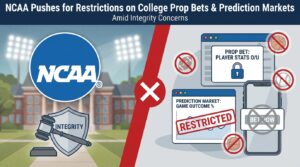
Senior NCAA officials used a recent panel discussion to advocate for tighter restrictions on proposition bets tied to college athletics and the growing influence of prediction markets on amateur sports. The call comes at a moment when state-by-state sports betting regulation remains fragmented and the line between wagering and fan engagement products continues to blur. With athlete safety and competitive integrity framed as the central concerns, the governing body’s stance signals a sharpening regulatory posture that could reshape how sportsbooks and emerging platforms interact with college sports.
Why the NCAA Is Drawing a Harder Line on Prop Bets
The panel discussion brought together NCAA leadership and compliance officials who argued that individual player prop bets present unique risks in the college environment. Unlike professional leagues, college athletes are unpaid (or, more precisely, compensated through NIL deals and scholarships rather than salaries), younger, and arguably more vulnerable to outside pressure. That vulnerability, officials contended, makes proposition wagers on individual statistical performances a direct threat to both the athletes and the games themselves.
Prop bets on college sports have expanded rapidly since the Supreme Court’s 2018 decision in Murphy v. NCAA opened the door to legalized sports wagering. But the NCAA has consistently maintained that certain bet types carry outsized integrity risks. A wager on whether a quarterback throws for over 250 yards, for instance, creates incentives that differ meaningfully from a simple moneyline bet on the game’s outcome.
And while several states have already restricted or banned college player props, the patchwork of regulations leaves significant gaps.
Strategic Implications for Stakeholders in College Sports Betting
The NCAA’s public advocacy carries weight beyond the panel room. Here’s what matters for the industry and its adjacent players:
- Sportsbook operators offering college player props in permissive states may face mounting pressure from both regulators and institutional partners to voluntarily restrict these markets or risk losing data-sharing agreements with conferences and schools.
- Prediction markets, which have surged in popularity following platforms like Kalshi gaining CFTC approval for event contracts, now sit in the NCAA’s crosshairs as a parallel integrity concern.
- State legislatures considering sports betting expansion or amendment bills will likely encounter more organized lobbying from the NCAA and its member institutions pushing for prop bet carve-outs.
- The distinction between a “prediction market” and a “sportsbook” remains legally and practically murky (a distinction regulators have been slow to enforce), which complicates any blanket restriction effort.
- NIL dynamics add another layer: athletes with personal brands and endorsement deals tied to performance metrics exist in an environment where prop bet markets can directly influence public perception of their value.
Prediction Markets: A Different Beast Entirely?
The NCAA’s decision to lump prediction markets alongside traditional prop bets deserves scrutiny. Prediction markets operate under a different regulatory framework, overseen in the United States primarily by the Commodity Futures Trading Commission rather than state gaming commissions. Platforms facilitating event-based contracts on outcomes like tournament results or conference championships argue their products serve a price-discovery function closer to financial instruments than gambling.
Still, the practical effect on college athletics may look similar. When real money rides on specific outcomes involving 19- and 20-year-old athletes, the integrity risk doesn’t vanish because the regulatory label changes. The NCAA’s sports wagering policies have historically focused on education and monitoring, but the tone from this panel suggested enforcement and legislative advocacy are becoming higher priorities.
Whether prediction market operators will be drawn into the same restrictive frameworks as sportsbooks remains an open question, one that neither the CFTC nor state regulators have fully addressed.
How Behavioral Framing Shapes the Debate
Beyond the regulatory mechanics, the NCAA’s messaging reflects a deliberate framing strategy rooted in how people process risk and responsibility. By centering the conversation on athlete welfare rather than institutional control, officials tap into a powerful cognitive anchor: the image of a young, unpaid competitor whose performance becomes a commodity for outside speculators. This framing doesn’t just appeal to legislators. It reshapes how the broader public evaluates the legitimacy of college sports betting itself.
Neurolinguistic research on persuasion suggests that arguments anchored in concrete human impact outperform abstract policy rationales. The NCAA appears to understand this. Rather than leading with market data or regulatory theory, officials repeatedly returned to specific scenarios involving student-athletes facing harassment, threats, or manipulation tied to betting outcomes. That rhetorical choice is strategic. It positions any opposition as implicitly tolerant of harm to young people, a frame that’s difficult to argue against in legislative hearings or public forums.
The language also creates what behavioral economists call a “default effect.” By establishing restriction as the protective norm, the burden shifts to sportsbooks and prediction platforms to justify why these markets should remain open, rather than requiring the NCAA to prove they should close. In practice, this reframing has already influenced legislative outcomes in states like New York, which banned college player props before its mobile sports betting market even launched.
This approach carries risks of its own. Overly broad restrictions can push betting activity to unregulated offshore markets where no integrity monitoring exists at all. The NCAA has acknowledged this tension without fully resolving it.
What Comes Next for Operators and Regulators
Several state legislative sessions in 2025 include bills that would either introduce or tighten restrictions on college prop bets. The NCAA’s panel comments are likely a precursor to more formal lobbying efforts targeting these bills. Operators with significant college sports handle, particularly during March Madness and the College Football Playoff, should anticipate a shifting landscape.
The broader question is whether a federal framework will eventually supersede the current state-by-state approach. Congressional interest in sports betting regulation has surfaced periodically but never gained sustained momentum. The NCAA’s escalating public advocacy could change that calculus, particularly if a high-profile integrity incident involving a college athlete and prop betting surfaces.
Frequently Asked Questions
What are college player prop bets?
These are wagers placed on individual athlete performances within a game, such as total points scored, passing yards, or rebounds, rather than on the overall outcome of the contest. They’re considered higher-risk from an integrity standpoint because a single player can more easily influence a specific statistical line than an entire game result.
How many states currently restrict college prop bets?
The number fluctuates as legislatures act, but roughly a dozen states with legal sports betting have implemented some form of restriction or outright ban on college player prop markets. New Jersey, New York, and Illinois are among the most notable.
Are prediction markets the same as sports betting?
Not legally. Prediction markets are regulated as event contracts under federal commodity law, while sports betting falls under state gaming commissions. But the functional overlap, real money wagered on real outcomes, is precisely what concerns the NCAA.
Could the NCAA enforce a nationwide ban on its own?
No. The NCAA lacks direct regulatory authority over betting markets. Its leverage comes through lobbying, public advocacy, and its relationships with conferences, broadcasters, and data providers who can impose contractual restrictions on how their content interacts with wagering platforms.



