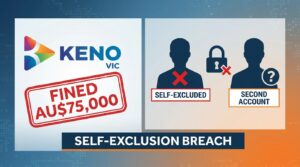
Victoria’s gambling regulator has imposed a AU$75,000 fine on Keno Vic for failing to prevent a self-excluded player from gambling through a second account. The penalty underscores persistent weaknesses in identity verification and self-exclusion enforcement across Australian gaming operators. It also arrives at a moment when regulators across the country are tightening their grip on responsible gambling compliance, making the case both a warning and a benchmark.
What the AU$75,000 Penalty Signals for the Industry
The fine, while modest in absolute dollar terms, carries implications that extend well beyond Keno Vic’s balance sheet. Self-exclusion programs exist as a frontline consumer protection mechanism, and when they fail, regulators increasingly treat the lapse as a systemic issue rather than an isolated error. Here are the core takeaways from this enforcement action:
- Identity verification gaps remain a live risk. The player was able to register a second account despite already being on the self-exclusion register, pointing to deficiencies in how Keno Vic cross-references new account applications against existing exclusion records.
- Regulators are willing to act on individual cases. A single player breach was enough to trigger formal enforcement, suggesting that Victorian authorities view each failure as indicative of broader process shortcomings.
- The penalty amount, AU$75,000, sits at a level designed to prompt operational review without being existential. That calibration matters: it signals proportionality, but also a willingness to escalate if repeat violations surface.
- Precedent for future actions. Other operators in Victoria and neighbouring jurisdictions should treat this as a template for how regulators will respond to similar breaches going forward.
How the Breach Occurred
At its core, the violation was straightforward. A player who had voluntarily self-excluded from Keno Vic’s gaming platform subsequently opened a new account and continued to gamble. The operator’s systems failed to flag the duplication. Whether the failure was technological, procedural, or both has not been publicly detailed by the regulator, but the outcome speaks for itself: a person who had sought protection from their own gambling behaviour was allowed to continue wagering without interruption.
Self-exclusion registers are only as effective as the verification infrastructure behind them. And in this case, that infrastructure did not hold.
Regulatory Context Across Australia
Victoria is not operating in isolation. Across Australian states and territories, gambling regulators have been sharpening enforcement tools and expanding the scope of responsible gambling obligations. New South Wales, for instance, has moved toward cashless gaming trials and enhanced patron identification requirements. Queensland has similarly increased scrutiny of operator compliance with harm minimisation standards.
What makes the Keno Vic case notable is not its complexity but its simplicity. This was not a sophisticated circumvention scheme. A player opened a second account. The system did not catch it. That kind of failure, arguably the most basic test of a self-exclusion program, draws regulatory attention precisely because it suggests the controls in place are either poorly designed or poorly maintained. Neither explanation is reassuring for an operator.
Operational Lessons: Building Stronger Exclusion Systems
For operators watching this case, the practical question is clear: would your systems catch the same breach? The answer requires honest assessment across several dimensions.
| Control Area | Minimum Standard | Best Practice |
|---|---|---|
| Identity Matching | Name and date of birth cross-check | Multi-factor matching including document verification, biometric data, and address history |
| Account Registration | Manual review of flagged accounts | Automated real-time screening against exclusion databases at point of registration |
| Ongoing Monitoring | Periodic audits of active accounts | Continuous algorithmic monitoring for behavioural and identity anomalies |
| Staff Training | Annual compliance refresher | Scenario-based training with documented competency assessment quarterly |
Operators relying solely on minimum standards are, at least on paper, compliant. But compliance and effectiveness are not the same thing, and this case illustrates the gap between the two with uncomfortable clarity.
The Psychology Behind Self-Exclusion and Why Enforcement Matters
Self-exclusion is, at its foundation, a behavioural intervention. A person recognises harmful patterns in their own conduct and takes a deliberate step to interrupt those patterns. That decision often comes at a moment of acute awareness, sometimes after significant financial or personal harm. The psychological weight of that choice cannot be understated.
When an operator’s systems fail to honour that decision, the consequences extend beyond regulatory non-compliance. The individual is re-exposed to the very environment they sought to leave. Cognitive biases, particularly the gambler’s fallacy and loss-chasing behaviour, can reassert themselves rapidly once the person re-engages with gambling products. Research in behavioural psychology consistently shows that environmental cues play a dominant role in triggering relapse behaviours, which is precisely why exclusion programs must function as reliable barriers rather than symbolic gestures.
Framing this through a neuro-linguistic programming lens adds another dimension. NLP principles suggest that the act of self-exclusion represents a significant identity-level shift: the person is redefining their relationship with gambling. They are moving from “I am someone who gambles” to “I am someone who has chosen not to gamble.” Systems that allow re-entry without friction effectively undermine that reframing process, pulling the individual back into a behavioural loop they had consciously decided to break. Operators who understand this dynamic are better positioned to design exclusion systems that respect and reinforce the psychological commitment the player has made. The technology should serve the intent, not erode it.
Frequently Asked Questions
What is self-exclusion in gambling?
Self-exclusion is a voluntary program that allows individuals to ban themselves from gambling venues or platforms for a set period. It functions as a harm minimisation tool, placing the obligation on operators to enforce the exclusion once registered.
Why was Keno Vic fined?
The operator was fined AU$75,000 because a self-excluded player was able to open a second account and continue gambling. The regulator determined that Keno Vic’s systems failed to detect and prevent this breach, which constitutes a violation of responsible gambling obligations.
Can operators face larger penalties for similar breaches?
Yes. Penalty amounts depend on the severity, frequency, and context of the breach. Repeat violations or failures involving multiple players could attract substantially higher fines, licence conditions, or even licence suspension. The AU$75,000 figure here reflects the circumstances of a single-player breach, but regulators have made clear that escalation remains on the table.
How should operators improve their self-exclusion systems?
Invest in automated identity matching at registration, implement continuous monitoring of active accounts, and conduct regular stress-testing of exclusion databases. Staff training should go beyond annual tick-box exercises.



