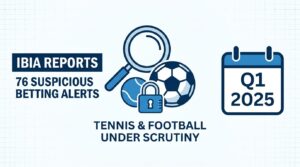
The International Betting Integrity Association recorded 76 suspicious betting alerts across nine sports during the first quarter of 2025, marking a slight decline from the 80 alerts flagged in Q4 2024. Tennis accounted for the largest share with 26 alerts, followed closely by football at 22. The figures underscore persistent integrity risks in global sports betting markets, even as monitoring frameworks grow more sophisticated and cross-border cooperation between regulators and operators deepens.
What Q1 2025’s Alert Data Reveals for the Betting Industry
While the raw number of alerts dipped modestly quarter-over-quarter, the distribution across sports and geographies tells a more layered story. Here are the strategic takeaways from IBIA’s latest integrity report:
- Tennis remains the most flagged sport globally, with 26 alerts representing over a third of the total. Lower-tier tournaments, where prize money is slim and oversight thinner, continue to drive the bulk of suspicious activity.
- Football’s 22 alerts span multiple confederations and competition levels, reinforcing that match-fixing risks are not confined to any single league or region
- Nine different sports triggered alerts, suggesting that integrity threats are broadening beyond the traditionally scrutinised disciplines into esports, table tennis, and basketball.
- The quarter-on-quarter decline from 80 to 76 alerts is marginal and should not be read as a trend reversal without longer-term data
- IBIA’s monitoring now covers betting activity from over 50 licensed operators worldwide, giving the dataset a breadth that few other integrity bodies can match
Tennis: A Familiar Problem That Refuses to Shrink
For years, tennis has topped IBIA’s alert tables. Q1 2025 was no different. The sport’s vulnerability stems from a structural reality: thousands of professional matches are played annually at ITF Futures and Challenger-level events, often in front of sparse crowds and with limited broadcast coverage. Players at these levels earn modest incomes, which arguably makes the financial incentive for corruption harder to dismiss. And while governing bodies have invested in education and sanctioning programmes, the sheer volume of competition creates gaps that integrity monitors struggle to close entirely.
What sets this quarter apart, at least on paper, is the geographic spread of tennis alerts. IBIA noted suspicious activity across events in Europe, South America, and parts of Asia, a pattern that complicates enforcement because no single regulatory authority holds jurisdiction over all flagged matches.
Football’s Integrity Landscape Grows More Complex
Football’s 22 alerts in Q1 2025 reflect a sport where the sheer scale of global competition creates fertile ground for manipulation. From lower divisions in Eastern Europe to friendlies and qualification matches in Africa and Asia, the alerts span a wide competitive spectrum. UEFA and FIFA have both expanded their monitoring partnerships in recent years, yet the decentralised nature of football governance means that enforcement varies dramatically from one confederation to another (a distinction regulators have been slow to harmonise).
Still, the data carries a nuance worth noting. Not every alert results in a confirmed case of match-fixing. IBIA has consistently emphasised that an alert signals irregular betting patterns warranting investigation, not proof of corruption. The conversion rate from alert to sanction remains relatively low, which raises a harder question: is the gap between detection and prosecution a sign of false positives, or of investigative bottlenecks?
Beyond the Big Two: Emerging Risk Sports
The remaining 28 alerts were distributed across seven other sports. Esports, table tennis, and basketball each contributed meaningfully to the total. Esports in particular has drawn increasing attention from integrity bodies, as rapid market growth has outpaced the development of robust anti-corruption frameworks in several jurisdictions. IBIA’s integrity monitoring platform now tracks betting patterns across a wider range of competitions than at any point in its history, reflecting both the expansion of regulated betting markets and the proliferation of events available for wagering.
Table tennis alerts, once considered an anomaly driven by pandemic-era betting on obscure leagues, have persisted. That persistence suggests the sport’s integrity challenges are structural rather than circumstantial.
How Operators and Regulators Are Responding
The betting industry’s response to integrity threats has evolved considerably over the past five years. Operators contributing data to IBIA’s alert system now represent a significant share of global regulated turnover, which strengthens the statistical reliability of flagged patterns. But detection alone does not solve the problem.
Regulators in markets such as the UK, France, and Australia have established formal information-sharing protocols with sports governing bodies. In the United States, where legalised sports betting continues to expand state by state, integrity agreements between operators and leagues are becoming standard. Yet enforcement capacity varies. Some jurisdictions lack the legal tools to prosecute match-fixing as a criminal offence, leaving sports bodies to pursue disciplinary sanctions that carry limited deterrent weight.
| Sport | Q1 2025 Alerts | Share of Total |
|---|---|---|
| Tennis | 26 | 34.2% |
| Football | 22 | 28.9% |
| Other Sports (7 combined) | 28 | 36.9% |
| Total | 76 | 100% |
The Psychology Behind Betting Integrity: Why Detection Is Only Half the Battle
Understanding suspicious betting patterns requires more than data science. It demands an appreciation of human behaviour and decision-making under pressure. Athletes competing at lower professional tiers often face financial stress, limited career longevity, and environments where corrupt approaches may be normalised within peer groups. These psychological factors create vulnerability that no monitoring algorithm can fully capture.
From a behavioural standpoint, the framing of integrity education matters enormously. Programmes that focus solely on punishment tend to be less effective than those that help athletes reframe their identity around long-term career value and personal agency. When players internalise the belief that their professional reputation carries compounding worth over time, the short-term financial lure of match-fixing loses some of its pull. Cognitive reframing techniques, drawn from established behavioural science, have shown promise in pilot programmes run by several tennis and football governing bodies. The challenge lies in scaling these interventions across thousands of athletes in dozens of countries, each operating within different cultural and economic contexts. Anchoring integrity messaging in concrete, relatable scenarios rather than abstract ethical principles tends to produce stronger recall and behavioural change among at-risk populations.
Frequently Asked Questions
What does a suspicious betting alert actually mean?
A suspicious betting alert indicates that unusual or irregular wagering patterns have been detected on a specific event. It triggers an investigation but does not, on its own, constitute evidence of match-fixing or corruption.
Why does tennis consistently generate the most alerts?
The sport’s structure plays a significant role. Thousands of lower-tier professional events take place each year with limited oversight, modest prize money, and players who may be financially vulnerable. That combination creates conditions where manipulation attempts are more likely to surface in betting markets.
How many IBIA alerts lead to confirmed match-fixing cases?
IBIA does not publicly disclose a precise conversion rate. The organisation has acknowledged that only a portion of alerts result in formal disciplinary or criminal proceedings, reflecting both the complexity of investigations and jurisdictional limitations.
Is the number of alerts increasing over time?
The trend has fluctuated. Q1 2025’s 76 alerts represent a slight decrease from Q4 2024’s 80, but year-over-year comparisons show that alert volumes have remained within a relatively stable band as IBIA’s monitoring coverage has expanded.



