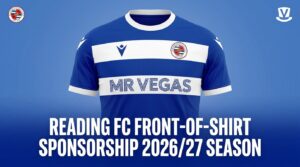
Online casino brand Mr Vegas has struck a deal to become the front-of-shirt sponsor for Reading FC ahead of the 2026/27 campaign. The agreement places the UK-facing gambling operator prominently on the Championship-aspiring club’s matchday kits, marking another entry point for iGaming brands into English football’s commercial ecosystem. While financial terms of the sponsorship have not been disclosed, the partnership underscores a persistent appetite among gambling companies for visibility in lower-league English football, even as regulatory scrutiny over such deals intensifies.
What the Mr Vegas–Reading FC Deal Signals for Gambling Sponsorships
Shirt sponsorships between gambling brands and football clubs remain one of the most contested areas in UK sports marketing. Before unpacking the broader implications, here are the key strategic takeaways from this announcement:
- Mr Vegas gains direct brand exposure across Reading FC’s matchday, training, and broadcast presence for the full 2026/27 season
- The deal arrives amid ongoing UK government deliberations around restricting gambling logos on football shirts, a measure that has been proposed but not yet legislated
- Reading FC, navigating financial restructuring in recent seasons, secures a commercial partner at a time when sponsorship revenue carries outsized importance for clubs outside the Premier League
- For Mr Vegas, the sponsorship represents a calculated bet on brand-building within a regulatory window that could narrow significantly in the coming years
Why Lower-League Clubs Still Attract Gambling Sponsors
Premier League clubs have been gradually distancing themselves from gambling shirt deals. A voluntary agreement among top-flight sides to phase out front-of-shirt gambling sponsorship took effect ahead of the 2025/26 season. But that shift has not cascaded uniformly through the Football League.
Clubs in the Championship and below operate under tighter financial constraints. Sponsorship income from gambling firms often fills gaps that other commercial categories simply cannot match at this level. Reading FC, which has faced well-documented ownership turbulence and financial difficulties, fits this pattern precisely.
The result: a market where gambling brands priced out of (or voluntarily excluded from) the Premier League redirect their budgets toward EFL clubs hungry for revenue. And while the optics may draw criticism from anti-gambling campaigners, the commercial logic on both sides is difficult to dismiss.
Mr Vegas: Positioning in a Crowded UK Market
Operated under a UK Gambling Commission licence, Mr Vegas offers slots, live casino, and table games to players in the British market. The brand competes in a saturated online casino segment where differentiation increasingly depends on visibility rather than product alone.
Football sponsorships offer something digital marketing channels struggle to replicate: sustained, emotionally anchored brand recall. A logo on a shirt is seen during live broadcasts, social media highlights, stadium signage, and fan-generated content. For a brand like Mr Vegas, which lacks the legacy recognition of operators such as bet365 or William Hill, this kind of exposure carries disproportionate value.
Whether the investment delivers measurable ROI depends on factors the sponsorship itself cannot control (a distinction that applies to most football marketing deals, yet rarely gets acknowledged in announcement-day coverage).
Regulatory Crosswinds and the Timing Question
The UK’s Gambling Act review, initiated in 2020 and still producing policy outcomes, has repeatedly flagged shirt sponsorships as a potential area for restriction. A white paper published in 2023 stopped short of an outright ban but signalled that the government expected the industry to self-regulate more aggressively.
At least on paper, the Premier League’s voluntary withdrawal from gambling shirt deals was a response to that pressure. Yet no equivalent commitment exists across the EFL. This creates a two-tier system where gambling brands remain visible on matchday kits in leagues that arguably reach younger and more financially vulnerable audiences through local community ties.
Still, legislation could change the landscape rapidly. If the UK government moves to codify a ban on gambling shirt sponsorships across all professional football tiers, deals like the Mr Vegas–Reading FC partnership would have a limited shelf life. The timing of this agreement suggests both parties are operating with that possibility in mind, securing value while the regulatory window remains open.
How Do Gambling Sponsorship Deals Typically Work in English Football?
Most front-of-shirt sponsorships involve a fixed annual fee paid to the club, sometimes supplemented by performance bonuses tied to promotion or cup runs. The gambling operator receives logo placement on home and away kits, stadium branding, digital rights, and often hospitality access. Contract lengths vary, though one-season deals have become more common as regulatory uncertainty makes multi-year commitments riskier for both sides.
Could This Deal Be Affected by Future Legislation?
Yes. Any statutory ban on gambling logos in football would override existing commercial agreements, though transitional provisions might allow current contracts to run their course. The government has not confirmed a timeline for such measures.
What Does Reading FC Gain Beyond Revenue?
Beyond the direct financial injection, a visible shirt sponsor signals commercial viability to other potential partners and investors. For a club rebuilding its off-pitch infrastructure, that signal matters almost as much as the money itself.
The Broader Pattern: Gambling and Football’s Uneasy Coexistence
English football’s relationship with gambling money has never been straightforward. Sponsorship revenue funds squad investment, academy development, and operational costs. But the social costs of problem gambling, particularly in communities where football clubs serve as civic anchors, complicate the equation in ways that balance sheets do not capture.
What makes the Mr Vegas–Reading FC deal worth watching is not the deal itself, which is structurally unremarkable. It is what it represents: a snapshot of an industry and a sport still negotiating terms of engagement under a regulatory framework that has not yet decided what it wants to be. The next twelve months of policy development will determine whether agreements like this one become relics of a closing era or templates for a model that persists well beyond 2027.



