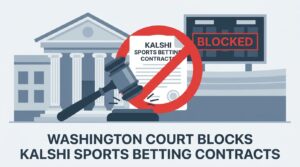
A Washington state court has granted a preliminary injunction against Kalshi, the federally regulated prediction market platform, finding that its sports-related event contracts likely constitute unlicensed gambling under state law. The ruling marks a significant legal setback for the company and raises fresh questions about where prediction markets end and sports betting begins. Washington’s attorney general brought the action, arguing that Kalshi’s offerings to state residents violated gambling statutes despite the platform’s federal oversight by the Commodity Futures Trading Commission (CFTC).
What the Washington Ruling Means for Prediction Markets
Before diving into the specifics, it helps to understand what’s actually at stake. This isn’t a narrow procedural matter. The court’s decision sits at the intersection of federal commodities regulation, state gambling enforcement, and a rapidly expanding market for event-based contracts that has drawn millions in retail participation since 2024.
- The court found that Kalshi’s sports-related contracts bear enough resemblance to sports wagering to trigger Washington’s gambling prohibitions
- Federal CFTC registration does not automatically shield platforms from state-level gambling enforcement, at least on paper
- Kalshi must now block Washington residents from accessing certain contract categories, potentially setting a template for other states considering similar actions
- The ruling could chill expansion plans across the prediction market sector, particularly for contracts tied to sporting outcomes
- Other states with strict gambling frameworks may view this as a green light to pursue their own enforcement actions
The Legal Fault Line: Commodities or Gambling?
At the heart of this dispute is a classification problem that regulators have struggled with for years. Kalshi has consistently maintained that its contracts are CFTC-regulated derivatives, not wagers. The company operates as a designated contract market (DCM), a status that subjects it to federal oversight and compliance requirements typically associated with futures exchanges.
But Washington’s attorney general argued that the substance of certain contracts, particularly those pegged to the outcomes of professional sporting events, functions identically to a sports bet. The court agreed, or at least found the argument persuasive enough to warrant injunctive relief at this preliminary stage.
That distinction matters enormously. If a CFTC-regulated contract can simultaneously be classified as an illegal wager under state law, then the entire prediction market model faces a patchwork of jurisdictional risk that no amount of federal licensing can resolve. And while Kalshi has operated under the assumption that federal preemption protects its offerings, this court was unconvinced (a position not every legal scholar shares, it should be said).
How Kalshi Got Here
Kalshi launched in 2021 as the first CFTC-regulated exchange for event contracts, initially offering markets on topics like economic indicators, weather events, and policy outcomes. The platform expanded aggressively into sports-adjacent contracts following a high-profile legal victory against the CFTC itself in 2024, when a federal court ruled that the agency had improperly blocked Kalshi from listing congressional election contracts.
That win emboldened the company. It began listing contracts tied to NFL games, NBA outcomes, and other major sporting events, drawing significant retail trading volume. The Kalshi event contracts platform quickly became a flashpoint in the broader debate over whether prediction markets represent legitimate financial instruments or repackaged gambling products.
Washington state moved swiftly. The attorney general’s office filed suit, seeking to block the platform from offering sports-linked contracts to state residents. The preliminary injunction now in place suggests the court sees a reasonable likelihood that the state will prevail on the merits.
Regulatory Ripple Effects Across States
What happens in Washington rarely stays in Washington when it comes to gambling enforcement.
Several states maintain strict prohibitions on sports betting, and many have not carved out explicit exemptions for CFTC-regulated event contracts. The Washington ruling gives enforcement agencies in those jurisdictions a judicial roadmap. States like Utah, which prohibits all forms of gambling, or Hawaii, which has similarly restrictive statutes, could pursue analogous actions without needing to break new legal ground.
The broader industry impact extends beyond Kalshi. Platforms like Polymarket, which operates offshore and does not hold CFTC registration, face even greater exposure to state-level enforcement. Arguably, Kalshi’s federal licensing should offer stronger legal protection than what unregulated competitors enjoy. Yet this ruling suggests that protection has limits.
| Factor | Kalshi’s Position | Washington State’s Position |
|---|---|---|
| Regulatory status | CFTC-registered designated contract market | Federal registration does not preempt state gambling law |
| Nature of contracts | Financial derivatives on event outcomes | Functionally identical to sports wagers |
| Legal precedent cited | 2024 federal court victory over CFTC on election contracts | State gambling statutes and consumer protection mandates |
| Consumer access | Open to all U.S. residents in eligible states | Must be restricted where state law prohibits such activity |
The Preemption Question Nobody Has Fully Answered
Federal preemption, the legal doctrine that federal law overrides conflicting state law, is the elephant in this courtroom. Kalshi’s strongest long-term argument rests on the idea that the Commodity Exchange Act (CEA) occupies the regulatory field for derivatives, leaving no room for states to reclassify CFTC-approved products as gambling.
Still, courts have historically allowed states considerable latitude in regulating gambling within their borders. The Professional and Amateur Sports Protection Act (PASPA) was struck down by the Supreme Court in 2018 precisely because it improperly commandeered state regulatory authority. The irony here is thick: the same federalism principles that opened the door to legal sports betting in dozens of states may now be used to shut the door on prediction markets in others.
Less clear is whether Kalshi will seek an emergency appeal or pursue a federal preemption challenge in a different venue. The company has not publicly detailed its next legal steps, though its track record suggests it won’t accept this ruling quietly.
What Market Participants Should Watch
For traders, platform operators, and institutional investors in the event contract space, several developments deserve close attention in the coming months:
- State attorney general activity: Any coordinated enforcement actions modeled on Washington’s approach would signal a broader crackdown
- CFTC response: Whether the federal regulator intervenes to assert preemption or remains on the sidelines will shape the legal landscape significantly
- Congressional interest in codifying the legal status of event contracts, which has been discussed but not acted upon
- Kalshi’s compliance adjustments: How the platform modifies its state-by-state access controls could become an industry template
Frequently Asked Questions
Does this ruling make Kalshi illegal nationwide?
No. The preliminary injunction applies specifically to Washington state and its residents. Kalshi continues to operate in other jurisdictions where it maintains regulatory approval, though the ruling could encourage similar actions elsewhere.
Can the CFTC override state gambling laws?
That question remains unresolved. The federal preemption argument has not been fully litigated in this context, and courts have historically given states broad authority over gambling regulation within their borders.
How does this affect other prediction market platforms?
Platforms without CFTC registration, such as offshore operators, face arguably greater legal risk. If a federally licensed exchange can be blocked by state gambling law, unregulated competitors have even less legal cover to rely on.
What types of Kalshi contracts are affected?
The injunction targets contracts linked to sporting event outcomes. Contracts tied to economic data, weather, or policy decisions were not specifically addressed in the ruling, though the legal reasoning could theoretically extend to other categories depending on how broadly a state defines gambling.



