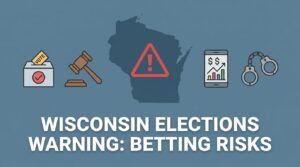
The Wisconsin Elections Commission (WEC) has drawn a sharp line between civic participation and financial speculation, issuing formal guidance that voters who wager on election outcomes risk losing their right to vote and facing criminal prosecution. The warning, approved through a unanimous bipartisan vote, targets a growing class of participants: individuals trading on commercial prediction markets tied to electoral results. State law, the commission emphasized, prohibits anyone with a direct or indirect financial interest in an election from casting a ballot in that contest. It’s a statute that has been on the books for years but is now colliding with a rapidly expanding industry.
What Wisconsin’s Guidance Means for Prediction Market Users
Before unpacking the broader implications, here are the core strategic takeaways from the WEC’s decision:
- Ballot disqualification risk: Voters who hold positions on prediction market platforms tied to specific election outcomes could have their ballots challenged and invalidated under existing Wisconsin statutes
- Felony prosecution pathway: The commission confirmed that violations may be referred for felony prosecution, raising the personal legal stakes for casual and institutional bettors alike
- The guidance applies not only to direct wagers but also to indirect financial interests, which arguably sweeps in a broader range of market instruments than many participants realize
- Bipartisan unanimity: The vote was not split along party lines, signaling that this is being treated as a matter of election integrity rather than partisan positioning
- State-level enforcement creates a patchwork of legal exposure for prediction market users who may trade across multiple jurisdictions
A Statute Meets a New Market
Wisconsin’s prohibition on voting while holding a financial interest in an election is not new legislation. But its application to prediction markets represents a significant interpretive step. Platforms that allow users to buy and sell contracts pegged to electoral outcomes have surged in popularity, particularly after federal courts cleared certain operators to offer event-based contracts to U.S. residents.
The WEC’s guidance effectively treats a prediction market position the same way it would treat a traditional bribe or wager. That equivalence matters. It means a retail trader holding a $50 contract on a gubernatorial race could, at least on paper, face the same legal jeopardy as someone caught in a vote-buying scheme.
Whether prosecutors would actually pursue such cases remains an open question.
How Prediction Markets Have Grown
Prediction markets have moved from niche academic tools to mainstream financial products in a remarkably short span. Platforms like Polymarket’s event-based trading platform have attracted millions in trading volume around U.S. elections, with contracts covering everything from presidential races to ballot initiatives. The Commodity Futures Trading Commission (CFTC) has grappled with how to regulate these instruments, and the legal landscape remains fragmented across states.
Wisconsin’s move is notable precisely because it doesn’t attempt to regulate the platforms themselves. Instead, it targets the voter. That’s a different enforcement vector, and one that could prove more immediately consequential for individual participants than any federal regulatory action.
The Legal Mechanics: What Triggers Disqualification
Under Wisconsin law, an elector may be challenged at the polls if there is reason to believe they hold a financial interest in the election’s outcome. The WEC’s guidance clarifies that prediction market positions qualify as such an interest. Here’s how the enforcement chain works in practice:
| Stage | Action | Potential Consequence |
|---|---|---|
| Pre-vote challenge | Poll worker or observer challenges voter eligibility | Voter must affirm eligibility under oath or withdraw |
| Post-vote review | Election officials identify financial interest after ballot is cast | Ballot may be invalidated; case referred to district attorney |
| Criminal referral | District attorney evaluates evidence of knowing violation | Felony charges under election fraud statutes, carrying potential prison time and permanent loss of voting rights |
Still, practical enforcement raises thorny questions. Prediction market accounts are often pseudonymous or held through intermediaries. Proving that a specific voter held a specific position at the time of voting would require subpoena power and cooperation from platform operators (a distinction regulators have been slow to enforce in other contexts).
Why Other States Are Watching
Wisconsin is not operating in a vacuum. Several states have begun examining how existing election integrity statutes interact with the rise of event-based wagering. And while no other state has yet issued comparable formal guidance, the WEC’s bipartisan approach gives it a template quality that election law scholars have already flagged.
The tension here runs deeper than a single state’s enforcement posture. Prediction markets are increasingly cited by media outlets and political analysts as indicators of electoral sentiment. If participation in those markets can disqualify voters, the pool of people generating those signals shrinks in ways that could distort the very data the markets are supposed to produce.
That feedback loop deserves more scrutiny than it has received.
Frequently Asked Questions
Does this apply to all prediction market platforms?
The WEC’s guidance does not name specific platforms. It applies broadly to any financial position, direct or indirect, tied to an election outcome in which the individual votes. Whether you’re using a regulated exchange or an offshore platform, the statute’s reach is the same under Wisconsin law.
Can I close my position before Election Day and still vote?
The commission’s guidance focuses on holding a financial interest at the time of voting. Closing a position before casting a ballot would, in theory, remove the conflict. But the timing and documentation of that closure could become contested facts in any challenge proceeding, so the safe harbor is narrower than it might appear.
Is this enforceable in practice?
Enforcement would likely depend on tips, complaints, or post-election audits that surface evidence of a voter’s market activity. Mass enforcement seems unlikely. Targeted cases, particularly involving high-profile races or large positions, are more plausible.
Could this be challenged in court?
Arguably, yes. First Amendment and due process challenges could test whether applying a decades-old statute to modern prediction markets survives judicial scrutiny. No such challenge has been filed yet in Wisconsin, but the legal ground is far from settled.
Broader Implications for Election Integrity and Market Design
What the WEC has done, perhaps unintentionally, is surface a fundamental tension in how democracies interact with financial markets built around democratic outcomes. The principle that voters should not have a financial stake in the elections they participate in is straightforward enough. But prediction markets blur the boundary between speculation and information aggregation in ways that existing law was never designed to address.
For platform operators, the Wisconsin guidance introduces a new category of user risk. Compliance teams will need to consider whether geolocation data, KYC records, or voter registration databases create obligations to warn users about state-specific disqualification rules. And for the growing number of retail traders who view election contracts as just another asset class, the message from Madison is blunt: in Wisconsin, your trade might cost you your vote.
Whether that trade-off reshapes user behavior or simply pushes activity into less transparent channels is something regulators across the country will be watching closely in the months ahead.



