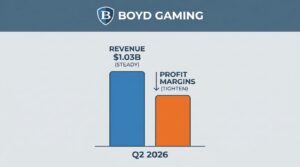
Boyd Gaming Corporation reported second-quarter 2026 revenue of approximately $1.034 billion, a figure that landed remarkably close to the year-ago period. But beneath that topline stability, profitability told a different story. Lower margins and rising operational costs compressed earnings, raising questions about whether the regional casino operator can sustain its growth trajectory in an increasingly competitive landscape.
What Boyd’s Q2 Numbers Signal for Regional Casino Operators
The quarter’s results sit at an interesting inflection point for the broader regional gaming sector. Revenue resilience, paired with profit erosion, suggests consumer demand hasn’t collapsed — yet cost pressures are outpacing operators’ ability to extract value from that demand. Here’s what stands out:
- Revenue held flat year-over-year at ~$1.034 billion, indicating sustained visitation and spend patterns across Boyd’s portfolio of 28 properties
- Profit margins contracted, pointing to wage inflation, energy costs, and promotional spending as likely culprits
- The results underscore a widening gap between topline performance and bottom-line health across mid-market gaming
- Boyd’s geographic diversification — spanning Nevada, the Midwest, and the South — may be masking weaker performance in specific markets
- Investors will be watching whether management adjusts its capital allocation strategy in response to margin compression
Revenue Stability Masks Deeper Operational Pressures
Flat revenue in a sector still absorbing post-pandemic normalization is, at least on paper, a reasonable outcome. Boyd Gaming’s portfolio of regional casinos has historically benefited from loyal, repeat customers who are less sensitive to macroeconomic swings than Las Vegas Strip visitors. That dynamic appears to have held through Q2.
Still, the profit decline deserves closer scrutiny. Regional operators face a particular squeeze right now: labor markets in secondary cities remain tight, utility costs have climbed, and promotional intensity — free play, dining credits, loyalty incentives — has escalated as competitors fight for the same customer base. When revenue stays flat but these costs rise, the arithmetic is unforgiving.
One question the earnings don’t fully answer: how much of Boyd’s promotional spending is defensive versus offensive? If the company is spending more just to maintain market share rather than capture new customers, the margin compression could prove structural rather than cyclical.
How Does Boyd Compare Across the Regional Gaming Landscape?
| Metric | Boyd Gaming Q2 2026 | Industry Context |
|---|---|---|
| Revenue | ~$1.034 billion | Broadly flat across major regional operators |
| Profit Trend | Declining | Mixed; some peers reporting margin stability through cost discipline |
| Property Count | 28 gaming properties | Among the largest regional footprints in the U.S. |
| Key Markets | Nevada, Louisiana, Mississippi, Indiana, others | Southern and Midwestern markets showing varied consumer resilience |
| Strategic Focus | Loyalty programs, operational efficiency | Industry-wide shift toward digital engagement and data-driven marketing is accelerating |
The Margin Question Regional Gaming Can’t Avoid
Boyd’s situation isn’t unique. Across the U.S. regional gaming sector, operators are grappling with a paradox: consumers keep showing up, but the cost of serving them keeps climbing. Wage increases negotiated during the post-COVID labor crunch haven’t reversed. Energy costs, particularly in southern markets where Boyd has significant exposure, remain elevated. And the competitive toolkit — loyalty programs, promotional credits, entertainment programming — all carry real expense.
What makes Boyd’s position arguably more exposed than some peers is the sheer breadth of its footprint. Operating 28 properties across multiple states means navigating 28 different cost structures, regulatory environments, and competitive dynamics simultaneously. Scale brings advantages in procurement and brand recognition. It also brings complexity that smaller, more focused operators avoid.
And while digital gaming and online sports betting have opened new revenue channels for some casino companies, Boyd has been more measured in its approach to iGaming (a distinction that could prove either prudent or costly depending on how state-level regulation evolves over the next two years).
Strategic Framing: Reading Between the Revenue Lines
For executives and investors parsing these results, the temptation is to anchor on the revenue number and call it a win. That reading misses the point.
Revenue stability without margin expansion is, in practice, a slow leak. The real signal in Boyd’s Q2 is not what the company earned — it’s what the company had to spend to earn it. If promotional and operational costs continue rising at their current pace while revenue remains flat, the compounding effect on free cash flow becomes material within two to three quarters.
Boyd’s management team has historically been disciplined about capital deployment, favoring share buybacks and targeted property renovations over splashy acquisitions. Whether that discipline extends to a more aggressive cost restructuring remains to be seen. The company’s next earnings call will likely face pointed questions about operating leverage and whether any properties are candidates for strategic review.
Frequently Asked Questions
Did Boyd Gaming’s revenue grow in Q2 2026?
Revenue was essentially flat compared to the same quarter last year, coming in at approximately $1.034 billion. Growth stalled, but the company avoided a decline — which, given current market conditions, some analysts may view as a reasonable outcome.
Why did Boyd’s profits decline despite stable revenue?
Rising operational costs, including labor, energy, and promotional spending, compressed margins. The company earned roughly the same topline but spent more to get there.
How many properties does Boyd Gaming operate?
Boyd operates 28 gaming properties across multiple U.S. states, with concentrations in Nevada, Louisiana, Mississippi, and Indiana. That geographic spread provides diversification but also adds operational complexity that not every competitor faces.
What should investors watch in Boyd’s next quarter?
Margin trends and management commentary on cost containment will matter more than revenue. If the company signals willingness to restructure underperforming properties or pull back on promotional spend, it could mark a strategic pivot worth tracking closely.