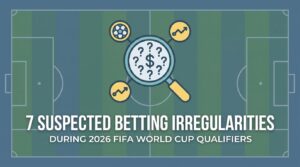
The International Betting Integrity Association (IBIA) recorded seven possible betting irregularities tied to 2026 FIFA World Cup qualifying matches, raising fresh questions about the vulnerability of international football to match-fixing. The alerts, spanning multiple confederations, were identified through IBIA’s monitoring systems that track betting market movements in real time. While none of the flagged matches have yet resulted in formal sanctions, the pattern adds to a growing body of evidence that qualification cycles for major tournaments remain a persistent target for manipulation.
What the Alerts Reveal About World Cup Qualifier Integrity
Before diving into the specifics, it’s worth framing what these alerts actually represent in practical terms. Each one signals unusual betting activity that deviates from expected market behaviour, though an alert alone does not confirm manipulation. Still, seven flags across a single qualifying cycle is a figure that warrants scrutiny, particularly given the geographic spread of the matches involved.
- Seven alerts were raised across 2026 World Cup qualifying fixtures, covering matches in multiple FIFA confederations
- The alerts were generated by IBIA’s real-time monitoring platform, which tracks odds movements across licensed betting operators globally
- No confirmed sanctions have been issued yet, but the data has been shared with relevant sports governing bodies and national regulators
- Qualification matches, especially those involving lower-ranked teams, continue to be disproportionately flagged for suspicious activity
- The findings reinforce calls from integrity bodies for stronger cooperation between FIFA, confederations, and betting regulators
Why Qualifiers Attract Manipulation
World Cup qualifiers present a particular problem for integrity monitoring. The sheer volume of matches, many played in jurisdictions with limited oversight infrastructure, creates gaps that organised networks can exploit. A fixture between two teams with little at stake in a later qualifying round, played in a stadium with minimal broadcast coverage, is a fundamentally different proposition from a group-stage match at the tournament itself.
And while FIFA has invested in education and detection programmes, the decentralised nature of qualifying (a distinction regulators have been slow to address) means enforcement varies dramatically from one confederation to another. A match in Europe operates under a different integrity framework than one in Asia or Africa, even though the betting markets treating them are often identical.
IBIA has consistently pointed to this asymmetry. The organisation, which represents more than 50 licensed betting operators worldwide, has argued that integrity protections must extend uniformly across all competitive tiers. That argument gains weight each time a qualifying cycle produces a cluster of alerts.
How IBIA’s Detection System Works
The monitoring infrastructure behind these alerts operates on a straightforward principle: when betting patterns on a specific match deviate significantly from what statistical models predict, the system flags it. Analysts then assess whether the deviation can be explained by legitimate factors (team news, weather, public sentiment) or whether it suggests coordinated market manipulation.
Not every alert leads to an investigation. Some are resolved quickly once contextual information is reviewed. But the ones that persist get referred to sports governing bodies and, where applicable, law enforcement. IBIA’s betting integrity monitoring platform processes data from dozens of operators simultaneously, giving it a broader view of market activity than any single bookmaker could achieve alone.
The seven alerts from this qualifying cycle sit within a broader trend. IBIA’s quarterly reports have shown football consistently accounts for the largest share of suspicious activity across all sports, with international fixtures overrepresented relative to domestic league play.
A Closer Look at the Risk Profile
| Factor | Domestic League Matches | International Qualifiers |
|---|---|---|
| Regulatory oversight | Generally robust, with national federations and local gambling authorities | Varies widely; some confederations lack dedicated integrity units |
| Media and broadcast scrutiny | High for top divisions | Often minimal for lower-ranked fixtures |
| Player compensation | Club salaries apply | Some national teams offer limited match fees, increasing vulnerability |
| Betting market liquidity | Deep and well-monitored | Thinner markets can be easier to manipulate |
| Historical alert frequency | Moderate | Disproportionately high relative to match volume |
The Psychological Dimension: Why Education Alone Falls Short
Integrity bodies frequently cite player education as a frontline defence against match-fixing. Yet the behavioural dynamics at play are more complex than a compliance seminar can address. Players approached by fixers often face a layered decision environment shaped by financial pressure, cultural norms around loyalty and obligation, and a perception (sometimes accurate) that detection is unlikely.
Framing matters enormously here. Research in behavioural economics suggests that when individuals perceive a low probability of consequences, even well-intentioned people rationalise participation. The language used in anti-corruption training, if it relies solely on moral appeals, often fails to shift behaviour in high-pressure moments. More effective approaches anchor the message in concrete, personal consequences: career bans, criminal prosecution, public exposure.
There is also the question of identity. Players who see themselves as professionals with long-term career trajectories respond differently to integrity messaging than those who view their international career as temporary or economically marginal. Tailoring interventions to these different psychological profiles, rather than delivering uniform presentations, arguably represents the next frontier in integrity protection. FIFA’s own integrity department has acknowledged this gap in previous reports, though implementation remains uneven across member associations.
What remains less clear is whether confederations with the highest alert rates are also the ones investing least in these behavioural interventions. That correlation, if it exists, would tell us something important about where resources need to flow.
What Comes Next for FIFA and Betting Regulators
FIFA’s disciplinary committee will review the referred cases, though timelines for resolution tend to stretch across months. In parallel, several national gambling regulators have signalled increased interest in cross-border cooperation on sports integrity, particularly as the 2026 tournament in the United States, Canada, and Mexico approaches.
The expanded 48-team format for the 2026 World Cup means more qualifying matches than any previous cycle. More matches mean more surface area for potential manipulation. Whether the integrity infrastructure scales proportionally is a question that these seven alerts make harder to ignore.
Frequently Asked Questions
Does a betting alert mean a match was fixed?
No. An alert indicates unusual betting market activity that warrants further investigation. Many alerts are resolved without finding evidence of manipulation, though some do lead to formal proceedings.
Which confederations were affected?
IBIA has not publicly disclosed the specific confederations or matches involved in these seven alerts. Historical data suggests alerts are spread across multiple regions, with no single confederation immune.
How does IBIA share its findings with FIFA?
IBIA operates formal information-sharing agreements with major sports governing bodies. Alert data, including supporting market evidence, is transmitted to FIFA’s integrity department and relevant national associations for review and potential disciplinary action.
Can betting operators refuse to take bets on suspicious matches?
Licensed operators can and sometimes do suspend markets on specific events when integrity concerns arise. This decision typically follows consultation with monitoring bodies and is more common than most fans realise.