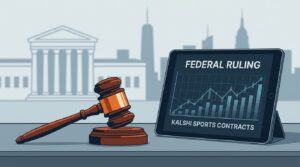
Kalshi, the federally regulated prediction market platform, has secured a short-term legal victory after a federal judge declined New York’s request for a temporary restraining order that would have immediately halted its sports-related event contracts in the state. The ruling allows the platform to continue offering these contracts while the broader legal dispute plays out. New York regulators had argued that Kalshi’s sports event contracts amount to unlicensed gambling under state law, but the court found insufficient grounds for emergency relief at this stage.
What the Ruling Means for Prediction Markets and Sports Betting Regulation
The intersection of prediction markets and sports wagering has become one of the most contested regulatory frontiers in U.S. financial services. Before diving into the strategic implications, it’s worth understanding what’s actually at stake for market participants, regulators, and the broader fintech ecosystem.
- Kalshi retains operational continuity in New York — at least for now. The denial of the temporary restraining order means the platform faces no immediate disruption to its sports event contract offerings in the state.
- New York’s legal challenge is not over. The state can still pursue its case through standard litigation channels, and a preliminary injunction hearing could yield a different outcome.
- The decision signals that courts may require a higher evidentiary bar before shutting down CFTC-regulated products at the state level
- Regulatory jurisdiction remains unresolved. The case sits at the fault line between federal derivatives oversight (via the CFTC) and state-level gambling enforcement, a distinction regulators have been slow to enforce consistently.
- Other states watching this case may recalibrate their own enforcement strategies depending on how the litigation develops
A Jurisdictional Tug-of-War
At the core of this dispute is a question that neither Congress nor federal regulators have fully answered: when does a prediction market contract cross the line from a regulated financial instrument into a wager? Kalshi operates as a designated contract market under the Commodity Futures Trading Commission, which gives it federal authorization to list and clear event-based contracts. New York, however, maintains that contracts tied to sporting outcomes fall squarely within the state’s gambling statutes, regardless of their federal classification.
The judge’s refusal to grant emergency relief doesn’t resolve this tension. It simply means New York failed to demonstrate the kind of immediate, irreparable harm that courts typically require before issuing a restraining order. That’s a procedural finding, not a substantive endorsement of Kalshi’s position.
Still, the optics matter. Every week that Kalshi’s event contracts remain available to New York users builds a stronger status quo argument. And in regulatory disputes, momentum can quietly shape outcomes.
Why New York Pressed for Emergency Action
New York has historically taken an aggressive posture toward unlicensed financial and gambling activity within its borders. The state’s gaming commission and attorney general’s office have broad enforcement mandates, and the expansion of prediction markets into sports-adjacent territory triggered a swift response. From the state’s perspective, allowing a federally regulated platform to offer what it considers sports betting without a state license would undermine its entire regulatory framework for gaming.
But the court wasn’t persuaded that the situation demanded emergency intervention. One possible reading: the judge viewed the contracts as sufficiently distinct from traditional sports betting to warrant fuller briefing before any injunction. Another: the court simply wasn’t convinced that New York consumers faced imminent harm requiring judicial intervention ahead of normal proceedings.
The Broader Regulatory Landscape Shifts
This case doesn’t exist in isolation. The CFTC’s evolving stance on event contracts has been a source of industry uncertainty for years. In 2024, the commission approved Kalshi’s election-related contracts after a separate legal battle, setting a precedent that event markets could survive federal scrutiny. Sports, however, occupies different political and regulatory terrain. Lawmakers in multiple states have carved out specific licensing regimes for sports wagering following the Supreme Court’s 2018 decision in Murphy v. NCAA, which struck down the federal ban on state-authorized sports betting.
What makes the Kalshi dispute particularly thorny is that the platform’s contracts are structured as binary options on outcomes rather than traditional bets. Whether that structural distinction holds legal weight across fifty different state regulatory regimes is, arguably, the defining question for the prediction market industry’s next chapter.
How Market Participants Should Read This Moment
For prediction market operators, the ruling offers cautious encouragement but not comfort. The legal architecture supporting event contracts remains fragile, built on a patchwork of federal approvals and state-by-state tolerance. Operators expanding into sports-linked products should anticipate continued state-level challenges, particularly in jurisdictions with established sports betting frameworks and active gaming commissions.
Institutional investors evaluating the prediction market space face a related calculus. The sector’s growth trajectory depends not just on consumer demand but on regulatory durability. A single adverse ruling in a major state could force platforms to geo-fence products, fragmenting liquidity and undermining the value proposition of national-scale event markets.
And for regulators themselves, this case highlights a gap that keeps widening. The CFTC’s mandate was designed for commodity derivatives, not binary contracts on NBA playoff outcomes. Whether the commission’s framework can stretch to accommodate this new asset class without congressional action remains an open question (and not one the agency seems eager to force).
Frequently Asked Questions
What are Kalshi sports event contracts?
They are binary contracts listed on Kalshi’s CFTC-regulated exchange that allow participants to take positions on the outcomes of sporting events. The platform structures them as derivatives rather than traditional wagers, though this classification is disputed by some state regulators.
Did the judge rule that Kalshi’s contracts are legal?
No. The court denied New York’s request for a temporary restraining order, which is a procedural decision about emergency relief. It did not address the underlying legality of the contracts. The substantive legal questions remain unresolved and will be litigated further.
Can New York still ban these contracts?
Yes. The state’s case continues through normal litigation. A preliminary injunction or eventual trial ruling could still restrict or prohibit Kalshi’s sports event offerings in New York.
How does this affect other prediction market platforms?
The ruling creates a temporary precedent that state regulators may face a high bar when seeking emergency action against federally regulated event contract platforms. But each platform’s regulatory posture and product design will determine its own exposure to state-level enforcement.