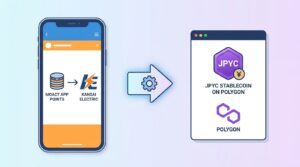
Users of MOACT, the rewards application operated by a wholly owned subsidiary of Japanese utility giant Kansai Electric Power, can now convert their accumulated loyalty points into JPYC, a yen-pegged stablecoin, on the Polygon network. The integration, announced by wallet developer HashPort on Thursday and live since July 30, marks a notable convergence of traditional utility-sector loyalty programs and decentralized finance infrastructure. It also signals that Japan’s corporate establishment is growing more comfortable with blockchain-based value transfer, even in consumer-facing products.
What the MOACT-JPYC Integration Means for Stakeholders
This development sits at an unusual intersection: a legacy energy utility, a stablecoin issuer, and a Layer 2 blockchain network. Before unpacking the broader implications, here are the strategic takeaways worth flagging.
- Corporate crypto adoption in Japan is accelerating beyond fintech. A subsidiary of Kansai Electric Power, one of the country’s largest utilities, is now directly facilitating stablecoin access through its consumer rewards ecosystem.
- JPYC gains a new distribution channel that reaches everyday consumers who may have had zero prior exposure to digital assets
- Polygon’s positioning as enterprise-grade infrastructure strengthens. The choice of Polygon over alternative networks reflects its growing traction with Japanese corporate integrations.
- HashPort’s role as a bridge between Web2 loyalty systems and Web3 wallets could become a template for similar partnerships across Asia’s utility and retail sectors.
- For regulators, the move tests how Japan’s relatively progressive stablecoin framework handles real-world consumer adoption at scale
Why a Japanese Utility Is Betting on Stablecoins
Kansai Electric Power serves roughly 13 million customers across the Kansai region, which includes Osaka, Kyoto, and Kobe. MOACT functions as the company’s customer engagement platform, offering points-based rewards that users can redeem for various goods and services. Adding stablecoin conversion to that menu is a deliberate step, not an experiment tucked away in a sandbox.
The timing matters. Japan revised its Payment Services Act in June 2023 to create a legal framework for stablecoins, making it one of the few major economies with explicit regulatory clarity on the asset class. JPYC, issued by JPYC Inc., operates within this framework as a prepaid payment instrument pegged 1:1 to the Japanese yen. That regulatory footing arguably makes the integration less risky for a conservative corporate entity like Kansai Electric than it would be in jurisdictions where stablecoin status remains ambiguous (a distinction that has kept many Western utilities far from similar moves).
Still, the question lingers: how many MOACT users will actually convert points to JPYC rather than redeeming them for conventional rewards?
Polygon’s Quiet Expansion in Japan’s Enterprise Layer
The decision to deploy on Polygon rather than Ethereum mainnet or a competing Layer 2 reflects a pattern. Polygon has cultivated relationships with Japanese enterprises for over two years, and its low transaction fees and high throughput make it practical for microtransactions like loyalty point conversions. A user converting a few hundred yen worth of points cannot absorb $5 in gas fees. On Polygon, that friction largely disappears.
This also fits within a broader trend of Japanese firms selecting Polygon’s blockchain infrastructure for consumer-facing applications, from NFT marketplaces to ticketing platforms. Each integration reinforces the network’s position in a market where institutional trust carries outsized weight.
How the Conversion Flow Works
| Step | Action | Platform |
|---|---|---|
| 1 | User accumulates MOACT loyalty points through Kansai Electric services | MOACT App |
| 2 | User initiates point-to-JPYC conversion | MOACT App via HashPort integration |
| 3 | JPYC stablecoin is issued on Polygon and delivered to user’s wallet | Polygon Network |
| 4 | User can hold, transfer, or use JPYC within supported ecosystems | Various JPYC-compatible platforms |
The Broader Signal: Loyalty Programs as Crypto On-Ramps
What makes this integration worth watching extends beyond any single company. Loyalty points represent one of the largest pools of dormant consumer value globally. Airlines, retailers, and telecoms collectively issue billions of dollars in points each year, most of which expire unredeemed. Converting those points into stablecoins transforms a depreciating corporate liability into a liquid digital asset the consumer actually controls.
And while this particular deployment is limited to JPYC on Polygon, the architecture HashPort has built could be adapted for other stablecoins, other chains, and other loyalty ecosystems. That modularity is the real product here.
Japan’s regulatory environment gives it a head start. But the concept itself is jurisdiction-agnostic. If a utility company in Osaka can do this within existing law, the pressure mounts on counterparts in Singapore, South Korea, and eventually Europe to explore similar pathways.
Reframing Consumer Relationships Through Digital Value
From a neuro-linguistic programming perspective, the framing of this feature matters as much as the technology behind it. MOACT is not asking users to “buy crypto” or “enter DeFi.” It is offering them a way to do more with points they have already earned. That reframe is significant. Consumer resistance to digital assets often stems from perceived complexity and risk. By anchoring the experience in something familiar, namely loyalty points they already possess, MOACT reduces the cognitive barrier to entry.
The language of conversion rather than purchase shifts the user’s internal representation of the transaction. They are not spending money; they are upgrading something they already have. This approach leverages the endowment effect, where people assign higher value to things they already own. Points sitting idle in an app feel like wasted potential. Offering a path to convert them into a stable, transferable digital asset reframes inaction as a missed opportunity rather than a safe default.
HashPort’s wallet design will need to sustain this framing. If the user experience introduces jargon-heavy screens or requires manual gas fee management, the psychological advantage dissolves. But if the flow feels as simple as redeeming points for a gift card, adoption could surprise skeptics. The bridge between Web2 comfort and Web3 capability is, at its core, a communication design problem as much as an engineering one.
Frequently Asked Questions
What is JPYC?
JPYC is a Japanese yen-pegged stablecoin issued by JPYC Inc. It operates as a prepaid payment instrument under Japan’s revised Payment Services Act, maintaining a 1:1 peg with the yen.
Who can use the MOACT loyalty point conversion feature?
The feature is available to existing MOACT app users, primarily customers of Kansai Electric Power’s services in the Kansai region of Japan. Eligibility details may depend on account status and regional availability.
Why was Polygon chosen over other blockchain networks?
Polygon offers low transaction costs and fast settlement times, which are critical for small-value conversions like loyalty points. It also has an established track record with Japanese enterprise partners, making it a practical fit for this type of consumer-facing integration.
Does this mean Kansai Electric is entering the crypto business?
Not exactly. The conversion feature is facilitated through HashPort’s infrastructure and JPYC Inc.’s stablecoin issuance. Kansai Electric’s subsidiary operates the rewards app, but the blockchain mechanics are handled by specialized partners.



