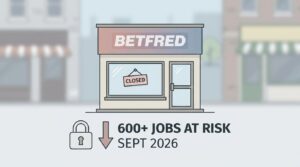
Betfred, one of the UK’s largest independent bookmakers, has announced plans to close 132 betting shops from September 2026, a move that places more than 600 jobs in jeopardy. The closures reflect mounting pressure on high-street gambling operators squeezed between tightening regulation, shifting consumer habits, and the relentless migration of wagering activity online. For a brand that built its identity around the physical betting shop experience, the scale of this retrenchment signals a structural pivot rather than a temporary adjustment.
What Betfred’s Shop Closures Mean for the UK Betting Landscape
The decision arrives at a moment when Britain’s retail gambling sector is already contracting. Several operators have trimmed their estate in recent years, but Betfred’s announcement stands out for its sheer proportion relative to the company’s footprint. Before unpacking the broader implications, here are the critical takeaways for industry stakeholders:
- 132 shops earmarked for closure from September 2026, representing a significant reduction in Betfred’s physical retail presence across the UK
- More than 600 employees face redundancy, though the company may seek redeployment options within its remaining operations
- The closures underscore a wider industry trend: high-street betting is losing ground to digital platforms, and operators are reallocating capital accordingly
- Regulatory headwinds, including affordability checks and stake limits introduced after the 2019 FOBT crackdown, continue to erode the economics of bricks-and-mortar betting
- Remaining shops will likely need to demonstrate stronger unit economics to justify their place in the portfolio
Why the High Street Keeps Shrinking
The UK’s betting shop count has been declining for the better part of a decade. When the government slashed maximum stakes on fixed-odds betting terminals (FOBTs) from £100 to £2 in April 2019, it removed the single most profitable fixture in many shops. That regulatory intervention triggered a first wave of closures across the sector. But the erosion didn’t stop there.
Online gambling now accounts for the majority of UK gross gambling yield. Customers who once visited a shop on Saturday afternoon increasingly place bets from their phones, often through apps that offer live streaming, in-play markets, and promotional incentives that a physical location simply cannot match. The pandemic accelerated this behavioural shift, and it has not reversed.
Betfred, founded by Fred Done in Salford in 1967, has long maintained one of the larger independent shop networks in the country. Yet even a brand with deep roots in retail gambling cannot ignore the arithmetic. Rising rents, staffing costs, and business rates compound the revenue pressure. At some point, the numbers stop working. For 132 of Betfred’s locations, that point is September 2026.
The Human Cost and Workforce Implications
More than 600 jobs at risk is not an abstraction. These are roles concentrated in towns and cities where alternative employment may not be readily available, particularly in retail-facing positions that have themselves been hollowed out by e-commerce. Betfred has not yet detailed whether affected staff will be offered transfers to remaining shops or roles within its growing online betting and gaming operations, though such measures are standard practice during managed closures of this kind.
Still, the gap between a shop-floor role and a digital operations position is wide enough that redeployment alone won’t absorb the full impact.
Regulatory Pressure Shows No Sign of Easing
The UK Gambling Commission’s ongoing review of operator practices (a process that has been neither swift nor predictable) adds another layer of uncertainty. Proposed affordability checks, which would require operators to verify a customer’s financial capacity before allowing significant wagers, threaten to further reduce footfall in retail shops where spontaneous, lower-value betting has traditionally sustained daily turnover.
Operators argue these checks are disproportionately burdensome for the retail channel. Whether regulators agree remains an open question, but the direction of travel is clear: compliance costs are rising, and the regulatory environment favours operators with scalable digital infrastructure over those reliant on physical premises.
How Does Betfred Compare to Competitors?
| Operator | Approximate UK Shop Count (2024) | Recent Closure Activity |
|---|---|---|
| Betfred | ~1,400 (pre-announcement) | 132 shops closing by Sept 2026 |
| Ladbrokes (Entain) | ~2,400 | Ongoing selective closures since 2019 |
| William Hill (888) | ~1,300 | Hundreds closed post-FOBT reform; further reductions under 888 ownership |
| Coral (Entain) | ~1,500 | Merged estate with Ladbrokes; rationalisation continuing |
Betfred’s closure programme, while substantial, mirrors a pattern already established by its publicly listed rivals. The difference is that Betfred, as a privately held company, faces less external scrutiny over its strategic decisions but also has fewer capital market levers to pull.
Reframing the Narrative: What Operators Can Learn from Behavioural Shifts
Understanding why customers leave physical shops is not purely an economic exercise. From a behavioural perspective, the migration to digital platforms reflects deeper shifts in how people relate to convenience, immediacy, and perceived control over their experience. Customers who bet online report feeling more in command of their decisions: they choose when to engage, how much information to consume before placing a wager, and how to manage their own pace. The shop environment, by contrast, imposes a social and physical structure that many younger bettors find unnecessary.
Operators who recognise this aren’t just responding to a revenue problem. They’re adapting to a change in customer identity. The bettor of 2025 sees themselves differently than the bettor of 2010. They expect personalisation, data transparency, and frictionless interaction. Betfred’s digital investment, which has grown considerably in recent years, suggests the company understands this shift at a strategic level. And yet the question lingers: can a brand synonymous with the British betting shop reinvent its emotional connection with customers who may never walk through a shop door?
For competitors watching closely, the lesson is less about closures and more about timing. Operators who delay rationalisation risk subsidising underperforming assets with profits from their digital arms, a cross-subsidy that erodes overall returns and delays necessary reinvestment in technology, responsible gambling tools, and customer acquisition online.
Frequently Asked Questions
When will Betfred close the 132 shops?
The closures are planned from September 2026, giving the company and affected employees a lead time of over a year to prepare for the transition.
How many jobs are affected by the Betfred closures?
More than 600 roles are at risk. Betfred has not confirmed how many of those employees may be redeployed to other parts of the business.
Why is Betfred closing betting shops?
A combination of factors: declining high-street footfall, the shift to online gambling, regulatory changes including FOBT stake reductions, and rising operational costs have made a significant number of shops financially unsustainable. It’s a pattern visible across the entire UK retail betting sector, not unique to Betfred.
Will Betfred focus more on online gambling?
All indications point that way. The company has been expanding its digital platform and online product offering, consistent with broader industry trends favouring mobile and desktop wagering over in-shop activity.