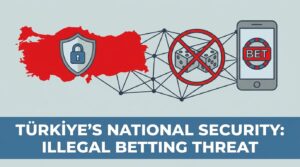
Türkiye has formally reclassified illegal betting as a national security concern, marking a significant escalation in the country’s approach to combating underground gambling networks. The move comes as authorities identify deepening links between unlicensed betting operations and organised crime syndicates that funnel billions of lira through shadow financial channels. By treating the issue alongside terrorism financing and narcotics trafficking, Ankara signals that the era of treating illegal gambling as a low-priority regulatory nuisance is over.
Why Türkiye’s Reclassification Reshapes the Enforcement Landscape
The decision to frame illegal betting through a national security lens carries consequences that ripple well beyond law enforcement budgets. It restructures how intelligence agencies, financial regulators, and judicial authorities coordinate their response. Here are the strategic takeaways:
- Intelligence-grade resources unlocked: National security classification gives Turkish authorities access to surveillance tools, cross-border intelligence sharing, and asset-freezing mechanisms previously reserved for counter-terrorism operations.
- Financial sector exposure increases: Banks and payment processors operating in Türkiye now face heightened scrutiny over transactions linked to unlicensed betting platforms, with potential penalties escalating sharply.
- Criminal organisations that relied on fragmented regulatory oversight between provinces will encounter a unified, centrally directed enforcement apparatus.
- Diplomatic implications: Türkiye can now invoke bilateral security agreements to pursue operators and financial flows across jurisdictions, particularly in Europe and Central Asia.
- Licensed operators in Türkiye’s regulated sports betting market stand to benefit from reduced competition with illegal alternatives, though compliance costs may also climb.
The Scale of Underground Betting in Türkiye
Estimates of Türkiye’s illegal betting market vary, but the figures consistently point to an operation worth tens of billions of Turkish lira annually. Criminal networks have built sophisticated digital infrastructures, mirroring (and sometimes surpassing) the user experience offered by licensed platforms. Mobile apps distributed through encrypted channels, cryptocurrency payment rails, and social media recruitment pipelines have made enforcement a moving target for years.
What distinguishes the current moment is the documented convergence of betting revenues with other criminal enterprises. Turkish authorities have traced proceeds from illegal wagers into real estate laundering schemes, drug distribution networks, and even human trafficking operations. That convergence is precisely what triggered the national security reclassification.
And while the government has not released a single consolidated figure for the market’s size, court filings from recent prosecutions suggest individual networks processing upwards of 500 million lira in monthly turnover.
How Criminal Networks Operate Across Borders
The operational architecture of these syndicates rarely respects national boundaries. Servers hosted in jurisdictions with lax enforcement feed betting platforms accessible to Turkish users. Payment processing often routes through shell companies registered in multiple countries, making it difficult for any single regulator to trace the full chain.
Turkish investigators have identified nodes in several European countries, with some operations allegedly maintaining call centres abroad to handle customer service for Turkish-language betting sites. The state-authorised sports betting framework administered through İddaa represents the legal alternative, but underground operators frequently undercut it with higher odds and tax-free payouts.
Still, the cross-border dimension cuts both ways. Türkiye’s reclassification gives its security services stronger standing to request cooperation from Europol and Interpol, transforming what were previously administrative complaints into formal security referrals.
Financial System Under Pressure
Banks are arguably the most exposed private-sector stakeholders in this shift. Under the new framework, facilitating transactions linked to illegal betting, even unknowingly, could trigger investigations under anti-money laundering statutes that carry criminal penalties for compliance officers. Several Turkish banks have already begun tightening transaction monitoring thresholds for patterns associated with betting-related flows.
Cryptocurrency exchanges operating in Türkiye face a parallel challenge. The pseudonymous nature of blockchain transactions has made digital assets a preferred settlement mechanism for illegal betting operators. Turkish regulators have signalled that crypto platforms will be expected to implement enhanced due diligence measures specifically targeting gambling-related activity.
The result: a financial sector caught between operational efficiency and regulatory survival.
Sectors Most Affected by the Reclassification
| Sector | Primary Risk | Regulatory Response Expected |
|---|---|---|
| Banking | Transaction facilitation liability | Enhanced AML monitoring, potential criminal exposure for compliance failures |
| Cryptocurrency Exchanges | Settlement channel for illegal operators | Mandatory enhanced due diligence on gambling-linked wallets |
| Telecommunications | Distribution of unlicensed betting apps | Expanded blocking orders and ISP-level filtering |
| Social Media Platforms | Recruitment and advertising pipelines | Content removal obligations under national security provisions |
| Licensed Betting Operators | Competitive distortion from illegal market | Potential market share recovery, but higher compliance burden |
What This Means for Regional Gambling Regulation
Türkiye’s decision does not exist in isolation. Across the broader region, governments are grappling with similar challenges as digital betting platforms outpace regulatory frameworks designed for a pre-smartphone era. But few countries have gone as far as elevating the issue to national security status, a move that effectively places illegal betting operators in the same enforcement category as terrorist financiers.
Whether neighbouring jurisdictions follow suit depends partly on how effective Türkiye’s approach proves in practice. At least on paper, the reclassification provides a comprehensive toolkit. Execution, however, requires sustained coordination between agencies that have historically operated in silos. The question nobody in Ankara has answered publicly is whether the institutional culture can shift as fast as the legal framework already has.
Broader Implications for Stakeholders and Market Participants
For executives in the gaming, fintech, and telecommunications sectors, Türkiye’s move demands immediate reassessment of risk exposure. Companies with any operational footprint in the Turkish market should audit their transaction monitoring systems, advertising partnerships, and third-party vendor relationships for potential links to unlicensed betting activity. The compliance window is narrowing rapidly, and the penalties under a national security framework are categorically different from standard regulatory fines.
Even so, the reclassification also creates opportunity. Licensed operators who can demonstrate robust compliance infrastructure may find themselves in a stronger competitive position as enforcement pressure drives users away from underground alternatives. Technology vendors offering anti-fraud and transaction monitoring solutions are likely to see increased demand from Turkish financial institutions scrambling to meet new expectations.
The interplay between enforcement intensity and market dynamics will determine whether this reclassification becomes a template for other countries, or remains a distinctly Turkish experiment in treating gambling crime as a matter of state security.
Frequently Asked Questions
Why has Türkiye classified illegal betting as a national security issue?
Authorities have documented extensive links between illegal betting revenues and organised crime, including money laundering, drug trafficking, and terrorism financing. The reclassification unlocks intelligence and enforcement tools that standard regulatory frameworks cannot provide.
How does this affect banks operating in Türkiye?
Financial institutions face significantly elevated compliance obligations. Facilitating transactions tied to illegal betting, even inadvertently, could now trigger investigations under anti-money laundering laws with criminal penalties attached. Banks are expected to implement enhanced monitoring specifically targeting betting-related transaction patterns.
Will this impact legal betting in Türkiye?
Licensed operators could benefit from reduced illegal competition over time, though they will also face a more demanding compliance environment. The net effect depends on how aggressively enforcement disrupts underground networks.
Could other countries adopt a similar approach?
Possibly. Several jurisdictions in Europe and Central Asia face comparable challenges with cross-border illegal betting. Türkiye’s approach, if it yields measurable results, may serve as a precedent, though political and institutional conditions vary considerably across the region.