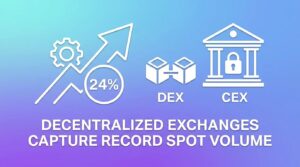
Decentralized exchanges (DEXs) reached a historic milestone in July, handling spot trading volume equivalent to 24% of centralized exchange (CEX) volume — the highest ratio recorded since The Block began tracking the metric in 2019. The record was set not during a boom, but in a contracting market where onchain activity proved more resilient than its centralized counterpart. Both segments saw declining volumes, yet DEX activity held its ground with notably less erosion, signaling a structural shift in how crypto traders allocate liquidity.
What the Record DEX-to-CEX Ratio Reveals About Market Structure
Before unpacking the strategic implications, it’s worth grounding the headline number. A 24% ratio doesn’t mean DEXs are processing a quarter of all crypto spot trades in absolute terms. It means that for every dollar traded on centralized platforms, roughly 24 cents moved through decentralized protocols. That distinction matters, because the ratio climbed not because DEX volumes surged, but because CEX volumes fell faster.
- Resilience over growth: DEX volumes contracted less sharply than CEX volumes in July, suggesting onchain traders are stickier and less reactive to macro-driven pullbacks.
- Structural migration: The steady climb in this ratio since 2019 reflects a longer arc of user migration toward self-custodial trading infrastructure, not a single-month anomaly.
- Protocols like Uniswap, which continues to dominate decentralized spot trading across multiple chains, likely absorbed a meaningful share of this activity.
- Liquidity fragmentation risk: As DEX share grows, centralized exchanges face pressure on fee revenue and order book depth, particularly in long-tail token pairs.
- Regulatory scrutiny of CEXs in the U.S. and Europe may be accelerating the shift, at least on paper, by pushing some traders toward permissionless alternatives.
A Shrinking Pie, Unevenly Divided
July’s broader crypto market was subdued. Trading volumes across both centralized and decentralized venues declined from June levels, consistent with seasonal patterns and a macro environment that offered few catalysts for aggressive positioning. But the contraction was asymmetric.
Centralized platforms bore the brunt. Binance, Coinbase, and OKX all saw reduced spot activity, a trend compounded by ongoing regulatory headwinds in multiple jurisdictions. The SEC’s enforcement posture in the United States, combined with MiCA implementation timelines in Europe, has created an environment where some market participants are rethinking their reliance on centralized intermediaries (a distinction regulators have been slow to enforce consistently).
DEX volumes, while also lower in absolute terms, declined at a gentler rate. Why? Part of the answer lies in the composability of DeFi. Onchain traders aren’t just swapping tokens — they’re interacting with lending protocols, yield strategies, and liquidity provision mechanisms that keep capital circulating even when speculative appetite fades. That stickiness is structural, not sentimental.
How Onchain Infrastructure Is Reshaping Trader Behavior
Understanding this shift requires looking beyond volume charts. The psychological and behavioral dynamics at play here align with principles familiar to anyone studying decision-making frameworks. Traders migrating to DEXs aren’t simply chasing lower fees or avoiding KYC. They’re responding to a reframing of what “control” means in financial transactions.
Self-custody, transparent execution, and permissionless access represent more than technical features. They function as anchors in a trader’s mental model of risk. When a centralized exchange freezes withdrawals or faces regulatory action, the perceived cost of custodial convenience spikes. Each such event recalibrates the internal risk calculus for thousands of users simultaneously. And that recalibration tends to be sticky — once a trader has internalized the operational risk of centralized custody, the threshold for returning is higher than the threshold for leaving was.
This is compounded by improved user experience on DEX frontends. Aggregators like 1inch and Jupiter on Solana have narrowed the execution quality gap considerably. The friction cost of going onchain has dropped, while the perceived safety premium of staying on a CEX has eroded. Together, these forces create a ratchet effect: each market cycle sees the DEX share baseline reset higher than the last.
Still, the picture isn’t uniformly favorable for decentralized venues. Institutional-grade liquidity remains concentrated on centralized order books. And for large block trades, the slippage characteristics of automated market makers can be prohibitive.
What Comes Next for the DEX-CEX Balance
The trajectory seems clear, but the pace is less certain. Several variables will determine whether the DEX-to-CEX ratio continues climbing or plateaus:
| Factor | Favors DEX Growth | Favors CEX Retention |
|---|---|---|
| Regulatory pressure on CEXs | Pushes retail toward permissionless alternatives | Could also target DeFi frontends |
| Layer 2 scaling | Reduces gas costs, improves DEX UX | CEXs already offer near-zero fees |
| Institutional adoption | Some funds exploring onchain execution | Compliance requirements still favor centralized venues heavily |
| Token listing speed | DEXs list assets instantly via permissionless pools | CEX listings carry credibility signals for less sophisticated participants |
Whether the 24% ratio holds, retreats, or pushes toward 30% in the coming months depends partly on macro conditions. A sharp rally in crypto prices would likely boost CEX volumes disproportionately, as speculative retail capital tends to flow through centralized onramps first. But the floor keeps rising.
Frequently Asked Questions
What does the DEX-to-CEX ratio actually measure?
It compares total spot trading volume on decentralized exchanges to total spot volume on centralized exchanges over a given period. A ratio of 24% means DEX volume was roughly one-quarter of CEX volume in July.
Does this mean DEXs are replacing centralized exchanges?
Not yet, and arguably not soon. Centralized platforms still dominate in absolute volume, institutional access, and fiat onramps. The ratio captures a trend, not a tipping point — though the direction has been consistent for years.
Which DEX protocols are driving this growth?
Uniswap remains the largest by volume on Ethereum. On Solana, Jupiter has emerged as a dominant aggregator. Across chains, the growth is broad-based rather than concentrated in a single protocol.
Is the rising DEX share a risk for centralized exchange stocks?
For publicly traded exchanges like Coinbase, a sustained erosion of spot market share could pressure transaction revenue over time. How quickly that translates into earnings impact depends on whether these platforms successfully diversify into derivatives, staking, and custody services.



