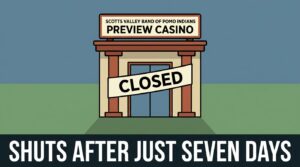
The preview casino operated by the Scotts Valley Band of Pomo Indians has closed after running for only seven days, raising immediate questions about the project’s viability and the regulatory landscape surrounding tribal gaming in California. The abrupt shutdown caught observers off guard, given the fanfare that accompanied the facility’s soft launch. While the tribe has not issued a comprehensive public explanation, the closure underscores the volatile intersection of tribal sovereignty, state gaming compacts, and local opposition that continues to shape casino development across the western United States.
What the Seven-Day Closure Signals for Tribal Gaming
Short-lived casino openings are rare in the tribal gaming sector, and when they happen, they tend to reflect deeper structural or political friction rather than simple operational missteps. Below are the key strategic takeaways from this development:
- Regulatory uncertainty persists: Preview or soft-launch casinos often operate under provisional frameworks, and the rapid closure suggests possible compliance or jurisdictional challenges that were not fully resolved before doors opened.
- Community and political pushback: Tribal casino projects in California frequently face opposition from neighboring communities, competing gaming interests, or state officials — any of which could have accelerated the shutdown timeline.
- The closure may affect investor and partner confidence in future phases of the project, particularly if the tribe intended the preview period as a proof-of-concept for a larger resort development.
- Precedent risk: Other tribes pursuing similar preview-format launches will likely reassess their strategies in light of this outcome, especially those operating without finalized state compacts.
The Scotts Valley Band’s Gaming Ambitions
The Scotts Valley Band of Pomo Indians has pursued gaming development as part of a broader effort toward economic self-sufficiency, a path well-trodden by dozens of federally recognized tribes across California. The tribe’s plans have included establishing a casino facility that would serve as both a revenue engine and an employment hub for tribal members and surrounding communities.
Preview casinos, sometimes called soft openings, typically feature a limited gaming floor with fewer table games and slot machines than a full-scale operation. They serve a dual purpose: testing operational systems and generating early revenue while construction or licensing for a permanent facility continues. But they also carry risk. Operating in a provisional state means any regulatory objection, legal challenge, or political shift can halt operations almost overnight.
That appears to be what happened here.
California’s Tribal Gaming Landscape: A Crowded and Contested Arena
California hosts more tribal casinos than any other state, with over 60 facilities generating billions in annual revenue. Yet the regulatory environment remains one of the most complex in the country. Tribes must negotiate individual compacts with the governor’s office, and those agreements can take years to finalize (a distinction regulators have been slow to streamline). Even after a compact is signed, local zoning disputes, environmental reviews, and federal Bureau of Indian Affairs approvals can delay or derail projects.
For smaller tribes like the Scotts Valley Band, the barriers are arguably steeper. Larger, established gaming tribes sometimes oppose new entrants, viewing them as competition for a finite pool of gaming dollars. Political dynamics in Sacramento add another layer. Whether the Scotts Valley closure was driven by one of these forces or by something more mundane remains an open question the tribe has yet to address publicly.
How Preview Casinos Fit Into Broader Development Strategy
| Factor | Preview Casino | Full-Scale Casino |
|---|---|---|
| Regulatory Requirements | Often provisional or interim | Full compact and federal approval required |
| Capital Investment | Lower upfront cost; limited gaming floor | Significant — typically $200M+ for mid-size California facilities |
| Revenue Potential | Modest; serves as proof-of-concept | Substantial; designed for long-term profitability |
| Political Exposure | High — operates before all approvals are locked in, leaving it vulnerable to challenge | Lower once operational, though not immune |
| Timeline to Open | Months | Years |
The table illustrates why preview formats appeal to tribes eager to begin generating revenue. Still, the Scotts Valley experience shows the model’s fragility when external conditions shift.
Reading Between the Lines: Strategic and Psychological Dimensions
Beyond the regulatory and financial mechanics, this closure carries a psychological weight that shouldn’t be underestimated. For tribal communities, gaming operations represent more than commerce. They are expressions of sovereignty, self-determination, and cultural resilience after centuries of dispossession. When a project falters publicly, the impact reverberates through community morale, internal governance dynamics, and the tribe’s standing in negotiations with state and federal authorities.
From a strategic communication standpoint, how the Scotts Valley Band frames this closure in the coming weeks will matter enormously. Framing it as a temporary pause for regulatory alignment sends a fundamentally different signal than silence. Stakeholders — tribal members, potential investors, state officials, and neighboring communities — will interpret the narrative through their own lenses, and the tribe’s ability to shape that narrative proactively could determine whether the project retains credibility for a relaunch. The difference between a setback and a failure often comes down to the story told about it, and who tells it first.
Industry consultants who work with tribal gaming operations have long emphasized the importance of building political coalitions before breaking ground. A preview casino that opens without broad-based support is, in practice, a negotiating position masquerading as a business. Whether the Scotts Valley Band had those coalitions in place is something only the coming months will reveal.
Frequently Asked Questions
Why did the Scotts Valley Band’s preview casino close after seven days?
The tribe has not released a detailed public statement explaining the closure. Possible factors include regulatory challenges, political opposition, or unresolved compact negotiations with the state of California.
What is a preview casino?
A preview casino is a limited-scale gaming facility that operates on a provisional basis, typically while a tribe works toward opening a full-scale permanent casino. Think of it as a soft launch designed to test operations and generate early revenue.
Can the tribe reopen the casino?
That depends on the specific reasons behind the closure and whether the tribe can resolve any outstanding regulatory or legal issues. Reopening is possible but far from guaranteed, particularly if state-level opposition played a role.
How does this affect other tribal gaming projects in California?
Tribes considering similar preview-format openings may recalibrate their timelines and political strategies. The closure doesn’t set a legal precedent, but it does set a cautionary one.



