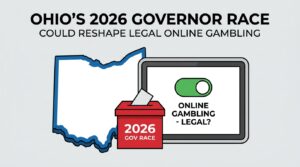
Ohio’s next gubernatorial election is shaping up as a pivotal contest for the future of legal online gambling in the state. Two leading candidates have staked out sharply divergent positions on whether to expand digital wagering beyond the current sports betting framework. The outcome in 2026 will likely determine whether Ohio becomes a full-scale iGaming market or maintains its more cautious regulatory posture. For operators, investors, and regulators watching the Midwest, this race carries outsized significance.
What the Ohio Governor’s Race Means for Online Gambling Expansion
The policy divide between the candidates reflects a broader national tension: states that have embraced sports betting are now wrestling with the logical next question of online casino gaming. Ohio legalized sports betting in January 2023, and the market has generated hundreds of millions in tax revenue since launch. But iGaming authorization remains off the table, at least for now. The 2026 race could change that calculus entirely.
Here are the strategic takeaways for industry stakeholders:
- Two competing visions for gambling regulation will be tested at the ballot box, with one candidate favoring broad iGaming legalization and the other advocating a more restrictive approach
- Ohio’s sports betting tax revenue performance gives expansion proponents a concrete fiscal argument to build on
- The outcome could influence neighboring states still weighing their own iGaming frameworks
- Operators already licensed in Ohio stand to benefit most from expansion, given their established compliance infrastructure and market presence
- Regulatory uncertainty in the interim may slow investment decisions from major gaming companies eyeing the Ohio market
A State at a Crossroads
Ohio’s gambling landscape has evolved rapidly. The state’s sports betting launch drew participation from major operators, and monthly handle figures have consistently exceeded initial projections. That success has emboldened advocates who argue the state is leaving revenue on the table by not authorizing online slots, table games, and poker.
Yet opposition is real, and it draws from a coalition that includes some brick-and-mortar casino operators wary of digital cannibalization, social conservatives, and legislators who view gambling expansion as a slippery slope. The governor’s office holds considerable influence over whether enabling legislation reaches the floor and, more critically, whether it gets signed.
What makes 2026 different from prior election cycles is timing. Several states, including Michigan, New Jersey, and Pennsylvania, have now accumulated years of iGaming data. Their revenue figures and regulatory track records provide a body of evidence that didn’t exist even four years ago. Candidates in Ohio can point to real numbers rather than projections (a distinction that tends to sharpen political debates considerably).
How the Candidates Diverge
The pro-expansion candidate has framed legal online gambling as both a fiscal opportunity and a consumer protection measure. The argument runs along familiar lines: unregulated offshore platforms already serve Ohio residents, and legalization would redirect that activity into a taxed, monitored environment. This candidate has also signaled openness to working with the Ohio Casino Control Commission on a phased rollout.
On the other side, the restrictive-leaning candidate has questioned whether the social costs of expanded gambling justify the revenue gains. This position resonates with a segment of Ohio’s electorate that remains skeptical of digital gaming’s rapid normalization. Still, even this candidate has stopped short of calling for a rollback of existing sports betting permissions, suggesting the political floor for gambling in Ohio has permanently shifted upward.
Revenue Context
| Metric | Ohio Sports Betting (2023–2024) | Potential iGaming (Projected) |
|---|---|---|
| Annual Handle | Over $20 billion combined | Estimates vary widely by model |
| Tax Rate | 20% on operator revenue | To be determined by legislation |
| Licensed Operators | 25+ | Likely limited initial licenses |
| Primary Beneficiary | State education fund | Allocation under debate |
Why Neighboring States Are Watching
Ohio doesn’t exist in a vacuum. Indiana, Kentucky, and West Virginia each occupy different points on the gambling legalization spectrum, and a decisive move by Ohio could trigger competitive pressure across the region. When one large-population state opens iGaming, border states face a familiar dilemma: match the offering or watch residents cross state lines digitally.
Michigan’s experience is instructive here. After launching iGaming in 2021, the state saw online casino revenue quickly surpass sports betting revenue, a pattern that has repeated in nearly every jurisdiction that has authorized both products. For Ohio, with its population of nearly 12 million, the revenue ceiling for iGaming could be substantial.
The Operator Perspective and Market Readiness
Major gaming companies have been positioning for potential Ohio iGaming authorization for some time. Several operators with active Ohio sportsbook licenses have publicly stated their interest in expanding into online casino products should the regulatory framework allow it. Their existing technology stacks, compliance teams, and customer databases give them a head start that new entrants would struggle to replicate quickly.
But readiness alone doesn’t guarantee a favorable outcome. The legislative path to iGaming in Ohio would likely involve intense lobbying from multiple directions, including tribal gaming interests, existing land-based casinos, and lottery officials who may view digital casino products as competition for their own online offerings. Arguably, the political complexity of iGaming authorization exceeds that of sports betting, which benefited from a narrower set of stakeholders and a clearer federal precedent following the 2018 Supreme Court ruling in Murphy v. NCAA.
Frequently Asked Questions
Is online casino gambling currently legal in Ohio?
No. Ohio legalized retail and online sports betting effective January 2023, but online casino games such as slots, blackjack, and poker remain unauthorized under state law.
When could Ohio potentially legalize iGaming?
The earliest realistic window would follow the 2026 gubernatorial election, assuming the winning candidate supports expansion and the legislature cooperates. Even then, a phased regulatory process could push actual market launch into 2027 or 2028.
Which operators are most likely to benefit?
Companies already holding Ohio sports betting licenses would have a structural advantage. They possess the compliance infrastructure, local market knowledge, and customer relationships that regulators typically value when awarding new gaming authorizations. That said, the specific licensing framework hasn’t been drafted yet, so the competitive landscape remains fluid.
How much revenue could Ohio iGaming generate?
Precise figures depend on tax rates, the number of authorized operators, and product scope. Comparisons to similarly sized states suggest annual gross gaming revenue in the hundreds of millions is plausible within the first few years of operation.