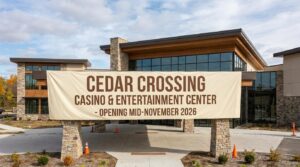
Cedar Crossing Casino & Entertainment Center has confirmed a mid-November 2026 opening date, marking a significant addition to the regional gaming and hospitality landscape. The development, which has been in planning and construction phases for an extended period, positions itself as a multi-faceted entertainment destination rather than a conventional casino floor. With a growing number of states and municipalities leaning into integrated resort-style venues, this project arrives at a moment when the competitive dynamics of regional gaming are shifting fast.
What the Cedar Crossing Opening Signals for Regional Gaming
The announcement carries weight beyond a single venue launch. Here are the strategic takeaways worth watching:
- A mid-November 2026 target gives the property a narrow window to capture holiday-season traffic, arguably one of the most lucrative periods for new entertainment venues
- The “Entertainment Center” branding signals a deliberate pivot toward non-gaming revenue streams, including dining, live events, and hospitality
- Regional casino markets have seen increased saturation in recent years, making differentiation through experience (not just table games) a competitive necessity
- Construction timelines holding firm in the current environment suggests strong financial backing and supply chain management
- Local employment impact during both the construction and operational phases will likely influence municipal support for future gaming expansions in the region
Beyond the Casino Floor: A Broader Entertainment Play
The inclusion of “Entertainment Center” in the venue’s name is not incidental. Across the U.S. gaming industry, operators have increasingly recognized that slot machines and table games alone no longer guarantee foot traffic or repeat visits. Cedar Crossing appears to be following a playbook that prioritizes experiential variety, bundling gaming with live entertainment, food and beverage concepts, and potentially hotel accommodations under one roof.
That shift matters because consumer expectations have changed. Post-pandemic leisure spending patterns show a clear preference for destinations that offer multiple reasons to visit. A casino that also hosts concerts, houses a craft cocktail bar, and runs a weekend brunch operation competes on a fundamentally different axis than one relying solely on gaming revenue.
Still, the question of whether Cedar Crossing can carve out a distinct identity in a crowded market remains open. Not every integrated entertainment venue succeeds in drawing visitors away from established competitors (a distinction that often comes down to programming quality and location accessibility rather than square footage).
Timing and Market Context
Opening in mid-November 2026 is a calculated move. The pre-holiday window offers natural marketing momentum, with consumers already in a spending mindset and looking for new experiences. But it also compresses the operational ramp-up period. Staff training, vendor relationships, and gaming floor calibration all need to be locked in well before doors open.
The broader regional gaming market has seen mixed performance in recent quarters. Some jurisdictions report steady gross gaming revenue growth, while others face declining visitation as competition intensifies. Cedar Crossing Casino & Entertainment Center enters this environment with the advantage of novelty, though sustaining that initial curiosity into long-term loyalty will require more than a grand opening weekend.
Economic Ripple Effects and Community Impact
Large-scale casino and entertainment developments generate economic activity that extends well beyond their walls. Construction-phase spending alone typically supports hundreds of jobs across trades, from electrical work to interior finishing. Once operational, venues of this scale commonly employ between 500 and 1,500 workers depending on scope, spanning gaming operations, hospitality, food service, security, and management roles.
Local governments often view such projects through a dual lens: tax revenue generation and job creation. Gaming tax structures vary by jurisdiction, but a new venue of this caliber can meaningfully boost municipal or county budgets. And while community opposition to casino developments persists in some areas, the economic argument tends to carry significant weight with local officials, particularly in regions where alternative large-scale employment anchors are scarce.
How Venue Positioning Shapes Consumer Perception
From a neuro-linguistic programming perspective, the way Cedar Crossing frames its identity will directly influence how potential visitors perceive and engage with the brand. The language choices in marketing materials, the sensory design of the physical space, and the emotional associations built through early advertising all function as anchoring mechanisms. When a venue positions itself as an “entertainment center” rather than simply a “casino,” it reframes the mental model consumers apply before they ever walk through the door.
This reframing taps into what NLP practitioners call representational systems. Visual cues like architectural design and lighting schemes, auditory elements such as curated soundscapes and live music programming, and kinesthetic triggers including seating comfort and spatial flow all contribute to a visitor’s internal representation of the experience. Cedar Crossing’s success will depend in part on how coherently these sensory channels align with the brand promise.
Even the name itself performs a linguistic function. “Cedar” evokes natural warmth and permanence. “Crossing” implies a meeting point, a convergence. Together, they suggest a destination that feels grounded yet dynamic. Whether intentional or not, these associations shape first impressions at a subconscious level, influencing everything from willingness to drive an extra thirty minutes to likelihood of recommending the venue to friends.
Effective pre-opening campaigns will likely leverage future pacing, an NLP technique that invites audiences to mentally project themselves into a desired future state. Messaging that helps potential guests visualize their experience before it happens builds anticipation and emotional investment, converting passive awareness into active intent.
Frequently Asked Questions
When does Cedar Crossing Casino & Entertainment Center open?
The venue has announced a mid-November 2026 opening date, positioning it to capture early holiday-season traffic.
What makes Cedar Crossing different from a traditional casino?
Its branding as an “Entertainment Center” suggests a broader offering beyond gaming, likely including live entertainment, dining, and hospitality components. The integrated approach reflects an industry-wide trend toward experiential destinations that give visitors multiple reasons to show up and stay longer.
How many jobs could the project create?
While specific employment figures have not been released, venues of comparable scale typically support hundreds of construction jobs and between 500 and 1,500 permanent operational positions.
Will the opening affect the regional gaming market?
Any new entrant reshapes competitive dynamics to some degree. The real test will be whether Cedar Crossing expands the overall market or redistributes existing demand.



