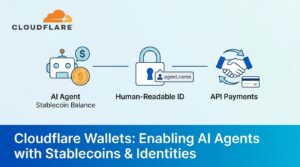
Cloudflare introduced Cloudflare Wallets on Tuesday, equipping AI agents operating on its infrastructure with stablecoin balances and human-readable names for paying for APIs, content, and MCP (Model Context Protocol) tools. The launch completes a two-sided payments architecture: just a month after building the sell side for agent commerce, Cloudflare now controls the buy side. It marks a significant step in the emerging machine-to-machine economy, where autonomous software agents transact without direct human intervention.
Why Stablecoin-Powered Agent Wallets Matter Right Now
The timing here is deliberate. As enterprises race to deploy AI agents capable of independently sourcing data, purchasing compute, and negotiating access to third-party services, the payment layer has remained a stubborn bottleneck. Traditional payment rails weren’t designed for thousands of micro-transactions initiated by non-human actors. Cloudflare’s answer is to embed crypto-native wallets directly into its network fabric, sidestepping legacy financial infrastructure entirely.
Before unpacking the strategic implications, here are the core takeaways from this launch:
- Two-sided agent commerce: Cloudflare now operates both the payment initiation (buy side) and the merchant acceptance (sell side) layers for AI agent transactions on its network
- Stablecoin-denominated balances reduce volatility risk while enabling near-instant settlement, a practical requirement for high-frequency agent-to-agent payments
- Human-readable wallet names give agents a verifiable identity when transacting, which addresses trust and auditability gaps in autonomous commerce
- The product targets a specific use case: agents paying for APIs, licensed content, and MCP tools without requiring human approval for each transaction
- By owning both sides of the payment flow, Cloudflare positions itself as a potential toll collector in the agentic economy (a distinction that competitors will not ignore)
How the Architecture Works
Each AI agent running on Cloudflare’s Workers platform can now be assigned a wallet with a stablecoin balance. That wallet carries a human-readable name, functioning as a kind of digital identity card when the agent initiates a payment. The receiving party sees not just a cryptographic address but a recognizable label tied to the agent’s owner or purpose.
This matters for compliance and audit trails. When an agent autonomously purchases access to a weather data API or licenses a content feed, the transaction is traceable to a named entity. In practice, this bridges the gap between the pseudonymous nature of blockchain transactions and the accountability requirements of enterprise procurement.
And while the underlying settlement uses stablecoins, the experience for developers is abstracted. They configure wallets through Cloudflare’s existing developer tooling rather than wrestling with raw blockchain integrations.
The Sell Side Was Just the Beginning
Last month, Cloudflare rolled out infrastructure allowing developers to monetize their APIs and MCP tools by accepting payments from AI agents. That was the merchant side. Wallets complete the circuit.
Controlling both ends of the transaction creates a network effect that is difficult to replicate piecemeal. A developer who already accepts agent payments through Cloudflare’s platform for AI agent infrastructure has every incentive to also provision wallets for their own agents on the same network. The friction of cross-platform settlement disappears. The data stays unified. Arguably, this is Cloudflare’s most consequential infrastructure play since it expanded from CDN into serverless compute.
What This Signals for the Agentic Economy
The broader industry context is worth examining. Multiple cloud providers and AI platforms are building agent frameworks, but few have addressed the payment question with this level of specificity. Most assume agents will transact through existing billing APIs or OAuth-gated subscription models. Cloudflare is betting that autonomous agents need their own financial primitives.
That bet carries risk. Regulatory frameworks for autonomous software conducting financial transactions remain underdeveloped in most jurisdictions. Whether a stablecoin wallet assigned to an AI agent falls under money transmission rules, for instance, is a question regulators have not yet answered definitively. Still, by building on stablecoins rather than proprietary tokens, Cloudflare avoids some of the more contentious regulatory territory.
Reframing Developer Identity in Machine Commerce
One underappreciated dimension of this launch is what it does to the concept of identity in automated systems. Traditional API commerce relies on API keys and OAuth tokens for authentication. These are functional but opaque. A human-readable wallet name introduces something closer to reputation: an agent that pays reliably under a known identity builds trust over time, much the way a business builds credit history.
This reframing has implications beyond payments. If agents carry persistent, named identities across transactions, those identities become assets. They accumulate transaction history, reliability scores, and spending patterns. The agent’s wallet name becomes, in effect, its brand. Whether Cloudflare intends to build reputation layers on top of this foundation remains an open question, but the architectural groundwork is now in place.
Frequently Asked Questions
| Question | Answer |
|---|---|
| What stablecoins do Cloudflare Wallets support? | Cloudflare has not publicly specified which stablecoins are supported at launch. The company has confirmed that wallets hold stablecoin balances, suggesting integration with at least one major stablecoin. |
| Do developers need blockchain expertise to use this? | No. The wallet functionality is abstracted through Cloudflare’s existing developer tools. |
| Is this available to all Cloudflare customers? | Availability details have not been fully disclosed. Given that the product targets AI agents running on Cloudflare Workers, it is likely tied to that platform’s access tiers, though the company has not confirmed whether free-tier users are included. |
| How does this relate to MCP tools? | MCP (Model Context Protocol) tools allow AI agents to interact with external services. Cloudflare Wallets enable agents to pay for access to these tools autonomously, completing the commercial loop. |
Whether the agentic economy scales as fast as its proponents predict or hits regulatory and technical friction first, Cloudflare has placed itself at a chokepoint that few competitors currently occupy. Owning both sides of the payment flow for AI agents is not just a product launch. It is an infrastructure thesis.



