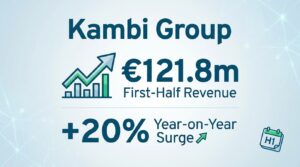
Kambi Group, the Stockholm-listed B2B sports betting supplier, reported first-half 2024 revenue of €121.8 million, representing a 20% increase compared to the same period last year. The growth reflects both expanding operator partnerships and a broader uptick in regulated market activity across multiple geographies. For a company that has spent the past two years navigating operator consolidation and competitive pressure from in-house sportsbook builds, the result signals a notable stabilisation. And while the headline number tells one story, the composition of that growth tells another.
What Kambi’s First-Half Numbers Reveal About B2B Betting Momentum
Before breaking down the figures, it is worth framing what this kind of revenue trajectory means for a pure-play B2B sportsbook technology provider operating in an increasingly fragmented supplier landscape. Kambi’s model depends on long-term operator contracts and turnover-based fees, which makes revenue growth a proxy for both client acquisition and underlying betting volumes.
- First-half revenue reached €121.8m, up 20% year-on-year, driven by operator expansion in the Americas and sustained European volumes
- The growth comes after a period of client losses, including the high-profile departure of DraftKings, which moved to a proprietary platform
- Kambi’s ability to replace lost revenue with new operator signings suggests its modular sportsbook offering retains competitive pull in mid-market and emerging regulated jurisdictions
- Kambi’s turnover-based B2B sportsbook platform continues to benefit from regulatory expansion in US states and Latin American markets
- Margin performance and EBITDA trajectory will be closely watched in the second half, particularly as the company absorbs integration costs from recent partnerships
Where the Growth Actually Came From
Not all revenue is created equal, and Kambi’s first-half performance draws from a mix of mature European markets and faster-growing American ones. The Americas segment has been the company’s most aggressive growth vector since 2021, with state-by-state US legalisation and new Latin American licensing frameworks opening doors that didn’t exist five years ago.
European revenue, meanwhile, remains the backbone. Operators in markets like the UK, Sweden, and the Netherlands continue to generate steady turnover through Kambi’s platform, even as regulatory tightening (particularly around affordability checks and stake limits) introduces friction. That Kambi managed 20% top-line growth despite these headwinds is telling.
One question lingers: how much of this growth is organic volume expansion versus new client onboarding? The distinction matters. Organic growth suggests deepening market penetration. New client revenue, by contrast, carries higher upfront costs and longer payback periods. Kambi has not broken out the split in granular detail.
The Strategic Landscape for B2B Sportsbook Providers
Kambi operates in a segment of the gambling industry that has been under structural pressure. Several tier-one operators have moved toward proprietary technology stacks, reducing their reliance on third-party suppliers. DraftKings’ departure was the most visible example, but the trend extends to other large-scale operators evaluating build-versus-buy decisions.
Still, the economics of building an in-house sportsbook are punishing. Development costs run into the hundreds of millions, and maintaining a competitive product across dozens of sports and thousands of markets requires sustained investment in trading, pricing algorithms, and regulatory compliance tooling. For mid-tier operators (a distinction that arguably defines Kambi’s core addressable market), outsourcing to a specialist remains the rational choice.
That dynamic helps explain Kambi’s resilience. The company has repositioned itself not as a one-size-fits-all platform, but as a modular provider capable of offering full turnkey solutions or selective components like odds feeds and risk management. This flexibility has attracted operators who want best-in-class trading without the capital expenditure of a full build.
Revenue Growth in Context
| Metric | H1 2024 | H1 2023 | Change |
|---|---|---|---|
| Revenue | €121.8m | ~€101.5m | +20% |
| Primary Growth Driver | Americas expansion + European stability | European core | Shift toward Americas |
| Key Risk Factor | Operator consolidation and in-housing trend | DraftKings migration impact | Risk partially absorbed |
Regulatory Tailwinds and What They Mean for H2
Kambi’s second-half outlook depends heavily on two variables: the pace of new market openings and the retention rate of existing operator contracts. Brazil’s regulated sports betting market, set to formalise operations in 2025, represents one of the largest untapped opportunities for B2B suppliers globally. Kambi has already signalled interest in the market through preliminary partnerships.
In the US, additional state-level legalisation continues to expand the addressable market, though the pace has slowed compared to the 2021–2022 wave. What remains less clear is whether Kambi can capture meaningful share in newly regulated states where established operators already hold dominant positions.
European regulatory developments cut both ways. Stricter responsible gambling requirements increase compliance complexity, which favours suppliers with mature regulatory tooling. But they also compress operator margins, which can reduce the turnover-based fees that flow to Kambi.
How Market Perception Shapes Supplier Valuation
Beyond the numbers, Kambi’s trajectory raises a broader question about how the market values B2B sports betting infrastructure. Investors have historically applied a discount to B2B models relative to B2C operators, partly because revenue visibility depends on client retention and partly because the in-housing trend introduced existential uncertainty.
A 20% revenue increase challenges that narrative. It suggests the addressable market for outsourced sportsbook technology is not shrinking but shifting, moving from a handful of mega-operators toward a longer tail of regional and mid-market players who need sophisticated technology without the overhead. Kambi’s ability to serve that segment profitably will determine whether this growth rate is sustainable or a one-off rebound.
Frequently Asked Questions
What does Kambi Group do?
Kambi is a B2B sports betting technology provider that supplies sportsbook platforms, odds compilation, and risk management services to licensed gambling operators worldwide. It does not operate any consumer-facing betting brands.
Why did Kambi’s revenue grow 20% in H1 2024?
The increase was driven by new operator partnerships, expansion in the Americas, and stable European betting volumes. The company has also benefited from regulatory expansion in several jurisdictions that created demand for turnkey sportsbook solutions.
Is Kambi affected by operators building their own sportsbooks?
Yes, and this has been a material concern. The departure of DraftKings to a proprietary platform was a significant revenue loss. However, Kambi has offset this by targeting mid-tier operators and offering modular technology components, which reduces the all-or-nothing risk of its earlier business model.
What markets are most important for Kambi’s growth?
The Americas, particularly the United States and emerging Latin American markets like Brazil, represent the highest growth potential. European markets remain important for baseline revenue stability but face increasing regulatory pressure that could moderate growth.



