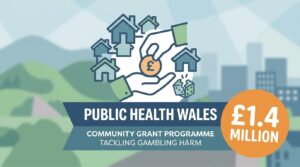
Public Health Wales has rolled out a £1.4 million grant programme aimed at community organisations working to prevent gambling-related harm across the country. The initiative targets grassroots groups and third-sector bodies that engage directly with populations most vulnerable to gambling’s downstream effects. Funded through existing public health budgets, the programme signals a shift toward localised, prevention-first approaches in a policy area historically dominated by treatment-focused interventions. It also arrives at a moment when regulators and health bodies across the UK are recalibrating how they define and respond to gambling harm.
What the Grant Programme Means for Community-Level Prevention
Before unpacking the strategic detail, here is what matters most for stakeholders tracking gambling harm policy and public health funding in Wales.
- The £1.4 million fund is open to community organisations delivering prevention-focused work, not solely treatment or crisis intervention
- Public Health Wales is positioning gambling harm as a public health issue rather than an individual behavioural problem, a framing that carries policy implications well beyond this single programme
- Grassroots reach: the programme prioritises organisations already embedded in communities where gambling harm concentrates, including areas of higher deprivation
- Funding of this scale from a devolved public health body could set a precedent for similar initiatives in Scotland and England
- The grant structure encourages multi-agency collaboration, linking gambling harm prevention with broader determinants of health such as housing, debt, and mental health support
Why Prevention Over Treatment?
For years, the dominant model for addressing gambling harm in the UK has leaned heavily on clinical treatment pathways. Counselling services, helplines, self-exclusion schemes. All necessary, but all reactive. What Public Health Wales’s gambling harm prevention programme does differently is fund the work that happens before someone reaches crisis point.
That shift matters because the evidence base increasingly supports upstream intervention. Research published by the Lancet Public Health Commission on gambling in 2023 argued that harm from gambling is not confined to those who meet clinical thresholds for addiction. It radiates outward, touching families, workplaces, and social networks. By funding community organisations that already operate in these spaces, Public Health Wales is arguably building infrastructure for a population-level response rather than patching individual outcomes.
Still, questions remain about measurement. How will the programme evaluate whether prevention is working when the outcomes it seeks to avoid (problem gambling, debt, relationship breakdown) are diffuse and long-latency?
Who Qualifies and How the Funding Works
The grant programme targets organisations with existing community presence and credibility. This is not a call for new entities to spin up gambling-specific services from scratch. Instead, it favours groups already doing adjacent work in mental health, youth engagement, financial inclusion, or community development that can integrate gambling harm awareness into their existing programmes.
Eligibility criteria include:
- Demonstrated track record of community engagement in Wales
- Capacity to deliver prevention-oriented activities (not exclusively treatment)
- Willingness to participate in programme-level evaluation and data sharing
- Alignment with Public Health Wales’s broader strategic priorities around health equity
Grant amounts vary depending on project scope and organisational capacity. Some awards may be modest, designed to seed pilot activity. Others could fund multi-year programmes with dedicated staffing. The flexibility is deliberate (and somewhat unusual for public health grants of this type).
A Broader Regulatory and Policy Context
This programme does not exist in isolation. The UK government’s 2023 Gambling Act review white paper proposed a range of reforms, from stake limits on online slots to mandatory levy discussions. Wales, operating within a devolved public health framework, has the latitude to move faster on community-level interventions than Westminster can on regulatory reform.
And while the Gambling Commission retains UK-wide licensing authority, public health responses to gambling harm are increasingly shaped at the national and local level. Public Health Wales joins a growing cohort of health bodies treating gambling not as a leisure regulation issue but as a determinant of population health, alongside alcohol, tobacco, and diet.
| Dimension | Traditional Approach | Public Health Wales Model |
|---|---|---|
| Focus | Individual treatment | Community-level prevention |
| Funding recipients | Clinical services, charities | Grassroots and third-sector organisations |
| Measurement | Treatment outcomes, referrals | Population health indicators, engagement reach |
| Policy framing | Behavioural/addiction | Social determinants of health |
| Geographic scope | UK-wide programmes | Wales-specific, community-embedded delivery |
How Community Framing Reshapes Perception of Gambling Harm
One of the less discussed but potentially more consequential aspects of this programme is how it reframes gambling harm in public consciousness. When funding flows to community organisations rather than clinical providers alone, the implicit message changes. Gambling harm stops being something that happens to “problem gamblers” and becomes something that affects neighbourhoods, families, and local economies.
This reframing draws on principles familiar to public health communication: anchoring abstract risks in lived, local experience. A community centre running financial literacy workshops that include gambling awareness reaches people who would never call a helpline. A youth organisation embedding conversations about online betting into its programmes normalises early intervention in ways that clinical pathways cannot.
The psychological dimension here is worth noting. When people encounter gambling harm messaging in trusted, familiar environments rather than through clinical or regulatory channels, their receptivity shifts. Resistance drops. Engagement becomes less stigmatised. This is, at its core, a communication strategy as much as a funding one, built on the understanding that where and how a message lands determines whether it lands at all. Community trust acts as a multiplier that no advertising budget can replicate.
By embedding prevention into the fabric of everyday community life, the programme also creates feedback loops. Local organisations gather intelligence about emerging patterns of harm, feeding that data back to Public Health Wales in ways that centralised surveillance systems often miss. The value here is not just in preventing harm but in detecting it earlier and understanding it better.
Frequently Asked Questions
Who can apply for the Public Health Wales gambling harm prevention grants?
Community organisations and third-sector bodies operating in Wales with an established track record of local engagement. Applicants do not need to be gambling-specific organisations but must demonstrate how they will integrate harm prevention into their work.
How much funding is available per organisation?
The total programme budget is £1.4 million, distributed across multiple grants. Individual award sizes vary based on project scope, and the programme accommodates both smaller pilot initiatives and larger multi-year efforts.
Does this replace existing gambling treatment services in Wales?
No. The programme is designed to complement, not replace, clinical treatment pathways. Its focus sits upstream, on prevention and early intervention rather than crisis response. Existing services such as the National Gambling Helpline continue to operate independently.
Is this the first programme of its kind in the UK?
At this scale and with this explicit community-prevention focus from a devolved public health body, it breaks relatively new ground. Other UK nations have funded gambling harm work, but the structural emphasis on grassroots delivery and population health framing distinguishes this initiative.



