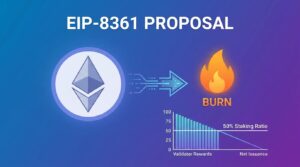
A group of six authors, led by Ethereum Foundation researcher Justin Drake, published a draft proposal on August 4 that could fundamentally alter how Ethereum handles consensus-layer issuance. Numbered EIP-8361 in its pull request, the proposal introduces a mechanism to burn an increasing fraction of validator rewards as the proportion of staked ETH rises, targeting zero net consensus-layer issuance once the staking ratio hits 50%. The move signals a deliberate effort to address growing concerns about ETH inflation and the economic sustainability of Ethereum’s proof-of-stake model.
What EIP-8361 Means for Ethereum’s Monetary Policy
Before diving into the strategic implications, it’s worth understanding the core mechanics. Under the current system, validators earn rewards for securing the network, and those rewards contribute to ETH supply expansion. EIP-8361 proposes a burn curve: the higher the staking participation rate, the larger the share of validator rewards that gets destroyed. At a 50% staking ratio, the burn would offset issuance entirely.
- The proposal targets a self-regulating equilibrium where staking participation directly governs ETH supply dynamics, creating a feedback loop between security incentives and monetary policy.
- Net issuance drops to zero at 50% staking, a threshold that Ethereum has been gradually approaching as liquid staking protocols expand.
- Validator profitability would compress at higher staking ratios, potentially discouraging over-concentration of staked ETH and reducing centralization risks.
- If adopted, this would make Ethereum one of the few major blockchain networks with a built-in deflationary pressure mechanism tied directly to network participation rather than transaction fees alone.
- The proposal complements EIP-1559’s base fee burn, layering a second deflationary force on the consensus side of Ethereum’s economics.
The Architects Behind the Proposal
Justin Drake has long been one of the more vocal researchers within the Ethereum Foundation’s research division on questions of issuance policy. His involvement lends the draft significant weight, though it remains early-stage. Five co-authors contributed to the proposal, reflecting a collaborative effort rather than a solo initiative. That matters because Ethereum’s governance culture tends to advance proposals faster when they carry broad researcher support from the outset.
Still, a draft is a draft.
The EIP process is long, contested, and frequently unpredictable. Proposals with strong initial backing have stalled before, and ones that seemed marginal have occasionally gained momentum through community pressure. Whether EIP-8361 follows the path of EIP-1559 (a contentious but ultimately successful reform) or fades into the archive of abandoned ideas depends heavily on validator sentiment and the broader staking ecosystem’s reaction over the coming months.
Why the Timing Raises Questions
Ethereum’s staking ratio has been climbing steadily since the Merge in September 2022. As of mid-2025, roughly 30% of all ETH is staked, with liquid staking derivatives from protocols like Lido accounting for a substantial share. The trajectory suggests 50% is not a distant hypothetical; it could arrive within 18 to 24 months at current growth rates. That makes EIP-8361 less of an abstract thought experiment and more of a pre-emptive policy tool.
But the timing also coincides with renewed debate about whether Ethereum’s current issuance rate is too generous to validators relative to the security they provide. Some researchers have argued that Ethereum is “overpaying” for security, a position that has drawn pushback from validator operators who point to rising infrastructure costs and the opportunity cost of locked capital. EIP-8361 doesn’t resolve that tension so much as it formalizes one side of the argument into protocol logic.
How Burn Mechanics Could Reshape Staking Economics
The burn curve introduces a dynamic that liquid staking protocols, solo validators, and institutional stakers will need to model carefully. Consider the incentive structure: as more ETH gets staked, individual validator returns shrink not just from dilution (more validators sharing the same reward pool) but from active destruction of a portion of those rewards. The compounding effect could be significant.
| Staking Ratio | Estimated Burn Rate | Net Issuance Impact |
|---|---|---|
| 25% | Low | Positive net issuance, reduced from current levels |
| 35% | Moderate | Substantially lower issuance, approaching breakeven |
| 50% | Full offset | Zero net consensus-layer issuance |
| 60%+ | Exceeds issuance | Net deflationary on consensus layer (a scenario the authors appear to have designed for deliberately) |
For liquid staking protocols, compressed yields could accelerate competition on fee structures and push innovation in restaking and DeFi composability. Solo validators operating on thin margins might find the economics increasingly difficult to justify, which introduces a centralizing pressure that somewhat contradicts one of the proposal’s stated goals.
Framing the Narrative: Scarcity as a Design Choice
Ethereum has spent years building a narrative around “ultrasound money,” the idea that ETH can be both a productive asset and a deflationary one. EIP-8361 would, arguably, be the most direct codification of that narrative into protocol rules. Where EIP-1559 made fee burns automatic, this proposal would make issuance burns responsive to network state. The distinction matters: one is passive, the other adaptive.
And while Bitcoin’s scarcity derives from a fixed supply cap, Ethereum’s approach under EIP-8361 would create scarcity through dynamic equilibrium. Neither model is inherently superior, but they appeal to fundamentally different economic philosophies. Whether Ethereum’s community is ready to commit to this particular version of monetary self-regulation remains an open question, one that the EIP process will test rigorously.
Frequently Asked Questions
What is EIP-8361?
EIP-8361 is a draft Ethereum Improvement Proposal that would burn a progressively larger share of validator rewards as the staking ratio increases, reaching zero net consensus-layer issuance at a 50% staking ratio.
Who proposed it?
The proposal was authored by six contributors, with Ethereum Foundation researcher Justin Drake among the lead authors. It was published as a draft pull request on August 4.
Would this make ETH deflationary?
At staking ratios above 50%, the consensus-layer burn would exceed issuance, creating net deflation on that layer. Combined with EIP-1559’s transaction fee burns, the overall supply dynamics could tilt deflationary under certain network conditions, though outcomes depend on transaction volume and staking participation simultaneously.
Is this proposal likely to be adopted?
It’s far too early to say. The EIP process involves extensive community review, technical auditing, and political negotiation among stakeholders. Strong researcher backing helps, but validator opposition or unforeseen technical complications could delay or derail it entirely.



