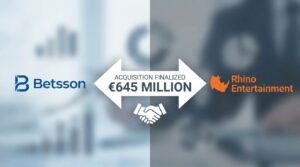
Betsson AB has closed its €645 million (approximately $743 million) acquisition of Rhino Entertainment, marking one of the more significant consolidation moves in the European gambling sector this year. The deal, which had been anticipated by industry observers for several months, reshapes Betsson’s portfolio and extends its operational footprint into new verticals and markets. And while the headline figure commands attention, the strategic calculus behind the transaction tells a more layered story.
What the Rhino Entertainment Deal Signals for Betsson’s Strategy
Before unpacking the specifics, it’s worth framing what this acquisition means in practical terms for both companies and the broader competitive landscape. The deal isn’t merely about scale; it reflects a deliberate pivot toward diversified revenue streams at a time when regulatory pressures across Europe continue to tighten margins for operators reliant on single-market dominance.
- Market consolidation accelerates: At €645 million, this ranks among the largest European iGaming acquisitions in 2024–2025, reinforcing a trend of mid-tier operators being absorbed by larger, multi-licensed groups.
- Revenue diversification: Rhino Entertainment’s portfolio gives Betsson access to player segments and product verticals it previously underserved.
- The deal strengthens Betsson’s hand in regulated markets where local licensing requirements favour operators with broader brand ecosystems.
- Competitive positioning: With Flutter, Entain, and Kindred all recalibrating their European strategies, Betsson’s move positions it as a more formidable counterweight in Tier 2 and Tier 3 markets.
- Integration risk remains the open question — Betsson has historically grown organically, and absorbing an entity of this size will test its operational infrastructure.
The Financial Architecture Behind the Transaction
The €645 million price tag, roughly $743 million at current exchange rates, was funded through a combination of existing cash reserves and structured debt facilities. Betsson’s corporate treasury had signalled capacity for a deal of this magnitude in its most recent annual report, where the company outlined a war chest earmarked for strategic M&A.
Still, the valuation raises questions. Rhino Entertainment’s reported EBITDA figures suggest a multiple that sits at the higher end of recent comparable transactions in the sector. Whether Betsson paid a premium for speed — securing the asset before rival bidders could formalise offers — or whether Rhino’s forward-looking revenue projections justified the price remains a point of debate among analysts (not all of whom are convinced the synergies will materialise as quickly as management expects).
One thing is clear: the deal was structured to close quickly. From announcement to completion, the timeline was compressed relative to transactions of similar scale, suggesting both parties had strong incentives to avoid a protracted process.
Regulatory Dimensions Worth Watching
Any acquisition of this size in the European gambling industry inevitably draws regulatory scrutiny. Betsson operates under multiple licences across jurisdictions including Malta, Sweden, and several Latin American markets. Rhino Entertainment’s own licensing portfolio, while less geographically dispersed, includes authorisations in jurisdictions where Betsson previously lacked a direct presence.
The combined entity will need to navigate overlapping compliance obligations. In practice, this means harmonising responsible gambling frameworks, anti-money laundering protocols, and reporting standards across what is now a significantly larger operational footprint. Regulators in Sweden’s Spelinspektionen and Malta’s MGA will likely monitor the integration closely.
How This Reshapes the Competitive Landscape
European iGaming has entered a phase where organic growth alone rarely delivers the returns shareholders demand. Flutter’s expansion into the US, Entain’s restructuring efforts, and Kindred’s delisting from Nasdaq Stockholm have all reshaped the competitive map. Betsson’s acquisition of Rhino Entertainment is, arguably, its clearest answer to these shifts.
By absorbing Rhino’s technology stack and customer base, Betsson gains operational leverage that would have taken years to build internally. The company also inherits Rhino’s B2B partnerships, which could prove equally valuable. Less clear is how Betsson plans to retain Rhino’s key technical talent during the integration period — a challenge that has derailed more than one promising acquisition in this sector.
What Operators and Stakeholders Should Consider
For executives tracking consolidation patterns in regulated gambling markets, this deal offers several reference points worth internalising. The framing matters: this isn’t just a financial transaction but a signal about where the industry’s centre of gravity is shifting.
Operators considering their own M&A strategies should note the speed of execution. Betsson moved decisively, which compressed the window for competing bids. That approach carries risk, but in a market where quality acquisition targets are increasingly scarce, hesitation can be costlier than overpaying.
Investors, meanwhile, should watch Betsson’s next two quarterly reports closely. Integration costs, revenue retention from Rhino’s existing player base, and any regulatory conditions attached to licence transfers will all surface in those filings. The numbers will tell the real story.
Frequently Asked Questions
How much did Betsson pay for Rhino Entertainment?
Betsson completed the acquisition for €645 million, equivalent to approximately $743 million at the time of closing.
Why is this acquisition significant for the European iGaming market?
It represents one of the largest single-operator acquisitions in the European gambling sector in recent years, accelerating a broader trend of market consolidation among licensed operators. The deal also gives Betsson access to new markets and product lines that strengthen its competitive position against larger rivals like Flutter and Entain.
What are the main risks associated with the deal?
Integration complexity tops the list. Betsson has historically favoured organic growth, so absorbing an entity of Rhino’s scale is operationally unfamiliar territory. Regulatory harmonisation across multiple jurisdictions and talent retention during the transition period also present material risks.