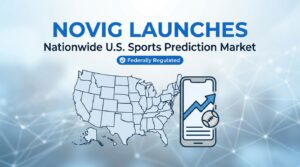
Novig, a sports prediction market platform operating under federal regulation, has opened access to users across all 50 U.S. states. The launch marks a notable expansion for a company that has positioned itself outside the patchwork of state-by-state sports betting frameworks, instead securing oversight at the federal level through the Commodity Futures Trading Commission (CFTC). For an industry long defined by jurisdictional fragmentation, the move raises questions about how prediction markets and traditional sportsbooks will coexist going forward.
What Novig’s Nationwide Rollout Signals for the Prediction Market Landscape
The significance of Novig’s expansion extends well beyond geographic reach. By operating under CFTC oversight rather than state gaming commissions, the platform occupies a regulatory lane that most sports betting operators have either avoided or been unable to access. Here are the strategic takeaways worth watching:
- Federal vs. state jurisdiction: Novig sidesteps the complex, costly process of obtaining individual state licenses, a barrier that has slowed even well-capitalized sportsbook operators like DraftKings and FanDuel.
- Market structure differentiation: Prediction markets function as peer-to-peer exchanges rather than house-banked books, which fundamentally alters the risk model and margin structure.
- The CFTC’s willingness to oversee sports-adjacent event contracts has been tested before, most visibly with Kalshi’s push into election prediction markets. Novig’s approval suggests the agency is growing more comfortable with this asset class.
- Consumer access: Users in states where sports betting remains unlicensed can now participate in sports-linked prediction contracts, a development state regulators have not yet publicly addressed.
- Traditional sportsbooks may face indirect competitive pressure, not on odds necessarily, but on the perception of fairness and transparency that exchange-based models tend to project.
How Federal Regulation Changes the Playing Field
Most Americans associate legal sports wagering with the post-PASPA era, the period after the Supreme Court’s 2018 decision that allowed states to authorize sports betting individually. Since then, more than 30 states have launched regulated markets, each with its own licensing regime, tax structure, and operational rules. Novig’s approach bypasses all of that.
Operating as a CFTC-regulated exchange means Novig’s contracts are classified as event-based derivatives, not wagers in the traditional sense (a distinction regulators have been slow to enforce consistently). That classification matters. It determines which agency has authority, what consumer protections apply, and whether state-level prohibitions on sports betting even reach the platform’s activity.
Still, the legal boundaries are not fully settled. The CFTC has faced pushback from state regulators and members of Congress who argue that event contracts tied to sports outcomes are functionally indistinguishable from sports bets. Whether that tension escalates now that Novig is live in all 50 states remains an open thread.
Prediction Markets vs. Traditional Sportsbooks: A Quick Comparison
| Feature | Traditional Sportsbook | Prediction Market (e.g., Novig) |
|---|---|---|
| Regulatory body | State gaming commission | CFTC (federal) |
| Market model | House-banked | Peer-to-peer exchange |
| Geographic availability | State-by-state licensing | Nationwide under federal framework |
| Odds/pricing | Set by operator | Determined by market participants |
| Revenue model | Spread/vig on losing bets | Transaction fees on matched contracts, typically more transparent to the user |
Why This Matters Beyond Sports
Prediction markets have been gaining institutional credibility for years, but mostly in political and economic forecasting. Polymarket’s surge during the 2024 U.S. presidential election cycle demonstrated that real demand exists for event-based trading among retail participants. Novig’s bet is that sports, with its built-in audience of millions and near-daily event cycles, can sustain even deeper liquidity.
And while the platform’s immediate appeal is to sports fans, the underlying infrastructure could eventually support contracts on a much wider range of outcomes. That possibility is arguably what makes Novig’s federally regulated prediction exchange interesting not just as a product launch, but as a regulatory precedent.
The Behavioral Edge: Why Prediction Markets Attract a Different Kind of Participant
There is a psychological dimension to prediction markets that traditional sportsbooks rarely tap into. In neuro-linguistic programming terms, the framing effect matters enormously. When a user places a “bet,” the mental model defaults to gambling, with all the emotional baggage and risk aversion that entails. But when the same user “buys a contract” on a sporting outcome, the cognitive frame shifts toward investment, analysis, and informed decision-making.
This reframing is not cosmetic. It changes behavior. Research in behavioral economics has shown that individuals operating within an investment frame tend to engage in more deliberate information processing, weigh probabilities more carefully, and exhibit less impulsive decision-making. Prediction markets, by design, reward calibration over conviction. The better you are at estimating true probabilities, the more consistently you profit.
Novig’s exchange model reinforces this dynamic. Because prices reflect aggregated market sentiment rather than a bookmaker’s margin-adjusted lines, participants receive real-time feedback on how their beliefs compare to the crowd’s. That feedback loop creates what psychologists call a “mastery orientation,” where users are motivated by accuracy and learning rather than pure outcome dependence. For a platform seeking long-term user retention, that behavioral architecture may prove more durable than the dopamine-driven engagement cycles that characterize most sports betting apps.
The anchoring effect also plays a role. Traditional sportsbooks anchor users to preset odds. Prediction markets let users set their own price, which fosters a sense of agency and ownership over the decision. In practice, this tends to produce more engaged, more analytical participants, exactly the user base a low-margin exchange model needs to thrive.
What Comes Next?
Several dynamics will shape how this story develops. State regulators could challenge the CFTC’s jurisdiction, particularly in states where sports betting generates significant tax revenue. Established sportsbook operators may lobby against what they view as an uneven regulatory playing field. And consumer advocacy groups will likely scrutinize whether federal oversight provides adequate protections for retail participants trading event contracts.
But the most consequential question might be simpler: will users actually show up? Prediction markets have historically struggled with liquidity outside of marquee events. Sports offers a natural advantage here, with thousands of games across major leagues each year. Whether Novig can convert that volume into a functioning, liquid marketplace will determine if this launch is a milestone or a footnote.
Frequently Asked Questions
How is Novig different from a regular sportsbook?
Novig operates as a peer-to-peer prediction exchange regulated by the CFTC, not a state gaming commission. Users trade contracts against each other rather than betting against the house, which typically results in more transparent pricing.
Is Novig legal in all 50 states?
Yes, at least on paper. Because it falls under federal CFTC regulation rather than state gaming law, Novig is accessible nationwide. Whether individual states will challenge this framework remains to be seen.
Do prediction markets offer better odds than sportsbooks?
Exchange-based models generally carry lower built-in margins than traditional sportsbooks, which means pricing can be more favorable. That said, liquidity and market depth vary, and thin markets can produce wider spreads that offset any structural advantage.