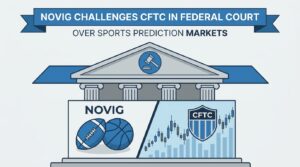
Novig, a sports prediction market platform, has filed a federal lawsuit challenging the Commodity Futures Trading Commission’s authority to regulate event contracts tied to sporting outcomes. The legal action, filed in a U.S. district court, represents a direct challenge to the CFTC’s longstanding position that sports-related event contracts fall under its jurisdiction and are effectively banned from regulated exchanges. If successful, the case could redraw the boundary between prediction markets and traditional sports betting in ways that neither regulators nor sportsbooks have fully anticipated.
What Novig’s Federal Challenge Means for Prediction Markets
The lawsuit arrives at a moment when prediction markets are gaining mainstream traction, yet regulatory clarity remains elusive. Platforms like Kalshi and Polymarket have tested the limits of what the CFTC will permit, but sports have remained the clearest red line. Novig is now asking a court to erase that line entirely. Here’s what matters most from a strategic standpoint:
- Direct constitutional challenge: Novig argues the CFTC lacks statutory authority to impose a blanket prohibition on sports-related event contracts, framing the ban as an overreach of the agency’s mandate under the Commodity Exchange Act.
- The case could establish judicial precedent that separates prediction markets from gambling classifications, a distinction regulators have been slow to enforce.
- Competitive implications: A ruling in Novig’s favor would open the door for CFTC-regulated exchanges to offer sports prediction contracts, potentially pulling volume away from state-licensed sportsbooks.
- Timing is strategic: The filing comes amid broader deregulatory sentiment in Washington and growing bipartisan interest in prediction market innovation.
- State gaming commissions, which currently hold jurisdiction over sports wagering through post-PASPA frameworks, could find their authority challenged indirectly.
The Regulatory Fault Line Between Prediction and Wagering
At the core of this dispute sits a question that sounds simple but has confounded regulators for years: when does a prediction contract become a bet? The CFTC has historically treated event contracts on sports as “activity contracts” under the Dodd-Frank Act, which grants the agency power to block contracts it deems contrary to the public interest. Novig’s filing reportedly contests whether that provision was ever intended to apply so broadly.
The distinction matters enormously. Prediction markets, at least on paper, serve a price-discovery function. They aggregate information from participants who have skin in the game, producing probability estimates that academic research has shown to be remarkably accurate. Sports betting, by contrast, operates through licensed bookmakers who set odds and manage risk. The economic mechanics differ, even if the surface-level activity looks similar.
But here’s where it gets thorny. State regulators built their post-2018 sports betting frameworks on the assumption that the CFTC would keep prediction markets away from sports. If a federal court disagrees, the resulting jurisdictional overlap could create compliance headaches for platforms operating in both spaces.
Why This Case Surfaces Now
Novig’s timing is not accidental. The prediction market sector has gained significant momentum following Kalshi’s partial legal victory against the CFTC over election-related contracts in 2024. That case demonstrated that courts are willing to scrutinize the CFTC’s use of its public interest authority rather than defer automatically. Novig appears to be leveraging that precedent, extending the argument into the one category the CFTC has defended most aggressively.
There’s also a political dimension. The current administration has signaled openness to financial innovation and lighter regulatory touch across several agencies. Whether that translates into weaker CFTC enforcement posture remains uncertain, but the environment arguably favors challengers more than it has in years.
How Stakeholders Are Positioned
| Stakeholder | Current Position | Potential Impact |
|---|---|---|
| Novig | Plaintiff challenging CFTC authority | Could operate sports prediction contracts on a regulated exchange if successful |
| CFTC | Defends blanket prohibition on sports event contracts | Risks losing regulatory scope over a fast-growing asset class |
| State Gaming Commissions | Hold exclusive jurisdiction over sports wagering post-PASPA | May face competing federal framework for sports-adjacent products |
| Traditional Sportsbooks | Operate under state licenses with established tax and compliance structures | New competitive pressure from exchange-based prediction models with potentially lower costs |
| Other Prediction Platforms | Watching from the sidelines, some with their own CFTC disputes | A favorable ruling would validate broader market expansion strategies |
The Broader Shift in Market Structure
What makes Novig’s challenge to CFTC sports contract restrictions particularly consequential is the structural argument underneath it. Exchange-based prediction markets operate on a peer-to-peer model. There is no house edge in the traditional sense. Participants trade contracts that settle at zero or one based on an outcome, and the platform earns revenue through transaction fees rather than by taking the opposite side of a wager.
This model, proponents argue, produces tighter spreads and more efficient pricing than traditional sportsbooks. It also sidesteps some of the consumer protection concerns that animate state gambling regulators, since participants are trading standardized contracts rather than placing bets against a bookmaker with an information advantage.
Still, not everyone sees it that way. Critics point out that the practical experience for a retail user placing a prediction contract on a football game is indistinguishable from placing a bet. The economic wrapper may differ, but the behavioral reality does not. And that behavioral reality is precisely what state gambling laws were designed to regulate.
Frequently Asked Questions
What is Novig arguing in its lawsuit against the CFTC?
Novig contends that the CFTC does not have the statutory authority to impose a blanket ban on event contracts tied to sports outcomes. The company argues the agency has overextended its public interest powers under the Commodity Exchange Act.
How does this differ from the Kalshi case?
Kalshi’s dispute centered on election-related event contracts. Novig is pushing into sports, which the CFTC has guarded far more aggressively. A win here would break open the last major category the agency has kept off-limits.
Could this affect state-regulated sports betting?
Potentially, yes. If federally regulated exchanges begin offering sports prediction contracts, state-licensed sportsbooks could face a new class of competitor operating under a different regulatory framework, one that may carry lower compliance costs and no state-level tax obligations on gross gaming revenue.
When might a ruling come?
Federal litigation of this complexity typically takes months to reach meaningful procedural milestones. Given the CFTC’s likely opposition and the possibility of appeals, a definitive resolution could stretch well into 2026.