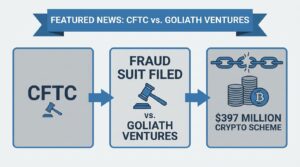
The U.S. Commodity Futures Trading Commission has filed a civil enforcement action against Goliath Ventures Inc. and its CEO Christopher Delgado, accusing the Florida-based firm of defrauding approximately 1,600 customers out of at least $397 million. The complaint alleges the company solicited funds by promising to deploy customer bitcoin and ether into decentralized exchange liquidity pools, generating outsized returns. Instead, according to the CFTC, the operation functioned as a classic misappropriation scheme. The case marks yet another aggressive move by the derivatives regulator into the digital asset enforcement space.
What the CFTC Complaint Reveals About the Alleged Scheme
Before unpacking the strategic implications, here’s what matters most for market participants and compliance teams watching this case unfold:
- Scale of alleged fraud: At least $397 million raised from roughly 1,600 customers, placing this among the larger crypto enforcement actions the CFTC has pursued in recent years
- The company allegedly promised returns from deploying customer assets into DeFi liquidity pools on decentralized exchanges, a strategy that carries real but often misunderstood risk profiles
- Jurisdictional signal: The CFTC’s willingness to pursue cases involving decentralized finance activity reinforces its position that bitcoin and ether fall squarely within its commodity jurisdiction
- Regulatory pattern: This filing fits a broader 2024–2025 trend of federal agencies targeting crypto fund managers who blend legitimate DeFi terminology with fraudulent operations
- Florida continues to surface as a recurring geography in crypto enforcement actions, raising questions about state-level oversight gaps
How Goliath Ventures Allegedly Operated
According to the CFTC’s complaint, Goliath Ventures and Delgado solicited customer deposits in bitcoin and ether, telling investors their digital assets would be placed into liquidity pools on decentralized exchanges. Liquidity provision on platforms like Uniswap or SushiSwap is a legitimate DeFi strategy (though one that carries impermanent loss risk and smart contract exposure that many retail participants underestimate). The firm allegedly used this technical framing to lend credibility to its pitch.
But the reality, as the CFTC describes it, looked nothing like professional DeFi treasury management.
The regulator alleges that customer funds were misappropriated rather than deployed into any verifiable on-chain strategy. Whether the assets were diverted to personal accounts, used to pay earlier investors, or simply held without execution remains part of the ongoing investigation. The complaint does not detail the full disposition of the $397 million, which leaves a significant forensic question unanswered.
The CFTC’s Expanding Reach Into DeFi-Adjacent Fraud
This case is not an isolated event. The CFTC’s enforcement division has been steadily building a portfolio of actions that touch decentralized finance, even as the agency’s formal rulemaking around DeFi remains incomplete. The distinction matters: the Commission is not regulating DeFi protocols directly in this instance. It is pursuing a centralized entity that allegedly used DeFi as a narrative device to attract capital.
Still, the jurisdictional implications are worth watching. By asserting authority over schemes that reference decentralized exchange activity, the CFTC is effectively drawing a boundary. Any entity that solicits U.S. customers with promises tied to crypto commodity trading falls within its enforcement perimeter, regardless of whether the underlying strategy involves centralized or decentralized infrastructure.
That boundary has practical consequences for fund managers, advisors, and platforms operating in the gray zone between CeFi and DeFi.
Why the DeFi Framing Matters More Than It Seems
Fraudulent schemes have always borrowed the language of whatever asset class is in vogue. In the 1990s, it was dot-com equity. In the 2010s, forex trading bots. Now it’s DeFi yield strategies. What makes the current cycle different is the opacity of on-chain verification for retail investors. A customer told their ETH is “in a Uniswap V3 liquidity pool” has, in theory, the ability to verify that claim on-chain. In practice, most don’t know how. And firms like Goliath Ventures allegedly exploited that gap between theoretical transparency and actual user behavior.
Arguably, this is where investor education and regulatory enforcement intersect most urgently. The technology exists to make fraud harder. The literacy to use it does not yet exist at scale.
Enforcement Trends: A Broader View
| Factor | Detail |
|---|---|
| Regulator | U.S. Commodity Futures Trading Commission |
| Defendants | Goliath Ventures Inc., Christopher Delgado (CEO) |
| Alleged Amount | At least $397 million |
| Number of Affected Customers | Approximately 1,600 |
| Location | Florida |
| Alleged Strategy | DeFi liquidity pool deployment (bitcoin and ether) |
| Core Allegation | Misappropriation of customer digital assets |
What This Means for Crypto Fund Operators and Investors
For legitimate crypto fund managers, the Goliath Ventures case carries a clear message: documentation, on-chain proof of execution, and regulatory registration are no longer optional differentiators. They are baseline requirements. The CFTC has shown it will pursue entities that solicit commodity-linked digital asset investments without proper registration, and the $397 million scale of this case ensures it will attract attention from both enforcement peers and legislators.
Investors, meanwhile, face a harder question. When a firm claims to be running a DeFi yield strategy, what verification should a reasonable person perform? Wallet address disclosure, third-party audits of on-chain positions, and real-time portfolio dashboards are all technically feasible. Yet few firms offer them voluntarily, and no regulation currently mandates them.
Even so, the direction of travel seems clear. Enforcement actions like this one build the evidentiary record that regulators and lawmakers will eventually use to justify more prescriptive disclosure rules for digital asset fund managers.
Frequently Asked Questions
What did the CFTC allege against Goliath Ventures?
The CFTC alleged that Goliath Ventures and CEO Christopher Delgado raised at least $397 million from approximately 1,600 customers by promising to invest their bitcoin and ether in decentralized exchange liquidity pools, but instead misappropriated the funds.
Does this case affect DeFi protocols directly?
No. The enforcement action targets a centralized company and its executive, not any decentralized protocol. The CFTC is pursuing the entity that allegedly used DeFi terminology to solicit funds fraudulently.
Is the CFTC the right regulator for crypto fraud cases?
The CFTC has jurisdiction over commodities, and it has consistently classified bitcoin and ether as commodities. That classification gives it authority over fraud and manipulation involving these assets, even when the underlying activity references decentralized platforms. Whether Congress will formalize or alter this jurisdictional arrangement remains an open legislative question.
What should investors look for to avoid similar schemes?
On-chain verification of fund positions, regulatory registration status, independent audits, and transparent fee structures. If a firm cannot or will not provide wallet addresses where assets are allegedly deployed, that absence alone should raise serious concerns.



