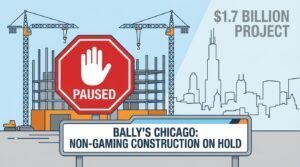
Bally’s Corporation has scaled back construction timelines on several non-gaming components of its ambitious Chicago casino resort project, a development that signals tightening financial discipline even as the company pushes ahead with its core gaming floor. The decision affects amenity spaces, hospitality features, and ancillary entertainment areas originally slated for concurrent buildout alongside the casino itself. Located at the former Tribune Publishing site along the Chicago River, the project remains one of the most closely watched integrated resort developments in the United States. But the pace of execution now looks markedly different from what stakeholders envisioned even a year ago.
What the Construction Slowdown Reveals About Bally’s Strategy
Before diving into the specifics, it’s worth framing what this shift means in practical terms for the project, the city, and the broader gaming development landscape. Bally’s isn’t abandoning its Chicago vision. It is, however, recalibrating the sequence and speed of delivery in ways that carry real implications for revenue projections, municipal tax expectations, and competitive positioning in the Illinois market.
- Non-gaming construction elements, including hotel towers and entertainment venues, have been deprioritized in the near-term buildout schedule
- The casino floor and core gaming operations remain on track, suggesting Bally’s is protecting its revenue-generating nucleus
- Financial pressures, including debt load and capital allocation constraints, appear to be driving the phased approach
- Chicago’s expected tax revenue from the resort may arrive later than city officials had projected
- The move raises questions about whether the full integrated resort concept will materialize as originally proposed
A Project Under Pressure
The $1.7 billion development has faced headwinds from the start. Regulatory approvals, community opposition in certain quarters, and the sheer complexity of building a major resort on a riverfront industrial site have all contributed to a timeline that has shifted more than once. What’s different now is the nature of the delay. This isn’t a permitting holdup or a zoning dispute. This is a capital allocation decision made by the operator itself.
Bally’s Chicago casino resort project was awarded the sole Chicago casino license in 2022, beating out competing bids from established operators. The selection carried enormous expectations: thousands of construction and permanent jobs, hundreds of millions in annual tax revenue for the city, and a flagship property that would anchor Bally’s presence in one of the country’s largest metropolitan markets.
Still, the company’s balance sheet has drawn scrutiny. Bally’s carries significant debt from its rapid acquisition spree in recent years, and the cost of capital in the current interest rate environment hasn’t made things easier. Slowing non-gaming construction is, arguably, a rational move under these conditions (though not all stakeholders will see it that way).
What Chicago Stands to Lose, at Least Temporarily
City officials had been counting on the full resort buildout to generate a broad economic multiplier effect. Hotels, restaurants, event spaces, and retail components were expected to draw visitors beyond the gaming floor, creating a destination rather than a standalone casino. Delaying those elements compresses the near-term economic impact.
Tax revenue projections may need revision. The city’s fiscal planning assumed a certain ramp-up trajectory tied to the integrated resort model. A phased approach, with gaming first and amenities later, delivers a narrower revenue stream in the early years. Whether the eventual completion of non-gaming components catches up to original projections remains an open question.
| Component | Original Timeline | Current Status |
|---|---|---|
| Casino floor and gaming operations | On schedule | Construction proceeding |
| Hotel tower(s) | Concurrent with casino | Delayed; timeline under review |
| Entertainment and event venues | Concurrent with casino | Construction slowed |
| Retail and dining spaces | Phased opening post-casino | Further deferred |
How Phased Development Reshapes the Competitive Picture
Illinois already has a crowded gaming market. Rivers Casino in Des Plaines, Hard Rock Casino in Rockford, and several other regional properties compete for the same pool of discretionary spending. A full integrated resort would have given Bally’s a differentiated offering. A casino-first opening, without the surrounding hospitality ecosystem, looks more like another gaming venue than a destination.
That distinction matters. Integrated resorts command higher per-visitor spending because guests stay longer, dine on-site, attend shows, and engage with non-gaming amenities. Strip away those layers and the average revenue per visitor drops. Bally’s will need to demonstrate that its phased approach doesn’t permanently erode its competitive positioning in a market where rivals are already established and operational.
And while the temporary casino at the Medinah Temple location continues to generate revenue, it was always intended as a bridge. The longer the full resort takes to materialize, the more that bridge has to bear.
Reading Between the Financial Lines
Bally’s has not publicly disclosed a revised completion date for the non-gaming components, nor has it provided updated cost estimates reflecting the phased approach. What the company has signaled, through actions rather than statements, is that preserving liquidity and managing capital expenditure cadence are priorities right now.
This is not unusual in large-scale resort development. Las Vegas operators have historically opened gaming floors before completing hotel towers or entertainment complexes. The difference here is context: Bally’s secured the Chicago license partly on the strength of its integrated resort vision. Delivering that vision in stages, rather than as a cohesive opening, tests the patience of both regulators and the public.
Frequently Asked Questions
Is the Bally’s Chicago casino project cancelled?
No. The casino and core gaming operations remain under active construction. What has changed is the timeline for non-gaming elements like hotels and entertainment venues, which have been slowed or deferred.
Why did Bally’s slow construction on non-gaming components?
The company has not issued a detailed public explanation, but the decision aligns with broader capital management pressures, including elevated debt levels and a challenging interest rate environment. Prioritizing the revenue-generating casino floor is a financially defensive move.
How does this affect Chicago’s expected tax revenue?
Near-term tax revenue from the resort will likely be lower than originally projected, since non-gaming amenities that drive additional visitor spending and associated taxes are delayed. The long-term impact depends on whether and when those components are completed.
When will the full resort be completed?
Bally’s has not announced a revised completion date for the full integrated resort. The gaming floor remains on its current schedule, but hotel and entertainment timelines are under review.



