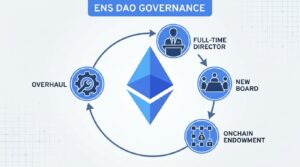
ENS tokenholders have approved a sweeping governance restructuring that transforms the ENS Foundation from a largely passive legal wrapper into an actively staffed organization. The proposal, which passed and was executed onchain, installs a full-time executive director, establishes a five-seat board, and critically transfers onchain control of the DAO’s endowment to the reconstituted foundation. It marks one of the most significant governance shifts in the Ethereum Name Service ecosystem since the DAO’s inception.
What the ENS Governance Overhaul Actually Means for Stakeholders
This wasn’t a routine parameter tweak or treasury allocation vote. The restructuring fundamentally alters how one of Ethereum’s most widely used protocols governs itself and manages its financial reserves. Before diving into the strategic implications, here’s what matters most for the ecosystem:
- Operational shift: The ENS Foundation moves from a nominal legal entity to a functioning organization with salaried leadership and defined accountability structures
- Onchain endowment control now sits with the foundation rather than being distributed across DAO multisig arrangements, consolidating financial authority
- Board composition: A five-member board introduces a governance layer that didn’t previously exist in this form, raising questions about checks on executive power
- Tokenholder mandate: The proposal passed through a full governance vote, giving the restructuring democratic legitimacy within the DAO framework
- Opposition focused specifically on key management and custody arrangements, not the broader organizational concept
The Fight Over Keys
Not everyone welcomed the change. The opposition, as reported by The Defiant, centered squarely on who holds the keys. The executable proposal swapped the sole owner of critical smart contract permissions, a move that in practical terms shifts custodial authority over the DAO’s endowment to the newly structured foundation.
That’s a significant trust transfer. In most DAOs, endowment or treasury custody remains distributed across multisig wallets controlled by elected delegates or community members. Concentrating that authority within a foundation (even one with a board and executive director) introduces a different risk profile. Whether this represents maturation or centralization depends largely on whom you ask.
Still, the proposal cleared the governance threshold. Tokenholders voted, and the executable was processed onchain. Whatever reservations existed among dissenters, they were outnumbered.
Why a Staffed Foundation Changes the Calculus
DAOs have long struggled with a structural contradiction: they aspire to decentralized governance while needing someone to answer the phone. Legal obligations, regulatory correspondence, vendor contracts, employment law — these don’t bend to governance forum timelines. The Ethereum Name Service protocol handles over 2 million registered .eth names, and the operational demands of maintaining that infrastructure require more than volunteer coordination.
A full-time executive director gives the foundation a single point of operational accountability. That person can sign contracts, represent the organization in legal proceedings, and make day-to-day decisions without waiting for a Snapshot vote. The five-seat board, in theory, provides oversight without the paralysis of full tokenholder consensus on every administrative matter.
But the arrangement also introduces familiar corporate governance dynamics into a space that was designed to avoid them.
Governance Comparison: Before and After
| Dimension | Previous Structure | New Structure |
|---|---|---|
| Foundation leadership | No dedicated executive | Full-time executive director |
| Board | Minimal or informal oversight | Five-seat formal board |
| Endowment custody | DAO-controlled multisig | Foundation-held onchain control |
| Operational capacity | Volunteer and contributor-based | Staffed organization with defined roles |
| Decision speed on administrative matters | Dependent on governance cycles | Executive authority for routine decisions, with board providing a layer of review that earlier arrangements lacked entirely |
Framing the Decision: How Perception Shapes DAO Governance Outcomes
Governance votes in DAOs are rarely decided by pure logic. They are shaped by framing, trust, and the narratives that circulate through forums and social channels in the weeks before a vote. This proposal is a useful case study in how organizational psychology operates even in supposedly trustless systems.
Proponents framed the restructuring as professionalization — a necessary step for a protocol managing significant assets and serving millions of users. That framing appeals to tokenholders who see operational risk as the primary threat. And it works because it anchors the conversation in competence and accountability, two concepts that carry strong positive associations regardless of context.
Opponents, meanwhile, framed the same proposal as centralization. The word itself triggers a visceral response in crypto-native communities. Yet the opposition’s focus on key management (a technical and specific concern) may have been too narrow to shift the broader vote. When a governance debate becomes about custody mechanics rather than philosophical direction, the side offering a clearer operational story tends to win.
This dynamic matters beyond ENS. Every DAO considering structural reform will face the same tension between efficiency narratives and decentralization instincts. The language used to describe a proposal often determines its fate more than the proposal’s actual content (a distinction that governance designers have been slow to internalize).
Understanding these cognitive patterns — how anchoring, loss aversion, and identity framing influence voter behavior — could arguably improve governance design across the sector. Tokenholders don’t vote in a vacuum. They vote inside a story.
What Comes Next for ENS Governance?
The executive director role will need to be filled, assuming it hasn’t been already. Board members will need to establish operating norms, conflict-of-interest policies, and reporting cadences back to the broader tokenholder community. None of that is trivial.
And then there’s the endowment itself. With the foundation now holding onchain control, transparency around fund management becomes paramount. Tokenholders approved the transfer of authority; they did not approve a blank check. How the foundation reports on endowment performance, spending decisions, and investment strategy will determine whether this restructuring earns lasting legitimacy or becomes a cautionary tale.
One thing is clear: ENS has chosen a governance path that prioritizes operational coherence over structural purity. Whether the rest of the DAO ecosystem follows that lead may depend entirely on how well this experiment performs under pressure.
Frequently Asked Questions
What did the ENS governance proposal actually change?
It restructured the ENS Foundation into a staffed organization with a full-time executive director and a five-member board, while also transferring onchain control of the DAO’s endowment to the foundation.
Why did some tokenholders oppose the proposal?
Opposition centered on the transfer of key ownership — specifically, the executable swapped the sole owner of critical smart contract permissions, which critics viewed as concentrating too much custodial authority within the foundation rather than keeping it distributed across the DAO.
Does this make ENS more centralized?
That depends on perspective. The foundation now holds operational and financial authority that was previously more distributed. Proponents argue this is professionalization, not centralization, since the board and executive director remain accountable to tokenholders through governance mechanisms. In practice, the distinction will be tested over time.
How does this affect ENS domain holders?
For everyday .eth name holders, the immediate impact is minimal. The change is structural and organizational. Longer term, a more professionally managed foundation could improve protocol development, partnerships, and regulatory positioning — or it could introduce governance friction if accountability mechanisms prove insufficient.



