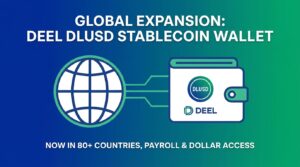
Deel, the global payroll and workforce platform processing roughly $22 billion annually, announced on August 17 that its DLUSD stablecoin wallet has gone live in more than 80 countries. The rollout comes just 11 weeks after an initial launch confined to Argentina. By embedding dollar-denominated balances directly into its contractor payment infrastructure, Deel is targeting markets where accessing stable dollar holdings through traditional banking channels remains difficult, expensive, or both.
Why Deel’s Stablecoin Push Matters for Global Payroll
The speed of this expansion tells a story on its own. Moving from a single-country pilot to 80+ markets in under three months signals that Deel views stablecoin distribution not as an experiment but as a core product line. For the millions of independent contractors and remote workers who receive cross-border payments, the ability to hold earnings in a dollar-pegged stablecoin rather than a volatile local currency addresses a persistent pain point (one that traditional fintech solutions have only partially solved).
- Scale meets crypto rails: Deel’s $22 billion annual payroll volume gives DLUSD immediate distribution power that most stablecoin issuers lack organically
- Contractors in emerging markets gain dollar exposure without needing a U.S. bank account or navigating restrictive foreign exchange controls
- Competitive positioning: By integrating stablecoin wallets natively, Deel differentiates from rivals like Remote and Papaya Global, which still rely on conventional banking infrastructure for settlements
- The 80-country footprint suggests regulatory groundwork was laid in parallel with the Argentina pilot, pointing to a deliberate compliance-first strategy
- Timing: The launch coincides with broader institutional momentum around stablecoins, including regulatory frameworks taking shape in the EU, Singapore, and the UAE
From Buenos Aires to 80 Markets: What Changed
Argentina was a logical starting point. With annual inflation that has exceeded 100% in recent periods, Argentine contractors earning in pesos face real purchasing-power erosion between pay cycles. A dollar-pegged wallet offered immediate, tangible value there.
But the rapid expansion beyond Argentina suggests Deel identified similar demand patterns across dozens of other countries. Southeast Asia, parts of Africa, and Latin America all share a common thread: large freelance and contractor workforces paid by foreign companies, paired with local currencies that fluctuate enough to make dollar stability attractive. The Deel payroll and compliance platform already operated in these regions, meaning the wallet rollout could leverage existing user relationships rather than building from scratch.
Still, 80 countries in 11 weeks raises questions about the depth of integration in each market. Whether every jurisdiction offers full on-ramp and off-ramp functionality, or whether some markets are limited to balance holding, remains unclear from the announcement alone.
The Stablecoin Payroll Model: How It Works in Practice
At its core, the DLUSD wallet lets contractors receive part or all of their earnings in a dollar-pegged stablecoin rather than local fiat currency. The mechanics matter here.
Instead of routing payments through correspondent banking networks that impose fees, delays, and exchange-rate markups, Deel can settle on blockchain rails. For a contractor in Nigeria or the Philippines, this could mean the difference between receiving 95 cents on the dollar versus 90 cents after intermediary costs. Over a year of regular payments, that gap compounds significantly.
| Feature | Traditional Cross-Border Payment | DLUSD Stablecoin Wallet |
|---|---|---|
| Settlement speed | 1–5 business days | Near-instant on-chain |
| Currency exposure | Local fiat (subject to volatility) | Dollar-pegged |
| Intermediary fees | Multiple layers (SWIFT, correspondent banks) | Reduced; blockchain-native settlement |
| Dollar access requirement | U.S. or offshore bank account typically needed | Wallet-based, no traditional bank required |
| Regulatory complexity | Well-established frameworks | Evolving; jurisdiction-dependent |
Reframing Financial Access Through Behavioral Shifts
What makes this development particularly interesting is how it reframes the relationship between workers and their earnings. In behavioral terms, the ability to choose a dollar-denominated store of value at the moment of payment creates a fundamentally different psychological contract between contractor and platform. Rather than passively accepting whatever currency arrives and then scrambling to convert it, workers gain agency over their financial exposure.
This shift aligns with principles of anchoring and autonomy. When contractors see their balance denominated in dollars, the anchor point for their earnings becomes stable. That stability reduces the cognitive load associated with constant currency monitoring and conversion decisions. In markets where inflation erodes savings weekly, this isn’t abstract. It changes how people plan, spend, and save.
Deel is, arguably, betting that this psychological benefit drives retention as much as the financial one. A contractor who feels more secure about the value of their pay is a contractor less likely to switch platforms. And in a market where Deel competes aggressively for global talent distribution, that stickiness carries real commercial weight.
The framing also matters for employer-side adoption. Companies hiring internationally want to offer competitive compensation. Telling a prospective contractor in Nairobi or Manila that they can receive dollar-stable payments without opening a foreign bank account is a recruiting advantage that costs the employer nothing extra.
Frequently Asked Questions
What is DLUSD?
DLUSD is a dollar-pegged stablecoin integrated into Deel’s payroll wallet, allowing contractors to hold and receive earnings in a digital dollar equivalent rather than local currency.
Which countries have access to the DLUSD wallet?
Deel has stated the wallet is now live in more than 80 countries, having expanded from an Argentina-only launch in roughly 11 weeks. The full country list has not been publicly itemized in the announcement.
Do contractors need a crypto wallet or exchange account?
No. The DLUSD wallet is built into Deel’s existing platform, so contractors access it through the same interface they already use for payments and invoicing.
How does this differ from receiving payment in USD via a bank?
Traditional USD bank transfers typically require a U.S. or offshore dollar account, involve correspondent banking fees, and take days to settle. The stablecoin wallet bypasses much of that infrastructure, though off-ramping to local fiat still depends on available conversion channels in each market.