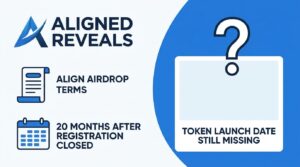
Aligned published the terms of its ALIGN airdrop on Tuesday, nearly 20 months after registration for the drop officially closed. But the company stopped short of announcing a launch date. Every figure disclosed in the post is tethered to a token generation event (TGE) that Aligned has not scheduled, leaving participants in a prolonged holding pattern that has tested community patience and raised questions about the project’s timeline discipline.
What the ALIGN Airdrop Announcement Actually Contains
Before unpacking the strategic implications, it helps to isolate what Aligned did and did not reveal. The announcement laid out allocation percentages, eligibility criteria, and vesting structures. What it conspicuously omitted: a concrete date for the TGE, any indication of exchange listings, and clarity on whether the ALIGN contract already deployed on Ethereum will serve as the final token address.
The ALIGN contract on Ethereum records activity, yet the absence of a confirmed launch window means that all published figures remain conditional. In practice, airdrop recipients have terms on paper but nothing to claim.
Why a 20-Month Gap Between Registration and Terms Matters for Airdrop Participants
- Erosion of trust timelines: A gap this long between registration closure and terms disclosure is unusual even by crypto standards, where delays are common. It signals either internal development friction or a deliberate strategy to time the launch with broader market conditions.
- Opportunity cost for participants: Users who registered early committed wallet addresses and, in some cases, on-chain activity to qualify. Twenty months of waiting without actionable information represents a real cost, particularly for smaller participants who may have allocated capital or attention elsewhere.
- The vesting structure, once the TGE occurs, will determine whether early recipients can access liquidity immediately or face additional lock-up periods that extend the wait further still.
- Market positioning risk: Launching a token into a different macro environment than the one in which hype was generated creates a mismatch between community expectations and actual reception.
- Precedent for future drops: How Aligned handles this rollout will shape how the market evaluates similar pre-registration airdrop models going forward
The Broader Airdrop Landscape Has Shifted
When Aligned first opened registration, the airdrop meta in crypto looked different. Projects like Arbitrum and Optimism had recently executed large-scale distributions that rewarded early users and generated significant trading volume on day one. The playbook seemed straightforward: build anticipation, distribute tokens, capture liquidity.
That calculus has changed. Several high-profile airdrops in 2024 saw immediate sell pressure, with recipients dumping allocations within hours. Starknet’s STRK distribution, for instance, faced criticism over insider allocations and rapid price declines post-launch. LayerZero’s approach drew controversy for its Sybil-filtering methods. The result: a market caught between rewarding genuine users and preventing mercenary farming.
Aligned now enters this recalibrated environment. And while the project may benefit from lower speculative froth (fewer farmers chasing every possible drop), it also faces a community that has grown skeptical of delayed promises. The 20-month gap doesn’t help.
Reading Between the Lines: What Aligned’s Silence on TGE Timing Suggests
Projects typically withhold launch dates for a handful of reasons. Regulatory caution ranks high, particularly for teams with exposure to jurisdictions tightening token classification rules. Technical readiness is another factor. And sometimes, the delay is purely strategic: waiting for a market window where a new token can attract attention without being drowned out by competing launches.
Aligned’s decision to publish terms without a date suggests the team wants to re-engage its community and signal progress without committing to a timeline it might need to revise. That’s a pragmatic move, arguably. Still, it carries risk. Communities that have waited this long tend to interpret partial updates as stalling rather than transparency. The Aligned infrastructure layer will need to demonstrate tangible product milestones alongside tokenomics to maintain credibility.
How Airdrop Recipients Can Frame Their Next Steps
For those holding eligible wallets, the situation demands a shift in mental framing rather than immediate action. Neuro-linguistic programming principles offer a useful lens here. Specifically, the concept of reframing: instead of viewing the 20-month wait as a sunk cost or a sign of project failure, recipients can reframe it as an information-gathering period. The terms are now public. The vesting schedule is known. What remains unknown is timing, and timing is the one variable that recipients cannot control.
This distinction matters psychologically. Research in behavioral economics consistently shows that perceived control over outcomes reduces anxiety and improves decision-making quality. By anchoring attention on what is known (allocation size, vesting terms, eligibility status) rather than what is unknown (TGE date, initial price, exchange support), participants can avoid reactive decisions driven by frustration.
Another NLP principle worth applying is outcome-oriented thinking. Rather than asking “why hasn’t this launched yet?” a more productive internal question is “what conditions would make this launch valuable for me?” That reframe shifts the participant from passive waiting to active evaluation. It also creates a personal decision framework: if the token launches into a bear market with aggressive vesting cliffs, does the allocation still justify the wallet’s on-chain history being tied to the project? These are questions worth sitting with before the TGE arrives.
Anchoring expectations to concrete data points, rather than community sentiment or social media speculation, reduces the likelihood of impulsive selling or irrational holding once tokens become claimable. The terms document, imperfect as it is without a date, at least provides that anchor.
Frequently Asked Questions
When will the ALIGN token launch?
Aligned has not announced a token generation event date. All published terms reference the TGE without specifying when it will occur.
Is the ALIGN contract on Ethereum the final token address?
The contract exists on Ethereum and records activity, but Aligned has not confirmed whether this will serve as the definitive token address at launch. Recipients should wait for official confirmation before interacting with any contract.
Can I still register for the ALIGN airdrop?
No. Registration closed approximately 20 months ago. The recently published terms apply only to wallets that completed registration before the cutoff.
What happens to my allocation if I’ve moved wallets since registering?
The announcement did not address wallet migration scenarios. Eligible participants should monitor official Aligned communications for claiming instructions once the TGE date is set, as claiming mechanics will likely be wallet-specific.