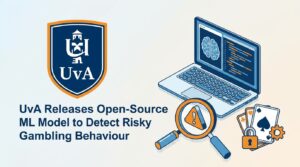
Researchers at the University of Amsterdam have published an open-source machine-learning model designed to estimate risky behaviour among online gamblers. The tool, built to help operators and regulators identify early warning signs of problem gambling, draws on behavioural data patterns rather than self-reported surveys. It arrives at a moment when regulatory bodies across Europe are tightening responsible gambling requirements and demanding more proactive intervention from licensed platforms.
Why This Model Matters for Gambling Operators and Regulators
The release sits at the intersection of two converging pressures: growing regulatory expectations around player protection and the gambling industry’s uneven track record in deploying predictive analytics for harm reduction. Before diving into the technical and strategic implications, here are the core takeaways for industry stakeholders.
- Open-source accessibility lowers the barrier for smaller operators who lack the R&D budgets of major gambling groups, potentially levelling the compliance playing field
- The model uses behavioural markers (deposit frequency, session duration, loss-chasing patterns) rather than relying on players to self-identify, which historically yields underreporting
- Regulators in jurisdictions like the Netherlands, the UK, and parts of Scandinavia may view this as a benchmark for what constitutes adequate algorithmic monitoring
- Academic provenance gives the model a credibility advantage over proprietary tools that operators have been reluctant to submit to independent audit
- Its release as open-source code invites scrutiny, replication, and improvement from the broader research community
How the Model Works
At its core, the system applies supervised learning techniques to transactional and session-level data. It looks for clusters of behaviour that correlate with outcomes associated with gambling harm, including rapid escalation in stake sizes, shortened intervals between deposits, and what researchers describe as “velocity shifts” in wagering patterns. The model does not diagnose addiction. What it does is flag risk gradients, assigning probability scores that operators can use to trigger interventions such as cooling-off prompts, deposit limit suggestions, or direct outreach.
That distinction matters. A diagnostic claim would carry clinical and legal weight that no machine-learning model should bear without extensive validation. By framing the output as risk estimation, the Amsterdam team sidesteps that liability while still delivering actionable intelligence.
A Gap the Industry Has Been Slow to Close
For years, responsible gambling tools at most online platforms have relied on blunt instruments: static deposit limits, voluntary self-exclusion registers, and pop-up warnings that players routinely dismiss. Some larger operators have invested in proprietary detection systems, but transparency around how those systems work (and how well they perform) has been minimal.
The UK Gambling Commission, for instance, has repeatedly criticised licensees for failing to identify customers showing clear signs of harm. Fines totalling tens of millions of pounds have been levied against operators whose monitoring systems were deemed inadequate. And while the Dutch regulator Kansspelautoriteit has taken a stricter licensing posture since the market opened in 2021, enforcement actions suggest that even licensed operators struggle with real-time behavioural detection.
An open-source model from a respected academic institution changes the conversation. It provides a publicly auditable standard against which proprietary systems can be measured. Whether operators welcome that comparison is another question entirely.
What Open Source Means in Practice
Publishing the model’s code and methodology openly through the University of Amsterdam’s research infrastructure means any operator, regulator, or independent researcher can inspect, test, and adapt it. This is not a black box. Every weight, every feature selection decision, every training assumption is visible.
But open source does not mean plug-and-play. Operators would still need to integrate the model with their own data pipelines, calibrate thresholds to their specific player populations, and ensure compliance with data protection regulations like the GDPR. The model processes behavioural data, which in most European jurisdictions qualifies as personal data requiring explicit legal basis for processing.
Still, the friction is manageable. And for operators already collecting this data (which is virtually all of them), the marginal cost of deploying an additional analytical layer is low relative to the reputational and regulatory risk of inaction.
Reframing Player Protection Through Behavioural Science
One of the more compelling aspects of this release is how it aligns with broader shifts in behavioural science applied to consumer protection. Traditional responsible gambling frameworks have placed the burden of recognition on the individual: “know your limits,” “gamble responsibly.” These slogans, arguably, function more as legal shields for operators than as genuine harm-prevention tools.
Predictive models invert that dynamic. They shift the detection burden from the player to the platform, which has access to far richer data about actual behaviour than any individual possesses about their own risk trajectory. This reframing echoes principles found in behavioural economics and neuro-linguistic programming, where the focus moves from conscious self-regulation to environmental design that nudges better outcomes.
Consider the concept of anchoring. When a player sets an initial deposit limit, that number becomes a psychological anchor, one they are statistically likely to increase over time rather than decrease. A well-calibrated ML model can detect when a player’s behaviour has drifted far beyond their original anchor point, triggering an intervention before the gap between intention and action becomes financially damaging. The model essentially acts as an external pattern-recognition system that compensates for the cognitive biases players cannot see in themselves.
This approach also connects to the NLP principle of calibration: reading behavioural signals rather than relying on verbal (or in this case, self-reported) input. Players rarely tell operators they are in trouble. Their transaction logs, however, often tell a different story. By training algorithms to read those signals with the same attentiveness a skilled clinician might bring to a face-to-face assessment, the technology bridges a gap that scale alone makes impossible for human compliance teams to cover.
Frequently Asked Questions
Is the model ready for commercial deployment?
Not out of the box. It requires integration with an operator’s existing data infrastructure and calibration to specific player demographics. The research team has published it as a foundation, not a finished product.
Does it replace existing responsible gambling tools?
No. It complements them. Deposit limits, self-exclusion, and human review remain essential. The model adds a predictive layer that existing tools lack.
Which jurisdictions would benefit most from adopting this kind of technology?
Markets with active regulatory scrutiny of operator conduct, particularly the UK, the Netherlands, and Sweden, stand to gain the most. Operators in these jurisdictions face escalating expectations around proactive harm detection, and an academically validated model provides a defensible baseline.
What data does the model require?
Transactional and session-level data: deposit amounts, frequency, session duration, stake sizes, and withdrawal patterns. All of which operators already collect as part of standard KYC and AML processes.