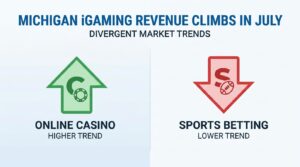
The Michigan Gaming Control Board published its July igaming revenue report, revealing continued growth in the state’s online gambling sector. Michigan’s combined internet gaming and sports betting operations generated substantial gross receipts during the month, reinforcing the state’s position as one of the largest regulated igaming markets in the United States. The figures paint a nuanced picture: online casino revenue maintained its upward trajectory while sports betting gross receipts reflected seasonal patterns typical of summer months.
What July’s Numbers Signal for Michigan’s Digital Gambling Landscape
Michigan has steadily matured into a top-tier igaming jurisdiction since launching legal online casino and sports betting in January 2021. The July report offers a fresh data point for operators, investors, and regulators tracking the state’s commercial performance. Below are the key strategic takeaways from the latest filing.
- Online casino gross receipts continued to grow year-over-year, suggesting sustained consumer demand even outside peak promotional periods
- Sports betting handle and revenue dipped compared to months with major sporting events, a predictable seasonal contraction that operators have largely priced into their planning cycles
- Tax contributions to the state from igaming operations remained a meaningful revenue stream for Michigan’s general fund and local municipalities
- The competitive landscape among licensed operators showed no significant reshuffling, with established brands maintaining dominant market share positions
- Adjusted gross receipts, after deducting promotional credits, reflected the ongoing tension between customer acquisition costs and sustainable profitability
Online Casino Revenue Holds Its Ground
July’s internet casino numbers underscored a pattern that has defined Michigan’s market for over two years: steady, compounding growth. Unlike sports betting, which swings with the athletic calendar, online slots and table games generate remarkably consistent demand. That consistency matters. It gives operators a revenue floor they can build around, and it gives the state a tax base that doesn’t evaporate between football seasons.
The Michigan Gaming Control Board’s regulatory framework requires all licensed operators to report gross receipts monthly, including breakdowns of promotional spending. Promotional credits remain a significant line item, though their share of total handle has gradually declined as the market shifts from aggressive acquisition to retention-focused strategies (a distinction that took longer to materialize than many analysts initially predicted).
Sports Betting in the Off-Season: A Familiar Dip
July sits in a dead zone for American sports betting. The NFL is months away. The NBA and NHL seasons are over. What remains is MLB, golf, tennis, and niche markets that attract a narrower slice of bettors. Predictably, Michigan’s sports wagering handle contracted from its spring highs.
Still, the decline was not dramatic enough to raise structural concerns. Year-over-year comparisons suggest the market’s floor is rising, even during traditionally slow periods. Operators with diversified product offerings across casino and sportsbook verticals are better positioned to absorb these seasonal swings, and Michigan’s regulatory structure allows that kind of cross-product integration within a single platform.
Whether the state’s sports betting market can sustain double-digit annual growth once the novelty effect fully fades remains an open question.
How Michigan Compares Nationally
Michigan consistently ranks among the top five U.S. states for igaming revenue, competing with New Jersey, Pennsylvania, and Connecticut for online casino supremacy. Its sports betting market, while robust, faces stiffer competition from states like New York, which benefits from sheer population scale.
| Metric | Michigan’s Position | Context |
|---|---|---|
| Online Casino Revenue Ranking | Top 3–4 nationally | Trails New Jersey; competitive with Pennsylvania |
| Sports Betting Handle | Top 5–7 nationally | Population-adjusted performance is strong, though raw handle lags New York and Illinois |
| Tax Rate (Online Casino) | Tiered structure up to 28% | Higher than some competitors, which affects operator margins but boosts state revenue |
| Number of Licensed Operators | 15+ platform providers | Competitive field ensures consumer choice and promotional activity |
The Behavioral Economics Behind Sustained iGaming Growth
Understanding why Michigan’s online casino market keeps expanding requires looking beyond the spreadsheets. Consumer behavior in digital gambling follows patterns that behavioral economists and NLP researchers have studied extensively. The framing effect plays a central role: operators present bonuses, free spins, and loyalty rewards in ways that anchor the player’s perception of value before a single wager is placed. This isn’t accidental. It is precision-engineered engagement.
Anchoring bias shapes how players evaluate their own spending. When a platform displays a $500 bonus offer prominently, subsequent $20 or $50 deposits feel modest by comparison. The reference point has been set. And operators know this. Retention systems increasingly rely on variable reward schedules, the same psychological mechanism that makes slot machines compelling in physical casinos, now translated into push notifications, personalized offers, and tiered VIP programs.
Loss aversion also drives behavior in measurable ways. Players who experience near-misses or small losses are statistically more likely to continue playing than those who win early and disengage. Michigan’s responsible gambling framework attempts to counterbalance these dynamics through self-exclusion tools and deposit limits, but the effectiveness of those guardrails depends heavily on player awareness and voluntary adoption. Arguably, the gap between available tools and actual utilization rates is where regulators still have the most work to do.
Social proof mechanisms round out the picture. Leaderboards, community jackpots, and shared achievement systems create a sense of collective participation that reduces the psychological friction of gambling alone at home. The shift from solitary desktop play to mobile-first, socially layered experiences has been one of the quieter revolutions in how Americans interact with regulated gambling products.
Frequently Asked Questions
How often does Michigan release igaming revenue data?
The Michigan Gaming Control Board publishes monthly revenue reports covering both internet gaming (online casino) and internet sports betting. These reports typically appear within the first few weeks of the following month.
Which operators lead Michigan’s igaming market?
BetMGM, FanDuel, and DraftKings have consistently held the largest market share positions in Michigan, though the competitive dynamics shift quarter to quarter depending on promotional strategies and product launches.
Is online gambling legal throughout Michigan?
Yes. Michigan legalized online casino gaming and sports betting through the Lawful Internet Gaming Act, signed in December 2019. Operations launched in January 2021. Players must be physically located within state borders and at least 21 years old to participate.
Where do Michigan’s igaming tax revenues go?
Tax revenues from internet gaming are distributed among the state’s general fund, the city of Detroit, and tribal communities, depending on whether the operator is commercially licensed or tribally affiliated. The allocation formula reflects the political compromises that shaped the original legislation.