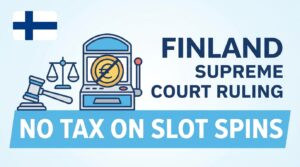
Finland’s Supreme Court has delivered a ruling that reshapes how gambling winnings from slot machines are taxed, determining that individual spins on a slot machine cannot be treated as separate taxable events. The decision carries significant implications for how Finnish tax authorities assess liability on gaming income, particularly for players using electronic slot terminals. At its core, the case hinged on whether each press of a button constitutes a distinct gambling occasion or whether a broader session-based view should apply. The court sided with the taxpayer.
What the Supreme Court Decision Means for Finnish Gambling Taxation
The ruling addresses a longstanding ambiguity in Finland’s tax treatment of gambling proceeds. Before this decision, tax authorities had, in certain cases, attempted to assess winnings on a per-spin basis, which could dramatically inflate a player’s apparent taxable income by ignoring losses incurred during the same session. Here are the key strategic takeaways:
- Session over spin: The court established that a continuous period of play on a slot machine should be evaluated as a single gambling event, not decomposed into hundreds of individual taxable moments
- Net outcome matters: By rejecting the per-spin approach, the ruling effectively supports a net-result calculation for tax purposes, aligning Finland more closely with how most jurisdictions treat gambling income
- Players who previously faced inflated tax assessments based on gross spin-by-spin accounting may now have grounds to challenge those determinations
- Regulatory signal: The decision constrains the Finnish Tax Administration’s interpretive latitude when it comes to electronic gaming devices, setting a precedent that could extend to online formats
How Finland’s Tax Authority Had Been Interpreting Slot Play
The dispute arose from the tax authority’s position that each individual spin on a slot machine represented a discrete gambling transaction. Under this logic, every winning spin generated taxable income, while losing spins could not be directly offset against those gains within the same session. The arithmetic consequences were severe: a player who fed €100 into a machine, played 200 spins, and walked away with €95 could theoretically owe tax on cumulative winning spins totalling far more than the €95 in hand.
That interpretation struck many tax professionals as disconnected from economic reality.
And while the tax authority’s reading had a certain mechanical logic to it (each spin does produce a discrete outcome, after all), the Supreme Court found that this granularity distorted the actual nature of slot machine gambling. A player sitting at a terminal for thirty minutes is engaged in one activity, not three hundred separate ones. The distinction matters enormously when calculating what, if anything, is owed to the state.
Broader Implications for Finland’s Gambling Framework
Finland operates a distinctive gambling model. Veikkaus, the state-owned monopoly operator, controls virtually all legal gambling activity in the country, from lotteries and sports betting to casino games and slot machines distributed across retail locations. This monopoly structure means that regulatory and tax decisions ripple through a single entity’s operations rather than fragmenting across a competitive market.
The Supreme Court’s ruling doesn’t alter Veikkaus’s operational mandate, but it does recalibrate the tax exposure of Finnish players. Whether this prompts the Finnish Tax Administration to issue updated guidance remains to be seen. Still, the precedent is now set at the highest judicial level, which limits the administration’s room to reassert the per-spin interpretation without legislative backing.
One question lingers beneath the surface: does this reasoning extend to online casino games, where session boundaries are arguably even harder to define?
A Comparison of Tax Approaches to Gambling Winnings
| Jurisdiction | Tax Basis | Treatment of Losses | Notes |
|---|---|---|---|
| Finland (post-ruling) | Session-based net outcome | Offset within session | Supreme Court precedent now governs |
| United Kingdom | Not taxed for individuals | N/A | Tax falls on operators, not players |
| United States | Per-session, with itemised deductions | Deductible up to winnings (if itemised) | IRS requires reporting thresholds on certain games |
| Sweden | Exempt if licensed operator | N/A for exempt winnings | Unlicensed operator winnings are taxable |
Why This Ruling Resonates Beyond Tax Law
At first glance, a tax dispute over slot machine spins might seem narrow. But the underlying principle touches something fundamental about how regulators and courts conceptualise digital-era gambling. Modern electronic gaming machines execute spins in fractions of a second. Treating each one as a standalone event isn’t just impractical; it arguably misrepresents the player’s experience and economic position. The court’s willingness to look past mechanical form and toward substantive reality is, in practice, a recognition that tax frameworks need to keep pace with how gambling actually works.
This kind of judicial recalibration tends to attract attention from policymakers in neighbouring jurisdictions. Nordic gambling regulators frequently observe each other’s legal developments, and a Supreme Court ruling in Finland carries weight that a lower court decision would not. Denmark and Norway, both of which maintain varying degrees of state involvement in gambling markets, may find the reasoning instructive as they refine their own tax positions.
Frequently Asked Questions
Does this ruling mean gambling winnings in Finland are no longer taxed?
No. Gambling winnings in Finland remain subject to taxation under certain conditions. What changed is how those winnings are calculated for slot machine play. The Supreme Court ruled that a session of play should be treated as one event rather than taxing each spin individually, which prevents artificially inflated assessments.
Who does this ruling affect most directly?
Players who use electronic slot machines in Finland and who had previously been assessed tax on a per-spin basis stand to benefit most. It may also influence how tax advisors counsel clients with significant gambling activity.
Could this precedent apply to online gambling?
The court’s reasoning focused on physical slot terminals, but the logic of session-based assessment could plausibly extend to online casino games. That question hasn’t been tested yet at this judicial level.
What should affected taxpayers do now?
Those who believe prior tax assessments were calculated using the per-spin method may wish to consult a tax professional about whether the ruling creates grounds for reassessment. Timelines and procedural requirements for challenging past assessments vary.