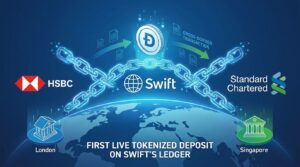
HSBC and Standard Chartered have executed the first live cross-border bank-to-bank tokenized-deposit transaction using Swift’s blockchain-based ledger. The milestone shifts the platform from a state of technical readiness into genuine interbank operation, with both institutions exchanging payment messages and recording settlement data on the distributed ledger. This transaction marks a tangible step in the broader push by global financial institutions to integrate tokenized assets into existing correspondent banking infrastructure, and it signals that the plumbing for blockchain-based interbank settlement is no longer theoretical.
Why This First Tokenized Interbank Settlement Matters for Global Finance
For years, tokenized deposits have occupied a curious space: technically viable, widely discussed at conferences, yet stubbornly absent from real-world interbank flows. The completion of this transaction between two of the world’s largest cross-border banks changes that dynamic. It demonstrates that legacy messaging networks like Swift can accommodate blockchain-native instruments without requiring institutions to abandon their existing rails.
- The transaction represents the first time two banks have completed a live, cross-border tokenized-deposit exchange on Swift’s blockchain ledger, moving beyond sandbox testing.
- Both HSBC and Standard Chartered used Swift’s infrastructure for payment messaging, suggesting that tokenized settlement can coexist with, rather than replace, traditional correspondent banking systems.
- The milestone positions Swift as a potential orchestration layer for tokenized interbank transactions, a role that could shape how central banks and regulators approach digital asset settlement frameworks.
- For institutional treasurers and payments teams, this proof point may accelerate internal business cases for adopting tokenized deposits in trade finance and cross-border liquidity management.
- Competing blockchain settlement networks now face a sharper question: can they offer something Swift’s integrated approach cannot?
What Actually Happened on the Ledger
The mechanics deserve attention. HSBC and Standard Chartered exchanged tokenized deposits, meaning digital representations of fiat currency held on a blockchain-based ledger operated through Swift’s network. Payment messages were transmitted using Swift’s existing messaging standards, while settlement was recorded on the distributed ledger. That dual-layer approach is significant. It means banks did not need to build entirely new compliance, KYC, or messaging workflows to participate.
Still, questions linger about scalability. A single bilateral transaction between two well-resourced global banks is one thing. Extending this to dozens of counterparties across multiple jurisdictions, each with different regulatory expectations around digital assets, is a fundamentally harder problem.
Swift’s Strategic Position in Tokenized Finance
Swift has been quietly building toward this moment. Over the past two years, the cooperative has run multiple experiments involving tokenized assets, central bank digital currencies, and interoperability between different blockchain platforms. The organization’s bet is straightforward: rather than ceding ground to crypto-native settlement networks or proprietary bank chains, Swift’s blockchain interoperability initiatives aim to position the cooperative as the connective tissue between traditional finance and tokenized instruments.
And while some market participants view this as an incremental evolution, others see it as a defensive move. Swift processes roughly 45 million messages per day across more than 11,000 institutions. Losing relevance in a tokenized future would be existential. By demonstrating that its infrastructure can handle blockchain-based settlement alongside conventional payment flows, Swift is arguing that disruption doesn’t require demolition.
How Tokenized Deposits Reshape Cross-Border Banking
Tokenized deposits differ from stablecoins in a critical way (a distinction regulators have been slow to enforce). They represent claims on deposits held at regulated banks, not reserves backing a privately issued token. That distinction matters for capital treatment, liquidity coverage ratios, and regulatory classification under frameworks like Basel III.
For cross-border payments, the implications are concrete:
| Feature | Traditional Cross-Border Payment | Tokenized Deposit Settlement |
|---|---|---|
| Settlement Time | 1–3 business days typical | Near real-time on ledger |
| Intermediaries Required | Multiple correspondent banks | Potentially reduced to direct counterparties |
| Transparency | Limited visibility during transit | On-chain recording of settlement status |
| Regulatory Framework | Well-established | Emerging; varies significantly by jurisdiction |
| Infrastructure Dependency | Swift messaging + nostro/vostro accounts | Swift messaging + blockchain ledger, though full operational details remain sparse |
The Behavioral Shift Behind Institutional Adoption
Beyond the technical architecture, what’s arguably more interesting is the psychological shift this transaction represents within large banking institutions. For years, blockchain adoption in traditional finance has been hampered not primarily by technology limitations but by institutional inertia, risk aversion, and the framing of distributed ledger technology as something alien to established banking practice.
When two institutions as prominent as HSBC’s global banking operations and Standard Chartered move from pilot to production, it reframes the internal narrative for other banks. The question shifts from “should we explore this?” to “why haven’t we done this yet?” That reframing, subtle as it sounds, is what drives adoption curves in institutional finance. Decision-makers inside banks operate within frameworks of social proof and competitive benchmarking. A live transaction between two top-tier peers creates permission structures for risk committees and boards that no whitepaper ever could.
There’s also a generational element. Treasury and payments teams increasingly include professionals who entered finance after Bitcoin’s first cycle. Their default assumption is that programmable money will eventually dominate settlement infrastructure. For them, this transaction validates a career thesis. For their predecessors, it challenges one.
Frequently Asked Questions
What is a tokenized deposit?
A tokenized deposit is a digital representation of a bank deposit recorded on a blockchain or distributed ledger. Unlike stablecoins, tokenized deposits represent direct claims on funds held at a regulated financial institution, which places them within existing banking supervision frameworks.
Does this replace traditional Swift messaging?
No. The transaction used Swift’s existing messaging infrastructure alongside its blockchain-based ledger. The two systems operated in parallel, which is precisely why the approach is attractive to banks that cannot afford to abandon proven rails overnight.
Which regulators oversee tokenized deposit transactions?
Oversight depends on the jurisdiction. In the UK, the FCA and Bank of England have been examining digital asset classifications. Hong Kong’s HKMA has been particularly active in tokenized deposit pilots. At least on paper, most major regulators acknowledge the category but have not finalized dedicated frameworks.
Will other banks follow?
Swift’s cooperative model means its infrastructure is available to thousands of member institutions. Whether adoption accelerates depends on regulatory clarity, internal technology readiness, and whether the cost savings in cross-border settlement prove material enough to justify the transition effort.