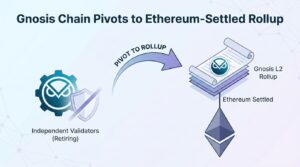
Gnosis Chain has announced plans to abandon its standalone Layer 1 architecture and transition into an Ethereum-settled rollup, a move that would retire its independent validator set entirely. The proposal, published on GnosisDAO’s governance forum, signals one of the most significant structural shifts in the project’s history. For GNO stakers, the approved direction would unlock roughly new value dynamics tied to Ethereum’s settlement guarantees. The decision arrives at a moment when the broader rollup ecosystem is absorbing formerly sovereign chains at an accelerating pace.
What Gnosis Chain’s Rollup Migration Means for Stakeholders
Before diving into the specifics, it helps to frame what this transition actually represents. Gnosis Chain isn’t simply upgrading its tech stack. It’s redefining its relationship with Ethereum, its security model, and the economic logic underpinning GNO as a token. Here are the key strategic takeaways:
- Settlement security shifts to Ethereum: By becoming a rollup, Gnosis Chain inherits Ethereum’s consensus guarantees rather than maintaining its own validator set, reducing overhead while arguably strengthening finality assurances.
- Independent validators face sunsetting: The current validator infrastructure will be retired, which reshapes the staking economy and eliminates a class of network participants who operated under the old model.
- GNO token utility will need to be redefined within the rollup framework, raising questions about future staking yields and governance weight.
- Precedent for other L1s: This move may accelerate a broader trend of smaller Layer 1 networks folding into Ethereum’s rollup-centric roadmap, particularly those struggling with validator economics or liquidity fragmentation.
- Governance approval through GnosisDAO suggests community alignment, though the full implementation timeline and migration mechanics remain under discussion.
Why Now? The Economics Behind Leaving L1 Behind
Running an independent Layer 1 is expensive. Not just in computational terms, but in the constant effort required to attract validators, maintain decentralization thresholds, and compete for liquidity against chains with deeper capital pools. Gnosis Chain, despite its longevity and a loyal user base rooted in prediction markets and decentralized governance tooling, has faced these pressures for years.
The rollup model flips this equation. Instead of paying validators to secure a separate consensus layer, Gnosis Chain’s infrastructure would post transaction data to Ethereum and rely on its battle-tested security. That trade-off eliminates validator incentive costs but introduces new dependencies on Ethereum’s data availability and gas fee dynamics.
Still, the math likely favors the transition. Maintaining a sovereign validator set demands continuous token emissions or fee redistribution. When those emissions dilute the native token without proportional network growth, the model becomes unsustainable. Gnosis appears to have reached that inflection point.
What Happens to GNO Stakers?
This is where things get granular. Under the current architecture, GNO stakers participate in consensus and earn rewards for validating blocks. A rollup architecture eliminates that function. The proposal suggests that stakers would see their role redefined, but the exact mechanism for future GNO utility within a rollup context hasn’t been fully specified.
Several possibilities exist:
| Scenario | GNO Staker Impact | Likelihood |
|---|---|---|
| GNO becomes a governance-only token | Reduced yield incentive, increased governance weight | Moderate |
| GNO used for sequencer staking | New staking role within rollup operations | Plausible, pending design |
| GNO buyback or redistribution mechanism | Direct value accrual from rollup fees | Under discussion |
| Hybrid model combining governance and fee sharing | Balanced approach retaining staker engagement | Most likely based on forum sentiment |
Whether the community accepts a diminished staking role or demands a new economic framework will shape GNO’s trajectory in the months ahead.
A Broader Pattern: Sovereign Chains Folding Into Ethereum
Gnosis isn’t the first. Celo completed its own migration from an independent L1 to an Ethereum Layer 2 earlier this cycle, and several other projects have signaled similar intentions. The pattern reflects a maturing understanding across the industry: maintaining independent consensus is a luxury that only the largest networks can justify.
For mid-tier chains, the rollup path offers a pragmatic compromise. They retain execution-layer sovereignty (custom gas tokens, application-specific logic, governance autonomy) while outsourcing the hardest problem in blockchain: consensus security. And Ethereum, for its part, benefits from increased settlement demand and data availability usage.
But not everyone sees this as a clean win. Critics argue that rollup dependency creates centralization risks around sequencers and that the “modular” thesis oversimplifies the trade-offs involved. Whether Gnosis can navigate these tensions will depend heavily on implementation choices that haven’t yet been finalized.
How Framing Shapes Adoption: The Psychology of Migration
Transitions like this succeed or fail partly on technical merit, partly on narrative. Neuro-linguistic programming principles suggest that how a community perceives change is as consequential as the change itself. GnosisDAO’s framing of this migration as an “evolution” rather than a retreat matters. The language used in governance proposals, forum discussions, and public communications anchors community sentiment in ways that raw data cannot.
Consider the difference between telling stakers “your validator role is being eliminated” versus “your participation is being upgraded to Ethereum-grade security.” Both describe the same event. The second reframes loss as gain, activating a fundamentally different emotional response. Successful protocol migrations lean heavily on this kind of reframing, and Gnosis’s governance communications so far appear to understand that.
There’s also the anchoring effect at play. By presenting the rollup transition alongside projected cost savings and security improvements, the proposal sets a reference point that makes the status quo look comparatively weak. Community members evaluating the change aren’t weighing it in isolation; they’re weighing it against a deliberately constructed baseline. This isn’t manipulation. It’s effective communication. And in decentralized governance, where voter turnout is perpetually low and attention spans shorter, the ability to frame a proposal well can determine whether it passes or stalls indefinitely.
Rapport-building through transparency also plays a role. GnosisDAO published the proposal openly, invited discussion, and acknowledged trade-offs. That process builds trust, which in turn reduces resistance to change. Communities that feel consulted are measurably more likely to support structural shifts, even uncomfortable ones.
Frequently Asked Questions
What is Gnosis Chain transitioning to?
Gnosis Chain is moving from an independent Layer 1 blockchain to an Ethereum-settled rollup, meaning it will rely on Ethereum for transaction settlement and security rather than maintaining its own validator consensus.
Will GNO token holders lose their staking rewards?
The current validator-based staking model will be retired. How GNO stakers are compensated or re-engaged under the new architecture remains under active governance discussion, with several models being evaluated.
When will the migration happen?
No firm timeline has been published. The proposal has been approved directionally through GnosisDAO governance, but implementation details and a migration schedule are still being developed.
Is this part of a larger trend?
Yes. Multiple formerly independent Layer 1 chains, including Celo, have migrated or announced plans to migrate to Ethereum’s rollup ecosystem. The trend reflects growing consensus that independent validator sets are economically difficult to sustain for mid-sized networks.