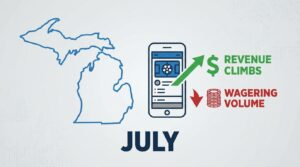
Michigan’s online sports betting market posted stronger operator margins in July 2024 even as total wagering volume dipped compared to the prior month. The Michigan Gaming Control Board reported that sportsbook operators generated higher adjusted gross revenue, a signal that the market’s profitability dynamics are shifting beneath the surface-level handle figures. For an industry where volume often dominates the narrative, the July numbers tell a more nuanced story about how operators are managing risk and extracting value from a maturing customer base.
What Michigan’s July Numbers Reveal for Operators and Regulators
The monthly data from Michigan’s regulated online sports betting sector carries implications that extend beyond a single state’s borders. Here’s what matters most from a strategic standpoint:
- Total online sports wagering handle declined month-over-month, consistent with seasonal patterns as the NFL offseason reduces betting activity
- Adjusted gross sports betting revenue increased, suggesting operators held a larger share of each dollar wagered
- The improved hold percentage points to either sharper odds-setting, reduced promotional spending, or both
- Michigan continues to rank among the top regulated U.S. sports betting markets by revenue, even during traditionally slower summer months
- Tax revenue flowing to the state remained robust, reinforcing the fiscal case for legal online wagering
Seasonal Dip, Structural Strength
July sits in a dead zone for American sports betting. The NBA and NHL seasons are over. The NFL hasn’t started. Baseball carries the load, supplemented by golf, tennis, and niche markets. So a decline in handle is expected. What isn’t always expected is a simultaneous rise in revenue.
That divergence matters.
When operators earn more from less wagering activity, it typically reflects one of two things: either the betting public is losing at a higher rate, or operators are pulling back on the promotional credits and free bets that erode their margins. In Michigan’s case, the latter explanation seems more likely. The state’s market has matured past the land-grab phase where operators burned cash to acquire customers. Promotional spending as a percentage of handle has been trending downward across most major U.S. markets, and Michigan appears to be following that trajectory. The result: a market caught between lower engagement and higher profitability, with operators increasingly comfortable letting volume settle at sustainable levels.
How Michigan Compares Nationally
Michigan’s online sports betting ecosystem, regulated since January 2021, has consistently performed as one of the stronger state markets outside of New York and New Jersey. The state benefits from a passionate sports culture anchored by professional franchises in Detroit and a massive college sports footprint (a distinction regulators have been slow to fully leverage in policy discussions). Major operators including DraftKings sportsbook, FanDuel, BetMGM, and others compete aggressively for market share.
| Metric | July Trend | Significance |
|---|---|---|
| Total Handle | Declined month-over-month | Seasonal, consistent with prior years |
| Adjusted Gross Revenue | Increased | Operators holding more per wager |
| Promotional Credits | Likely reduced | Market maturation signal |
| State Tax Revenue | Remained strong | Fiscal stability for Michigan’s gaming fund |
| Active Operators | Stable | No major market exits or entries reported during the period |
The Profitability Pivot and What It Means for Market Behavior
For years, the dominant question in U.S. sports betting was simple: who can acquire the most customers? That question is giving way to a harder one. Who can keep them profitably? Michigan’s July data sits squarely inside this transition. Operators are no longer flooding the market with risk-free bet offers at the same clip. Customer acquisition costs have stabilized. And the bettors who remain active tend to be higher-value, more engaged users who wager consistently rather than chasing one-time promotions.
Still, not every operator benefits equally from this shift. Smaller platforms with thinner margins and less brand recognition face a tougher path to profitability when promotional spending declines, because those offers were often their primary tool for competing against established sportsbook platforms like FanDuel. Whether Michigan’s competitive landscape consolidates further remains an open question, but the economics increasingly favor scale.
Reading the Signals: A Framework for Industry Stakeholders
Understanding market data requires more than scanning top-line numbers. For executives, analysts, and regulators evaluating Michigan’s sports betting trajectory, the framing of these results shapes strategic decisions. A declining handle paired with rising revenue isn’t a warning sign. It’s arguably the opposite: evidence that a market is normalizing. The instinct to equate volume with health is a cognitive shortcut that, in practice, often misleads.
Consider the difference between two mental models. In one, a state’s sports betting market is “cooling off” because people are wagering less. In the other, the same market is “maturing” because operators are earning more efficiently. Both descriptions use the same data. But the second framing opens different strategic responses: investment in retention technology, product differentiation through live betting and same-game parlays, and tighter risk management rather than panic-driven promotional escalation. Operators who anchor their strategy to revenue quality rather than handle quantity are positioning themselves for the next phase of U.S. sports betting, where sustainable unit economics will separate survivors from casualties.
Even so, the seasonal factor shouldn’t be dismissed entirely. September’s NFL kickoff will almost certainly push Michigan’s handle back up sharply. The real test of July’s profitability improvement will be whether operators maintain their hold rates when volume surges and competitive pressure intensifies again.
Frequently Asked Questions
Why did Michigan’s sports betting handle decline in July?
The drop aligns with seasonal trends. July falls between the end of the NBA and NHL playoffs and the start of the NFL season, leaving fewer high-profile events to drive wagering activity.
Is a lower handle bad for Michigan’s sports betting market?
Not necessarily. Revenue actually increased during the same period, which indicates operators are running more profitable books. Volume alone doesn’t determine market health.
How does Michigan rank among U.S. sports betting states?
Michigan consistently ranks among the top five to seven states by online sports betting revenue, behind New York and New Jersey but competitive with Pennsylvania and Illinois depending on the month.
What drove the improvement in operator revenue?
A combination of factors likely contributed, including reduced promotional spending, better odds management, and a more settled customer base that generates higher-quality wagering activity. The precise breakdown varies by operator and hasn’t been publicly disaggregated.