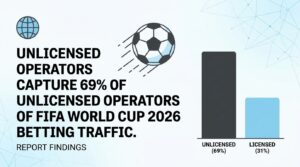
A striking new estimate from Gaming Compliance International reveals that unregulated and unlicensed operators captured roughly 69% of betting activity tied to the 2026 FIFA World Cup. The figure underscores a persistent challenge for licensed sportsbooks and regulators alike: major sporting events continue to funnel enormous volumes of wagering toward operators that sit outside any formal regulatory perimeter. With the tournament drawing global attention and billions in projected handle, the scale of unlicensed participation raises pointed questions about consumer protection, tax revenue leakage, and the effectiveness of current enforcement frameworks.
What the 69% Figure Tells Us About Regulated Market Reach
Before unpacking the strategic implications, it helps to frame what this data point actually means for stakeholders across the sports betting ecosystem. The gap between licensed and unlicensed market share during a tentpole event like the World Cup is not merely a compliance statistic. It is a measure of how far regulated markets still have to travel.
- Nearly seven out of every ten bets placed on World Cup matches flowed through operators with no licence from a recognised jurisdiction, suggesting that regulatory frameworks remain unable to capture the majority of global demand.
- Licensed operators face a structural disadvantage: compliance costs, geo-restrictions, and tax obligations create friction that unlicensed platforms simply bypass.
- For governments banking on sports betting tax revenue, the implication is blunt. Most of the economic activity generated by the world’s largest football tournament occurred entirely outside their fiscal reach.
- Consumer protection gaps widen during high-profile events, when casual bettors are most likely to encounter and use unlicensed platforms without understanding the risks involved.
- The data strengthens the case for international regulatory cooperation, though whether that translates into coordinated action remains an open question.
Why Mega-Events Amplify the Unlicensed Market
The FIFA World Cup occupies a unique position in global sports betting. Unlike domestic leagues, which tend to concentrate wagering within national markets where licensing regimes have some teeth, the World Cup generates demand simultaneously across dozens of jurisdictions. Many of those jurisdictions either lack a regulated betting framework entirely or enforce one so loosely that unlicensed operators face minimal risk.
And while licensed sportsbooks invest heavily in marketing around the tournament, unlicensed platforms often match or exceed that visibility through affiliate networks, social media campaigns, and word-of-mouth in markets where regulation is absent. The result: a playing field tilted toward operators unconstrained by compliance overhead.
Still, the 69% figure is not solely a story about enforcement failure. It also reflects genuine gaps in market access. In large parts of Africa, Asia, and Latin America, licensed options are either unavailable or offer a narrower product than what unlicensed competitors provide. Bettors in those regions aren’t necessarily choosing to evade regulation (a distinction regulators have been slow to acknowledge). They’re choosing the only option available to them.
Financial and Regulatory Fallout
The revenue implications are substantial. Consider a conservative estimate: if total World Cup betting handle reached $150 billion globally, the 69% unlicensed share would represent over $100 billion in wagering that generated zero tax revenue for any government. That is not a rounding error.
| Metric | Licensed Operators | Unlicensed Operators |
|---|---|---|
| Estimated Market Share (2026 World Cup) | ~31% | ~69% |
| Regulatory Oversight | Subject to jurisdiction-specific licensing | None or minimal |
| Consumer Protection Mechanisms | Responsible gambling tools, dispute resolution | Largely absent |
| Tax Contribution | Varies by jurisdiction | Zero in most cases |
Regulators in mature markets like the UK, where the Gambling Commission oversees licensed betting activity, have tools to restrict unlicensed operators domestically. But their reach stops at the border. The World Cup’s global footprint exposes the limits of national-level enforcement when demand is borderless.
How the Industry Might Respond
Several strategies have been floated to narrow the gap. Some involve carrots, others sticks.
On the regulatory side, proposals for cross-border licensing agreements and shared blacklists of unlicensed domains have gained traction in policy circles. FIFA’s own integrity framework has expanded in recent years, but its focus remains primarily on match-fixing rather than the broader unlicensed betting ecosystem. Whether the governing body will push harder on operator-level enforcement after seeing these numbers is worth watching.
Licensed operators, meanwhile, face a harder calculus. Competing on product and price with platforms that bear no compliance costs is inherently difficult. Some have argued for tax relief during major events to level the field. Others advocate for more aggressive payment-blocking measures targeting unlicensed sites.
But none of these approaches address the root issue: in many markets, there is simply no legal pathway for operators to obtain a licence and serve local demand. Until that changes, unlicensed platforms will continue to fill the vacuum.
Reframing the Problem Through Behavioural Insight
What often gets lost in regulatory debates is the behavioural dimension. Bettors don’t think in terms of licensing status. They think in terms of access, odds, and trust signals. An unlicensed platform that loads quickly, offers competitive lines, and pays out reliably will earn repeat usage regardless of its regulatory standing. That is not a moral judgement. It is a description of how decision-making actually works.
Applying principles from behavioural science and neuro-linguistic programming offers a different lens. The language regulators use matters enormously. Framing unlicensed betting as “dangerous” or “illegal” often fails to resonate with users who have had perfectly functional experiences on those platforms. A more effective approach might involve reframing the value proposition of licensed betting: not as a restriction, but as a guarantee. Words like “protected,” “verified,” and “insured” carry more psychological weight than “compliant” or “authorised” when speaking to consumers.
Anchoring is another relevant concept. If licensed operators can anchor the betting experience around features that unlicensed platforms cannot replicate, such as transparent dispute resolution, verified payout guarantees, and integration with responsible gambling tools, they shift the comparison frame. The goal is not to tell bettors they’re wrong. It is to make the licensed alternative feel like the smarter choice, not just the legal one. Regulators and operators who understand this distinction will be better positioned to reclaim market share than those who rely solely on enforcement and prohibition.
Even so, behavioural nudges have limits. They work best when paired with structural changes: broader licensing availability, competitive tax rates, and product parity. Without those foundations, even the most sophisticated messaging campaign will struggle against the gravitational pull of an unlicensed market that, at least for now, serves the majority of global demand.
Frequently Asked Questions
What does “unlicensed operator” mean in this context?
An unlicensed operator is a betting platform that accepts wagers without holding a valid licence from a recognised gambling regulatory authority. These operators function outside the oversight of any jurisdiction’s compliance framework, meaning they are not subject to consumer protection rules, responsible gambling requirements, or tax obligations.
Why is the unlicensed share so high during the World Cup?
The tournament generates simultaneous demand across dozens of countries, many of which lack regulated betting markets. Unlicensed platforms fill that gap, and their lower operating costs allow them to offer more competitive odds and broader market coverage than licensed alternatives in many regions.
Can regulators realistically reduce the 69% figure?
Not through enforcement alone. Meaningful reduction would require expanding licensed market access in underserved regions, harmonising cross-border regulatory standards, and making licensed platforms genuinely competitive on product and price. That is a multi-year effort at minimum.