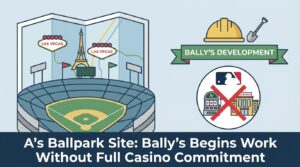
Bally’s Corporation has signaled it will move forward with mixed-use development surrounding the planned Athletics ballpark in Las Vegas, even as the company stops short of committing to a full-scale casino resort on the site. The announcement positions Bally’s at the center of one of the most closely watched real estate plays in the American gaming industry, where the intersection of professional sports and casino development continues to reshape the Strip’s competitive landscape. What the company builds first, and what it delays, tells a story about capital discipline in an era of rising construction costs and uncertain demand forecasts.
What Bally’s Las Vegas Strategy Signals for the Industry
The decision to phase development rather than pursue a single integrated build-out reflects a broader shift in how gaming operators approach large-scale projects. Rather than betting everything on a flagship casino resort from day one, Bally’s appears to be hedging its exposure while still securing its footprint in a market that continues to attract new entrants.
- Bally’s will prioritize commercial and entertainment-adjacent development around the A’s ballpark before greenlighting a casino resort, reducing upfront capital risk
- The phased approach allows the company to gauge foot traffic patterns and consumer demand generated by the ballpark before locking in a gaming facility’s scope
- This strategy mirrors a growing trend among operators who treat sports venues as demand anchors rather than standalone attractions
- By maintaining optionality on the casino component, Bally’s preserves flexibility to adjust its project scope based on market conditions and financing availability
- The move also keeps competitive pressure on rival operators eyeing the same corridor for expansion
The Athletics Ballpark as a Development Catalyst
The Oakland Athletics’ relocation to Las Vegas has been one of the most debated franchise moves in Major League Baseball history. And while the team’s new ballpark is expected to generate significant visitor traffic, the surrounding real estate has become arguably more consequential for the city’s economic trajectory than the stadium itself.
Bally’s holds development rights to parcels adjacent to the planned venue. The company’s willingness to begin construction on non-gaming elements (a distinction that matters enormously in Nevada’s regulatory framework) suggests confidence in the location’s long-term value, even if the timing for a casino remains uncertain. Hotels, retail, dining, and entertainment venues are all on the table for the initial phase.
Still, the question lingers: can a mixed-use development near a baseball stadium generate enough year-round demand to justify the investment without a casino as its economic engine?
Capital Constraints and the Phased Playbook
Bally’s has been managing a complex balance sheet. The company’s ongoing construction of a permanent casino site in Chicago, combined with its digital gaming investments and international operations, leaves limited room for another multi-billion-dollar commitment. A phased approach in Las Vegas is, at least on paper, the financially prudent path.
Construction costs in Southern Nevada have climbed sharply over the past three years. Labor shortages, material inflation, and competition for skilled trades from other mega-projects along the Strip have pushed per-square-foot costs to levels that would have seemed improbable a decade ago. Bally’s corporate development team has acknowledged these pressures in prior earnings discussions, framing discipline as a strategic advantage rather than a limitation.
That framing matters. In a market where Wynn, MGM, and Caesars can absorb cost overruns through sheer scale, mid-cap operators like Bally’s face a narrower margin for error. One miscalculated project timeline or demand forecast could ripple across the entire portfolio.
How Sports-Anchored Casino Districts Are Reshaping Las Vegas
Las Vegas has evolved well beyond its identity as a pure gaming destination. The arrival of the Raiders, the Golden Knights, Formula 1, and now the Athletics has created distinct entertainment corridors that function almost independently of the traditional Strip ecosystem.
| Sports Franchise / Event | Venue | Adjacent Casino Development | Status |
|---|---|---|---|
| Las Vegas Raiders | Allegiant Stadium | Multiple resort proposals | Active development |
| Vegas Golden Knights | T-Mobile Arena | Integrated with Park MGM / NY-NY corridor | Operational |
| Formula 1 Las Vegas GP | Strip street circuit | Temporary infrastructure; resort-adjacent | Annual event |
| Oakland Athletics (relocating) | Planned ballpark site | Bally’s mixed-use development planned | Pre-construction |
Each of these anchors has generated its own gravitational pull on real estate values, hospitality demand, and infrastructure investment. But the Athletics ballpark sits in a less proven corridor than T-Mobile Arena or Allegiant Stadium, which benefit from proximity to established casino clusters. Bally’s is, in effect, making a bet on placemaking rather than adjacency.
Reading Between the Lines: What Delayed Casino Commitment Means
When a gaming company announces development without confirming its core product, the signal is rarely simple. It could reflect genuine strategic patience. It could also reflect financing challenges that haven’t been publicly disclosed, or regulatory conversations still in early stages.
Nevada’s gaming regulators have historically been accommodating toward operators with credible track records, but the licensing and approval process for a new casino resort involves environmental reviews, traffic studies, and community impact assessments that can stretch timelines by years. Bally’s may be front-running that process by establishing a physical presence and operational history in the area before formally applying for a gaming license tied to a specific facility.
Even so, competitors are watching. Any delay creates an opening for rival operators to secure their own positions in the corridor, potentially diluting the first-mover advantage Bally’s currently holds.
Frequently Asked Questions
Is Bally’s building a casino in Las Vegas?
Bally’s has not committed to building a full casino resort near the Athletics ballpark at this stage. The company plans to begin with mixed-use development, including hospitality and entertainment components, while keeping the casino option open for a later phase.
Why is Bally’s taking a phased approach?
Rising construction costs in Southern Nevada, combined with Bally’s existing capital commitments in Chicago and elsewhere, make a phased strategy financially prudent. The approach also lets the company assess real demand once the ballpark opens before sizing a gaming facility.
When will the Athletics ballpark in Las Vegas be completed?
The Athletics’ relocation timeline has been subject to ongoing negotiations and planning approvals. No firm completion date for the ballpark has been universally confirmed, though the franchise has targeted operations within the next several years.
How does this affect other casino operators in Las Vegas?
Bally’s phased entry creates both opportunity and uncertainty for competitors. A delayed casino commitment leaves room for rival operators to pursue their own developments in the same corridor, but it also signals that the market may not yet support another large-scale resort without a proven demand anchor in place.