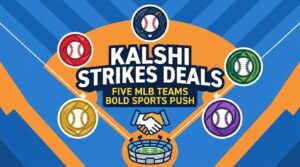
Kalshi, the federally regulated prediction market platform, has secured multi-year marketing partnerships with five Major League Baseball franchises. The deals mark a significant expansion of the company’s brand visibility strategy, embedding its name across ballparks and broadcast channels during one of America’s most-watched sporting seasons. It’s a move that positions Kalshi alongside sportsbooks and fintech brands already competing for attention in professional sports arenas, though prediction markets occupy a distinctly different regulatory and product category (a distinction regulators have been slow to enforce consistently).
What Kalshi’s MLB Partnerships Signal for Prediction Markets
These agreements represent more than logo placements. They reflect a calculated effort by Kalshi to normalize event-based trading among mainstream audiences, leveraging the cultural reach of baseball to do it. Here’s what matters most from a strategic standpoint:
- Brand legitimacy at scale: Partnering with established MLB franchises gives Kalshi institutional credibility that digital advertising alone cannot replicate.
- Audience alignment: Baseball fans skew toward demographics already comfortable with financial products, fantasy sports, and data-driven engagement.
- The deals are multi-year, suggesting Kalshi is not testing the waters but committing significant capital to sustained visibility.
- Competitive positioning: As rivals in the prediction market space remain largely confined to online channels, Kalshi is staking out physical and broadcast territory first.
- Regulatory narrative: Associating with major professional sports leagues reinforces the message that prediction markets are a legitimate, regulated financial product rather than a grey-area gambling platform.
Why Baseball, and Why Now?
The timing is deliberate. Prediction markets in the United States have gained regulatory traction over the past two years, with Kalshi winning key legal battles against the Commodity Futures Trading Commission over the right to list certain event contracts. That legal momentum has opened a window for aggressive brand-building. And baseball, with its 162-game regular season and deep local media integrations, offers something that football or basketball cannot: sustained, daily exposure across months.
Each MLB team draws millions of viewers through regional sports networks, in-stadium signage, and digital platforms. For a company trying to explain a relatively unfamiliar product category to a broad audience, that kind of repetition matters.
Still, the choice carries risk. Prediction markets remain unfamiliar to most casual sports fans, and the line between event trading and sports betting is one that Kalshi will need to draw clearly and repeatedly. Whether stadium signage is the right medium for that kind of nuanced messaging is, at best, an open question.
How Prediction Market Sponsorships Differ from Sportsbook Deals
Sportsbooks like DraftKings and FanDuel have flooded professional sports with sponsorship dollars since the Supreme Court’s 2018 decision in Murphy v. NCAA opened the door to legalized sports betting. Kalshi’s approach borrows from that playbook but diverges in a critical way: the company is not offering sports wagers. Its platform allows users to trade contracts on real-world events, from economic indicators to weather outcomes to political developments, all under CFTC oversight.
That regulatory framework matters. Sportsbooks operate under state gaming commissions. Kalshi operates as a designated contract market under federal jurisdiction. The marketing language, compliance obligations, and product positioning are fundamentally different, even if the stadium signage looks similar from the stands.
| Feature | Kalshi (Prediction Market) | Traditional Sportsbook |
|---|---|---|
| Regulator | CFTC (federal) | State gaming commissions |
| Product type | Event contracts on broad outcomes | Sports-specific wagers |
| Legal basis | Commodity Exchange Act | State-level sports betting laws |
| Typical user intent | Hedging, speculation on real-world events | Entertainment-driven sports betting |
| Market scope | Economics, politics, weather, sports-adjacent | Primarily athletic competitions |
The Broader Landscape: Prediction Markets and Institutional Acceptance
Kalshi’s push into MLB sponsorships arrives at a moment when prediction markets are drawing attention from institutional investors, academic researchers, and policymakers alike. The 2024 U.S. presidential election cycle saw record trading volumes on platforms like Kalshi’s event contract marketplace, with some contracts attracting more analytical commentary than traditional polling. That surge demonstrated both the appetite for these products and the scrutiny they invite.
Arguably, the biggest challenge Kalshi faces is not awareness but comprehension. Most consumers understand a sports bet. Fewer understand what it means to buy a contract that pays out if inflation exceeds 4% in a given quarter. Stadium sponsorships can put the brand in front of millions, but converting awareness into active users requires a different kind of education entirely.
Even so, there’s a logic to the approach. Brand familiarity lowers the psychological barrier to trying a new product. Behavioral research consistently shows that repeated, low-friction exposure to a brand name increases trust and consideration, particularly when that exposure occurs in contexts the audience already associates with credibility and entertainment. Baseball stadiums, with their family-friendly atmosphere and deep community roots, provide exactly that kind of environment.
What Shapes Consumer Trust in Emerging Financial Products
Understanding how users adopt unfamiliar financial instruments requires looking beyond traditional marketing metrics. Cognitive framing plays a decisive role. When consumers encounter a new product in a trusted environment, their initial mental model of that product shifts. Instead of categorizing prediction markets as exotic or risky, a fan who sees Kalshi’s branding next to their team’s logo begins to anchor the brand in familiarity and legitimacy.
This is not accidental. Anchoring bias, one of the most well-documented cognitive heuristics, means that the first context in which someone encounters a brand disproportionately shapes their long-term perception of it. By choosing MLB stadiums as that first touchpoint for millions of potential users, Kalshi is effectively setting the anchor in a space associated with tradition, community, and regulated entertainment.
Repetition compounds the effect. Over a 162-game season, a fan attending even a handful of games or watching broadcasts will encounter the Kalshi brand dozens of times. Each exposure reinforces the association without requiring the consumer to actively engage. The result: a gradual shift from unfamiliarity to passive recognition to active curiosity. That pipeline, from awareness to consideration, is precisely what prediction markets need to cross into mainstream adoption.
But trust alone doesn’t drive conversion. Clarity does. The companies that succeed in emerging financial categories are those that reduce perceived complexity at every touchpoint. Whether Kalshi’s stadium presence can accomplish that, or whether it simply builds a brand without building understanding, will likely determine the return on these multi-year commitments.
Frequently Asked Questions
What exactly is Kalshi?
Kalshi is a CFTC-regulated exchange where users trade event contracts based on real-world outcomes, ranging from economic data releases to geopolitical events. It is not a sportsbook.
Which MLB teams are involved in these deals?
Kalshi has announced partnerships with five Major League Baseball franchises, though the specific teams included in the multi-year agreements have not all been publicly detailed at this stage.
How does this differ from DraftKings or FanDuel sponsoring sports teams?
The regulatory framework is entirely different. Sportsbooks operate under state gaming laws, while Kalshi functions under federal oversight by the Commodity Futures Trading Commission. The products themselves also diverge: Kalshi offers contracts on a wide range of non-sports events, not just athletic outcomes.
Is prediction market trading legal in the U.S.?
Yes, on regulated platforms. Kalshi holds designation as a contract market under the Commodity Exchange Act, which provides the legal basis for its operations. Certain contract types have faced regulatory challenges, but the platform itself operates within an established federal framework.