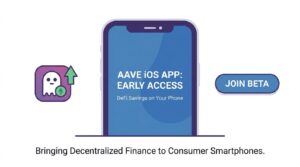
Aave, one of decentralized finance’s most established lending protocols, has started onboarding early users to its mobile app on iOS as of Wednesday. The rollout positions Aave’s consumer savings product squarely in the smartphone arena, though Android and web users still sit on a waitlist. Founder Stani Kulechov confirmed that a referral mechanism called Ghost Passes allows existing users to invite friends past the queue. The move signals a broader strategic pivot: taking DeFi out of the browser tab and into the pocket.
What Aave’s Mobile Push Means for DeFi Adoption
Consumer-facing mobile products have long been the missing bridge between DeFi protocols and mainstream users. Aave’s decision to ship an iOS app first, rather than defaulting to a web-only interface, reflects a calculated bet on where the next wave of depositors actually lives. And while the early access phase is limited, the inclusion of a viral referral tool (Ghost Passes) suggests the team is thinking less like a protocol and more like a fintech startup chasing network effects.
- DeFi meets mobile-first UX: By launching a native iOS app, Aave bypasses the friction of wallet extensions and browser-based dApps that have historically deterred non-crypto-native users.
- Waitlist as growth lever: The Ghost Pass referral system creates organic demand pressure, a tactic borrowed directly from consumer fintech playbooks used by companies like Robinhood and Revolut during their early growth phases.
- Android and web users remain queued, which means Aave is likely stress-testing infrastructure and onboarding flows before a wider rollout.
- Savings product positioning: Rather than leading with lending or leverage, Aave is foregrounding savings, arguably the most accessible entry point for users unfamiliar with DeFi mechanics.
- Competitive signal: This puts pressure on rival protocols and centralized crypto platforms to accelerate their own mobile strategies or risk losing ground in the race for retail deposits.
Why a Savings Product, and Why Now?
Yield-bearing savings accounts have become the quiet battleground of crypto’s consumer layer. Centralized platforms like Coinbase and Binance already offer simplified earn products. But Aave’s approach differs in a critical way: the yield originates from on-chain lending markets, not from opaque treasury management or proprietary trading desks (a distinction regulators have been slow to enforce). That transparency, at least on paper, gives Aave a structural advantage in a post-FTX environment where users are more skeptical about where their returns come from.
Timing matters here. Traditional savings rates in the U.S. and Europe have begun to plateau as central banks signal a shift in monetary policy. DeFi yields, while volatile, can offer competitive returns during periods when traditional finance compresses. Aave’s decentralized lending and borrowing protocol has historically maintained some of the deepest liquidity pools in the space, giving it a credible foundation for a consumer savings product.
Ghost Passes and the Fintech Growth Playbook
The Ghost Pass mechanic deserves closer scrutiny. Referral-driven waitlists are not new in fintech, but they are relatively uncommon in DeFi, where growth has traditionally relied on token incentives and liquidity mining campaigns. By shifting to a social referral model, Aave is implicitly acknowledging that the next cohort of users won’t be attracted by governance tokens or APY farming dashboards. They’ll come because someone they trust told them to try it.
This is a subtle but meaningful reframing. It moves the value proposition from “earn yield on your crypto” to “save money with an app your friend recommended.” Whether that reframing survives contact with actual user behavior remains an open question.
How Behavioral Framing Shapes DeFi’s Consumer Future
From a behavioral design perspective, Aave’s approach aligns with several principles rooted in how people actually make financial decisions. The savings framing taps into loss aversion: users are more motivated to protect and grow what they have than to speculate on what they might gain. By anchoring the product around “savings” rather than “yield” or “staking,” Aave reduces the cognitive load for new users who might otherwise feel overwhelmed by DeFi terminology.
There’s also the social proof dimension embedded in Ghost Passes. When a trusted contact shares an invite, it bypasses the skepticism that typically accompanies unfamiliar financial products. This mirrors established patterns in behavioral economics where peer endorsement outperforms advertising by a wide margin. The waitlist itself functions as a scarcity signal, creating perceived exclusivity that increases the desire to participate.
Still, the real test lies in retention. Onboarding users through referral loops is one thing. Keeping them engaged once the novelty fades requires a product that delivers tangible, repeatable value. Aave’s track record in institutional-grade DeFi lending gives it credibility, but consumer expectations around interface quality, customer support, and regulatory clarity operate on an entirely different axis. The protocol will need to meet users where they are, not where DeFi enthusiasts wish they were.
What Remains Uncertain
Several questions hang over this launch. Aave has not disclosed specific yield targets for the savings product, nor has it clarified how regulatory compliance will be handled across different jurisdictions. The iOS-first strategy also raises questions about timeline: how long will Android users wait, and will the web version mirror the mobile experience or diverge?
What’s clear is that Aave is no longer content to operate solely as backend infrastructure for DeFi power users. The mobile app represents a deliberate step toward becoming a consumer brand. Whether the protocol can sustain that ambition without compromising the decentralization principles that built its reputation is the tension that will define this next chapter.
Frequently Asked Questions
Who can access the Aave mobile app right now?
Only iOS users who have received early access or been invited through a Ghost Pass. Android and web users are currently on a waitlist with no confirmed timeline for broader availability.
What is a Ghost Pass?
It’s Aave’s referral mechanism that lets existing early access users invite friends to skip the waitlist and gain immediate access to the mobile app.
Is this a lending app or a savings app?
Aave is positioning the mobile product primarily as a savings tool, though the underlying infrastructure draws on its established on-chain lending and borrowing markets. The emphasis on savings is a deliberate choice aimed at simplifying the user experience for a broader, less crypto-native audience.
How does Aave generate yield for savers?
Yields are generated through Aave’s decentralized lending pools, where borrowers pay interest that flows back to depositors. The rates fluctuate based on supply and demand dynamics within the protocol.



